

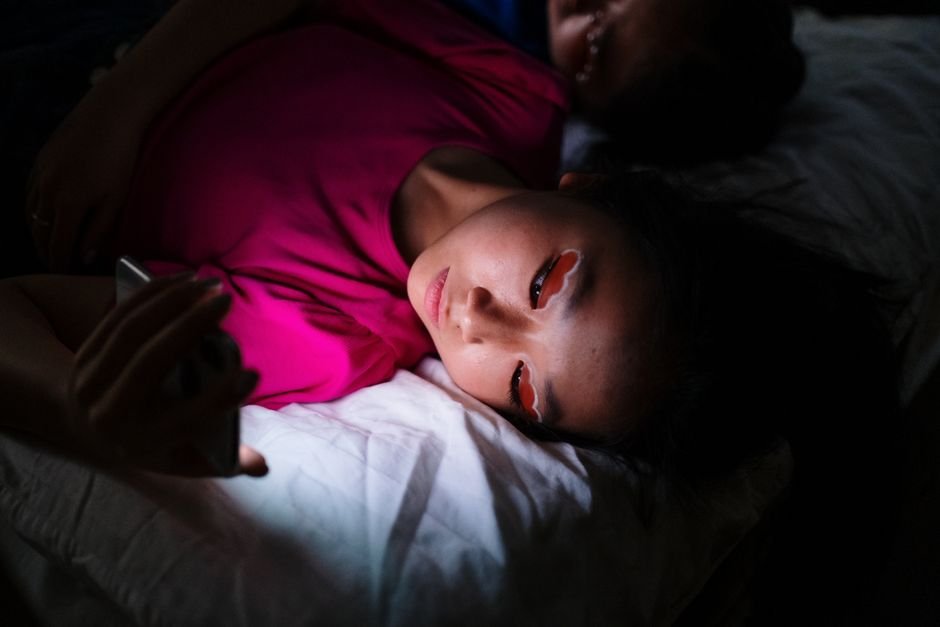
The cycle is vicious and familiar to millions of teenagers and their parents: poor sleep leads to more time on the phone, and more phone time makes sleep worse. But a new study published this week in PLoS One reveals what actually drives that loop, and the answer has less to do with screen time itself than with what happens inside a sleep-deprived adolescent brain.
Researchers analyzing data from nearly 49,000 Korean middle and high school students found that poor sleep quality and short sleep duration both predict problematic smartphone use. More striking, two emotional mechanisms, anxiety and loneliness, together account for nearly half of the connection. The findings suggest that simply limiting screen time may be less effective than addressing the underlying emotional distress that makes teens reach for their phones in the first place.
What They Found
The study drew on the 2023 Korea Youth Risk Behavior Survey (KYRBS), a nationally representative sample of 48,829 adolescents. Problematic smartphone use (PSU) was measured with the 10-item Problematic Smartphone Use Screening Tool (PSS), which scores from 10 to 40. Students were classified into three groups: general users (72.1%), potential-risk (24.8%), and high-risk (3.1%).
The high-risk group reported an average of 7.01 hours of daily smartphone use, compared to lower-risk peers. Their sleep patterns were starkly different, too. On a five-point scale of sleep satisfaction, how often in the past week they felt their sleep was sufficient to recover from fatigue, general users averaged 2.90, potential-risk users averaged 2.65, and high-risk users averaged just 2.41 (p < 0.001 for the trend). Weekday sleep duration followed the same pattern: 6.33 hours for general users, 6.08 for potential-risk, and only 5.80 for high-risk. High-risk users showed a larger weekend catch-up sleep effect (2.53 hours versus 2.31 hours), suggesting they were chronically sleep-deprived during the school week.
The regression analysis confirmed each factor’s independent contribution. Even after controlling for sex, school level, economic status, residential area, physical activity, smoking, alcohol use, and perceived health, every one-unit increase in sleep satisfaction reduced the odds of PSU by about 5% (OR = 0.947, p < 0.001). Longer weekday sleep was similarly protective (OR = 0.954, p < 0.001). Exercise was even more strongly protective: teens who did physical activity at least five days per week had 28% lower odds of problematic use (OR = 0.722, p < 0.001). On the other side, using a smartphone four or more hours daily nearly doubled the odds (OR = 1.806, p < 0.001), and weekend catch-up sleep of more than zero hours actually predicted higher risk (OR = 1.080, p = 0.021), likely as a marker of accumulated weekday sleep debt.
The Mediation Analysis: Anxiety and Loneliness as Hidden Drivers
The study’s most novel contribution is its formal mediation analysis using a counterfactual framework, a statistical method that estimates how much of the sleep-PSU relationship is explained by specific intermediate variables. The approach is grounded in Compensatory Internet Use Theory and the I-PACE model, which propose that people use digital devices to regulate negative emotional states.
Anxiety emerged as the stronger mediator. Measured with the GAD-7 (Cronbach’s alpha = 0.907), anxiety explained 30.0% of the pathway from poor sleep to problematic smartphone use (p < 0.001). The theoretical chain works like this: sleep dissatisfaction impairs emotional regulation, which amplifies worry and rumination. To escape that internal distress, teens turn to smartphones for relief, which over time becomes compulsive and functionally impairing.
Loneliness accounted for a smaller but still significant 15.2% of the pathway (p < 0.001). The proposed mechanism is social: poor sleep leads to fatigue and social withdrawal, which increases loneliness, and teens compensate by using smartphones as a social connection tool. Together, the two mediators account for roughly 45% of the total sleep-PSU relationship.
Both pathways likely reinforce each other. An anxious, sleep-deprived teen withdraws socially, feels lonelier, and leans harder on the phone for both emotional regulation and social contact, creating a downward spiral.
Why It Matters
The authors are careful to note that this is a cross-sectional study, so causal direction cannot be established. It is entirely plausible that problematic smartphone use itself worsens sleep quality and mental health, creating a bidirectional loop. But the mediation analysis makes a practical case: interventions targeting sleep alone may be insufficient if they ignore the emotional drivers.
The authors argue that identifying modifiable mediators like anxiety and loneliness is essential for developing targeted interventions. Anxiety and loneliness are treatable conditions. Cognitive-behavioral therapy, school-based mental health programs, and sleep hygiene interventions may each address a different piece of the puzzle, and the study suggests that combining them could be more effective than any single approach.
Notably, the researchers emphasize that PSU should be distinguished from merely frequent or prolonged use. Problematic use reflects functional impairment and compulsive tendencies, not just how many hours a teen spends on their phone. That distinction matters for clinicians: a teen who uses a phone six hours a day for homework and social connection may be fine, while one who uses it compulsively to escape anxiety is not.
Limitations
The study has several important caveats. Sleep satisfaction and loneliness were each measured with a single self-report item, which limits reliability compared to multi-item scales or objective sleep tracking (actigraphy). The PSS is a validated screening tool but still relies on self-report, which may be subject to recall bias. The cross-sectional design means the direction of the relationships is uncertain, and unmeasured confounders, such as parenting style, academic pressure, or pre-existing mental health conditions, could influence the results.
Bottom Line
Among nearly 49,000 Korean adolescents, poor sleep satisfaction and shorter weekday sleep duration both predicted higher odds of problematic smartphone use. Anxiety and loneliness together explained 45% of that relationship, with anxiety accounting for 30% and loneliness for 15%. The findings suggest that effective interventions may need to address emotional distress and mental health alongside screen time limits and sleep hygiene.
Source
Kim J, Cho M. Poor sleep satisfaction and problematic smartphone use in adolescents: The mediating roles of anxiety and loneliness. PLoS One. 2026 Jul 24;21(7):e0354423. doi: 10.1371/journal.pone.0354423. PMID: 42497135. Open access.