

Astronomers Spot an Extremely Rare Sextuple Galaxy Mega-Merger
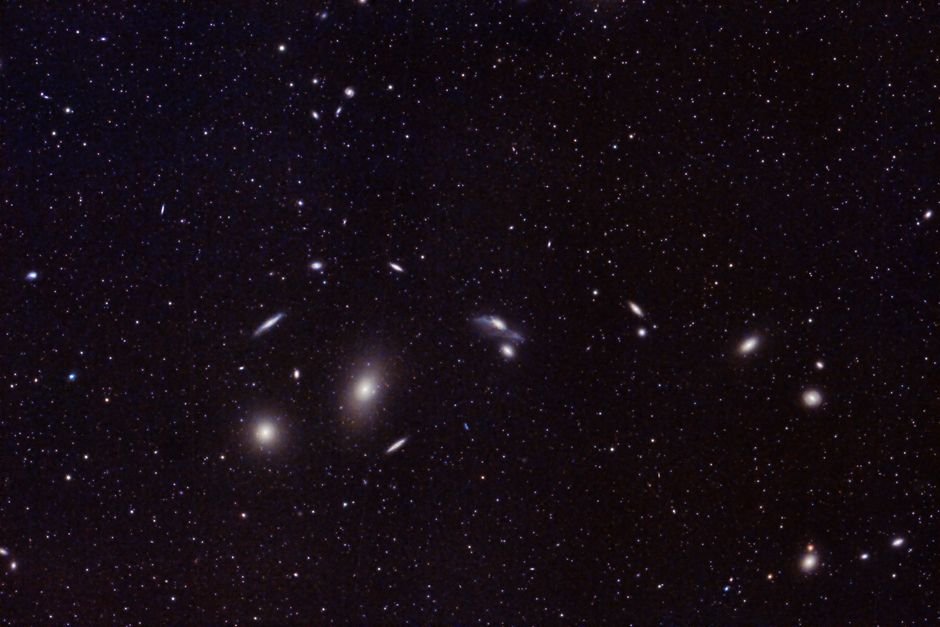
Featured image: [Composite X-ray/optical image of the galaxy cluster WHY J0501+01 showing the sextuple merger and intracluster light; credit: Z.L. Wen et al., Chinese Academy of Sciences / Einstein Probe]
A team of astronomers led by Z.L. Wen of the Chinese Academy of Sciences has identified an extraordinarily rare event in the nearby universe: six massive galaxies caught in the act of merging into a single supermassive galaxy. The discovery, accepted for publication in Astronomy & Astrophysics, offers an unprecedented snapshot of how the largest galaxies in the cosmos are assembled.
The target is the galaxy cluster WHY J050106.2+013714, abbreviated WHY J0501+01, located at a redshift of 0.151, roughly 2 billion light-years from Earth. While galaxy mergers are common in astronomy, a sextuple merger of this scale is exceptional. A systematic search of 52,803 galaxy clusters from the DESI Legacy Imaging Surveys found that only this single cluster contains more than four merging galaxies. Just 12 quadruple mergers and 2,233 binary mergers were identified in the same sample.
The six merging galaxies are no small fry: five of them each harbor more than 100 billion stars, with individual stellar masses exceeding 10^11 solar masses. A sixth, slightly smaller galaxy is also participating. Combined, they hold a total stellar mass of 1.16 x 10^12 solar masses, roughly 2.6 standard deviations above what typical scaling relations predict for such clusters. Once the merger completes over the next 800 million to 1.9 billion years, the result will be one of the largest known galaxies in the universe.
The team used observations from the Einstein Probe’s Follow-up X-ray Telescope (EP-FXT) to study the cluster’s gas dynamics. The X-ray data reveal a cluster that is dynamically young and disturbed, with an average gas temperature of 2.8 kiloelectronvolts and a total X-ray luminosity of 9.4 x 10^43 ergs per second. These values match the scaling relations for typical disturbed clusters.
The X-ray observations also show evidence of violent gravitational interactions: sloshing of ultra-hot plasma and a tail of gas likely kicked out by the ongoing collision. The galaxies themselves are described as “unrelaxed,” a technical term for systems undergoing catastrophic gravitational interactions.
Surrounding the merging galaxies, the astronomers detected a well-defined shroud of intracluster light (ICL) extending 310 kiloparsecs (about 1 million light-years). This ghostly glow comes from stars stripped from their host galaxies by the immense tidal forces of the merger. Detecting it required carefully subtracting the light of the galaxies themselves.
The initial cluster was first identified in 2018 using all-sky surveys (Two Micron All Sky Survey, WISE, and SuperCOSMOS). Follow-up work with the DESI Legacy Imaging Surveys, using the Mayall, Bok, and Blanco telescopes in Arizona and Chile, resolved the sextuple merger structure that had been hidden in coarser data.
This discovery bears directly on a long-standing debate in astronomy: whether Brightest Cluster Galaxies (BCGs), the most luminous galaxies at the centers of galaxy clusters, grow primarily through frequent minor mergers with small galaxies, or through rare but dramatic major mergers. The WHY J0501+01 system strongly favors the major-merger scenario, providing a clear example of hierarchical assembly at its most spectacular.
The finding also gives astronomers a rare opportunity to watch cosmic structure formation in real time. Most BCGs in the local universe are already fully assembled, their merger histories long finished. WHY J0501+01 offers a window into a process that most galaxy clusters completed billions of years ago.
The paper, “A rare sextuple-merging brightest cluster galaxy system in a disturbed galaxy cluster observed with the Einstein Probe Follow-up X-ray Telescope,” is available as a preprint on arXiv (2606.17700) and has been accepted for publication in Astronomy & Astrophysics.