

Published: June 04, 2026, 04:29 UTC
# Republicans quietly drop $1bn for Trump’s ballroom — and the midterms explain why
The White House ballroom became a symbol of everything voters hate about the war and its costs, and Senate Republicans noticed just in time to save themselves from voting for it.
The ballroom was never supposed to be a political problem. When Donald Trump announced last year that the East Wing of the White House would be demolished and replaced with a grand new ballroom — paid for, he said, by private donors to the tune of $400 million — it was sold as a gift to the nation. A venue for state dinners, diplomatic receptions, and the kind of gilded spectacle that Trump believes a superpower deserves.
But the gift came with a catch. The $400 million covered construction. It did not cover the security — the hardened perimeter, the blast-resistant windows, the underground command-and-control bunker that would need to be extended, the extra Secret Service personnel, the surveillance infrastructure, the bulletproof vehicles, the helicopter landing zone modifications. That part, the administration argued, was a matter of national security and therefore a taxpayer responsibility. The price tag: $1 billion.
For eight weeks, that $1 billion sat buried inside the Secure America Act, the centerpiece immigration enforcement bill of Trump’s second term. The bill itself was a $70 billion package funding the mass deportation campaign, border wall expansion, and a surge in ICE enforcement. Republicans were expected to pass it unanimously. It was, by their own framing, the defining legislative promise of the Trump 2.0 agenda.
But the ballroom became a problem. Not in the committee rooms, where it was quietly inserted by the leadership. Not in the closed-door caucus meetings, where no one wanted to be the one to question the president’s pet project. The problem was outside. The problem was the voters.
Here is the arithmetic that Senate Republicans are now doing, and it is the only arithmetic that matters in Washington: gas prices are up 27 percent since the Iran war began. The average American household is spending an additional $180 a month at the pump. Inflation, which had been cooling, is creeping back. The war in Iran, now in its seventh month, shows no signs of ending. Troop casualties are rising. The administration’s strategy of “maximum pressure with maximum bombing” has produced a lot of rubble but no surrender.
And the White House is building a ballroom.
It was the sort of detail that editorial cartoonists dream about. A president who promised to end wars — who campaigned on the idea that Ukraine was a drain and Afghanistan was a disaster — had started a new war in Iran and was now asking taxpayers to fund a party venue while their gas bills climbed. The contrast wrote itself. “A ballroom bunker,” one commentator called it. The image stuck.
By the time the Secure America Act reached the Senate floor, the ballroom funding had become a political liability that no amount of procedural maneuvering could hide. The Senate parliamentarian, Elizabeth MacDonough, delivered the first blow: the ballroom security improvements, she ruled, did not comply with the Byrd Rule for budget reconciliation. They were not sufficiently germane to the budget. They were, in plain language, a luxury item smuggled into an immigration bill.
The ruling gave Republicans cover. They could say the ballroom funding was removed on procedural grounds, not because they abandoned the president. But the truth is simpler: they were relieved.
It was the second time in two days that Senate Republicans had flinched. The day before, the House had passed a war powers resolution — symbolic, non-binding — asserting that Congress had not authorized the Iran war. Two dozen Republicans voted for it. The message was unmistakable: the party’s uneasy truce with Trump on foreign policy is fracturing. The war is unpopular. The costs are visible. And with the midterms five months away, many Republicans would rather vote against the war than explain to their constituents why they keep supporting it.
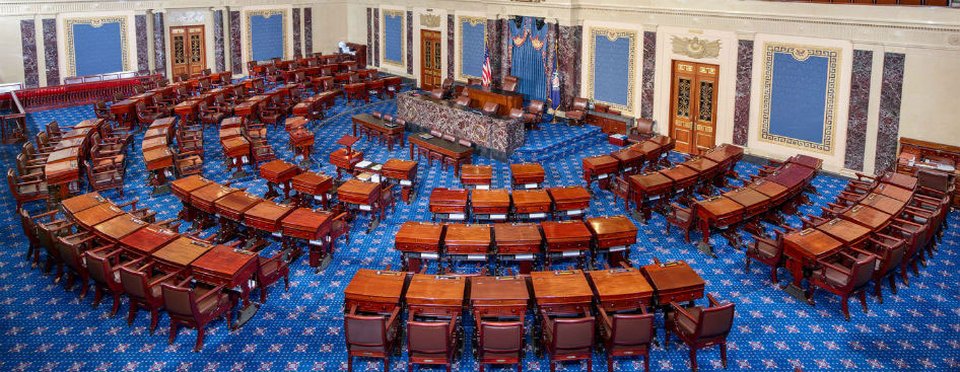
The Senate vote on the Secure America Act came Wednesday afternoon. The ballroom funding was gone. The anti-weaponization fund — Trump’s separate $1.776 billion proposal to compensate allies and political supporters he claims were “weaponized” against by the Biden administration — was also stripped after Acting Attorney General Todd Blanche announced the administration was dropping the demand. What remained was a straight immigration enforcement bill. It passed 53-46, entirely along party lines, with every Democrat opposed.
The missing billion was barely mentioned in the floor speeches. Senator John Thune, the majority leader, praised the bill as “the strongest border security legislation in American history.” Senator Chuck Schumer, the minority leader, called it “a cruel deportation machine wrapped in a flag.” Neither mentioned the ballroom. Neither needed to.
But the real story is not what happened on the floor. It is what happened behind closed doors in the weeks leading up to the vote. Schumer had made clear that if Republicans kept the ballroom funding in the bill, Democrats would force a “vote-a-rama” — an unlimited series of amendment votes designed to put every Republican on the record on the most painful issues imaginable. The Iran war: do you support an authorization for the use of military force? Gas prices: do you support a windfall profits tax on oil companies? The ballroom itself: do you support spending $1 billion on a White House party venue while families struggle to afford groceries?
Republicans knew they would lose on all of them. Not the votes — they have the majority, and they could kill the amendments on party-line votes. But they would lose the soundbites. They would lose the clips played in attack ads. They would lose the independent voters who are already drifting away.
The missed deadline — Trump had demanded the bill on his desk by June 1 — was another sign of the strain. The president wanted a victory. He wanted to sign the Secure America Act at a Rose Garden ceremony, surrounded by border patrol agents and Republican lawmakers, and declare that his deportation agenda was in motion. Instead, the bill missed the deadline by three days, and the ballroom was a carcass on the cutting room floor.
Trump has not lost the fight. He will try again. The ballroom is not canceled — it is merely delayed. The private construction continues, and the White House has signaled that the security funding will be reintroduced in a standalone bill or attached to a must-pass appropriations package later this year. The president does not give up on symbols. The ballroom is a symbol. So is the fight for it.
But the Senate Republicans who dropped it are sending a signal too. They are running scared of November. The midterm elections are approaching, and the map is treacherous. Republicans hold a narrow majority in the Senate — 53 seats — and are defending seats in states where the Iran war is deeply unpopular: Maine, North Carolina, Ohio, Florida. The House majority is even thinner. The historical pattern is brutal: the president’s party almost always loses seats in the midterms. And Trump’s approval rating, which has never cracked 50 percent in his second term, is sagging under the weight of a war he promised would never happen.
The ballroom vote was a test. It tested whether Republicans would go to the mat for a president who demands total loyalty while delivering rising costs, an open-ended conflict, and a billion-dollar party venue. They flunked. Quietly. Procedurally. With a parliamentarian’s ruling as their excuse.
But the country noticed. The voters noticed. And in November, the question will not be about the Byrd Rule or budget reconciliation or the finer points of Senate procedure. It will be a simpler question: why are we paying for a ballroom when we can barely pay for gas?
That is a question no Republican wants to answer. That is why the billion dollars disappeared.
**