

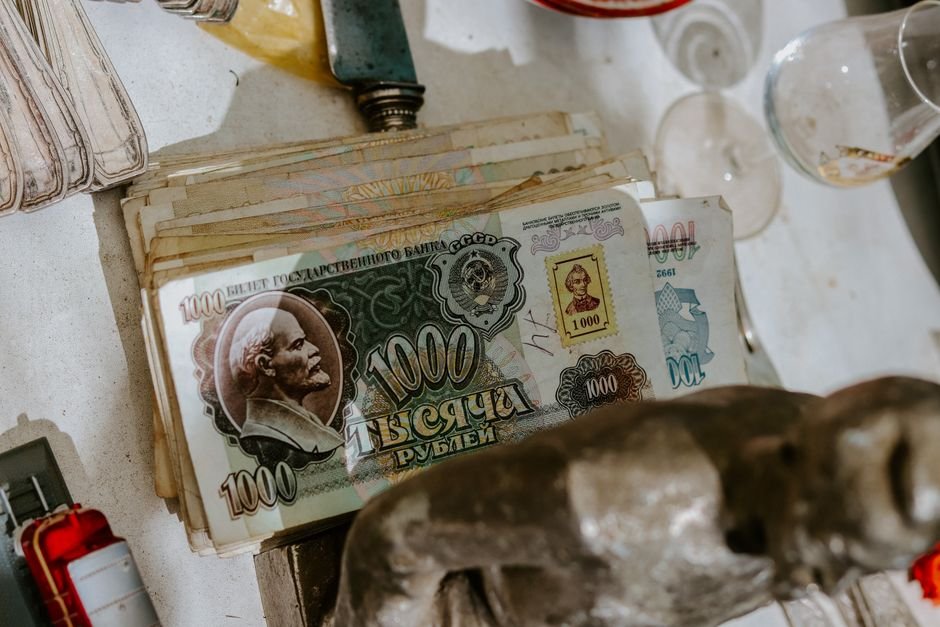
Russians are pulling money out of banks and stuffing it under mattresses at a rate not seen since the pandemic, a sign that four years of war, tax hikes, and mobile internet shutdowns are fraying faith in the country’s financial system.
Cash in circulation has increased by 1.56 trillion roubles ($20 billion) since the start of 2023, according to Central Bank data, the biggest increase for that period outside the Covid-19 pandemic. And the money is not coming back. Sberbank’s chief financial officer, Taras Skvortsov, said the bank is seeing “very serious signs” of a structural shift.
“This is a very worrying moment,” Skvortsov said. “We are not seeing cash return to the banking system through cash collection, ATMs or self-service terminals. It is staying in people’s hands.”
The reasons for the cash surge tell you everything about the state of Russia’s wartime economy.
First, mobile internet shutdowns. Every time Ukrainian drones approach, Russian authorities turn off mobile networks to make targeting harder for the Ukrainian military. The side effect: card payments stop working. A Moscow woman told the BBC she keeps cash because “if there’s an emergency in the city, I know I’ll still be able to buy basic necessities, even if the mobile network goes down.”
Second, taxes. The Kremlin raised VAT from 20 to 22 percent in January 2023 and lowered the threshold for small and medium businesses. More businesses now ask customers to pay in cash so they can understate turnover and stay below the threshold. A copywriter in Moscow said his vendor offered a discount for cash payment and “was upfront about the reason, higher taxes.”
A survey by Opora Russia, a small-business lobby, found that 6 percent of entrepreneurs have turned to “grey schemes” to cope with the new tax burden. At a market in Pskov, a stall owner said “most of those still trading ask customers to pay in cash whenever they can, so less money goes through the till.”
Third, the economy is slowing. Russia’s economy ministry cut GDP growth for 2026 to 0.4 percent in May, the weakest since 2022. In May alone, 550 billion roubles were withdrawn from bank accounts, including 200 billion from fixed-term deposits. Even Sberbank’s one-year deposit rate of 10 percent is not enough to keep money in the system.
The cash flight has a perverse effect on the Kremlin’s finances. Higher taxes are meant to fund the war, but the same war is creating conditions that make tax collection harder. As Alexander Kolyandr of the Center for European Policy Analysis put it: “One arm of the government is trying to squeeze as much money as possible out of people through higher taxes, fines and other charges. But another, in trying to counter so-called terrorist threats, is undermining that strategy by making it harder to collect tax.”
It is Soviet-era behavior returning: cash under the mattress, trust in nothing official, every man for himself. The Kremlin needs maximum revenue to keep the war going. Its own policies are pushing the money out of reach.