

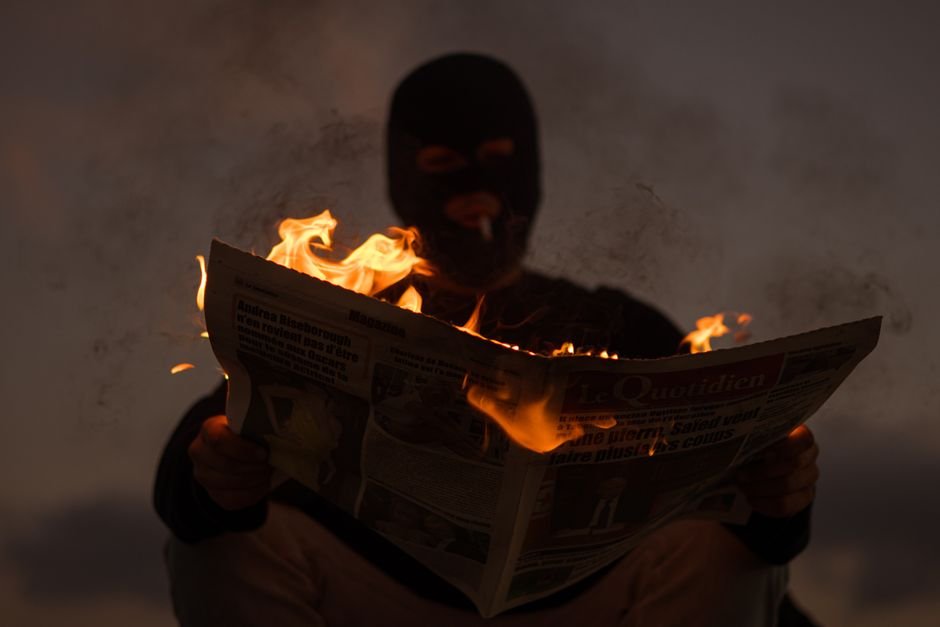
Every few weeks, Russian state television airs another segment about the coming war with NATO. Tanks massing on the Baltic border. Nuclear threats against Poland. A “new front” opening while the war in Ukraine grinds on.
Western media dutifully reports it. Headlines scream that Russia is preparing to attack the alliance. Alarm bells ring in Brussels and Washington.
There is just one problem: Russia cannot fight NATO. It cannot even win the war it is already fighting.
The numbers do not lie
Russia has lost over one million soldiers killed and wounded in Ukraine, according to both Western intelligence estimates and Ukrainian figures cited by Kyiv’s ambassador to the US. Its tank fleet has been decimated. Its Black Sea Fleet has been driven from Crimea by drones. Its economy is being strangled by sanctions, and its oil refineries are burning after Ukrainian drone strikes hit targets 2,400 kilometers inside Russian territory.
The Russian military is so stretched that it has had to rely on North Korean artillery shells and Iranian drones to keep fighting. It cannot open a second front. It cannot even properly supply the one it has.
The “war with NATO” rhetoric is not a strategic plan. It is a coping mechanism for domestic audiences, a way for the Kremlin to explain why the “special military operation” has turned into a grinding, four-and-a-half-year catastrophe.
How the propaganda machine works
Since 2022, Russian state TV has devoted enormous airtime to vilifying NATO, the US, and Ukraine. The message is simple: Russia is not losing in Ukraine; it is fighting the entire Western alliance. NATO is the real enemy. The war is existential. Russians must sacrifice because the alternative is annihilation.
This serves a dual purpose. It justifies the war to a population tired of casualties and economic hardship. And it sets the stage for future mobilization, the Kremlin can argue that if Russia does not win in Ukraine, NATO will attack next.
But none of it is backed by military reality.
“The losses for the Russian military are over 1 million people,” Ukraine’s US Ambassador Olga Stefanishyna said this week. “What could be worse? There’s no way to normalize what is happening right now.“
False equivalence is not analysis
Western media often reports the NATO-war rhetoric as if it were a genuine expression of Russian intent, as if Putin’s propagandists and his general staff were saying the same thing. They are not.
The Russian General Staff knows exactly how outgunned the country would be in a war with NATO. The alliance has 32 members, a combined defense budget of over $1 trillion, and a nuclear deterrent that dwarfs Russia’s. Even in a conventional conflict, NATO’s air forces alone would achieve dominance in days.
The Kremlin’s propagandists, by contrast, are paid to scare Russians into obedience. Their job is not strategic analysis. It is crowd control.
What matters is not what Russian TV says. What matters is what Russia can do. And right now, Russia can barely hold its lines in eastern Ukraine. The rest is noise, designed for domestic ears, not for Western headlines.