

Published: June 02, 2026, 14:19 UTC
New Calculations Pinpoint Planet Nine’s Mass, Orbit, and Location in the Sky
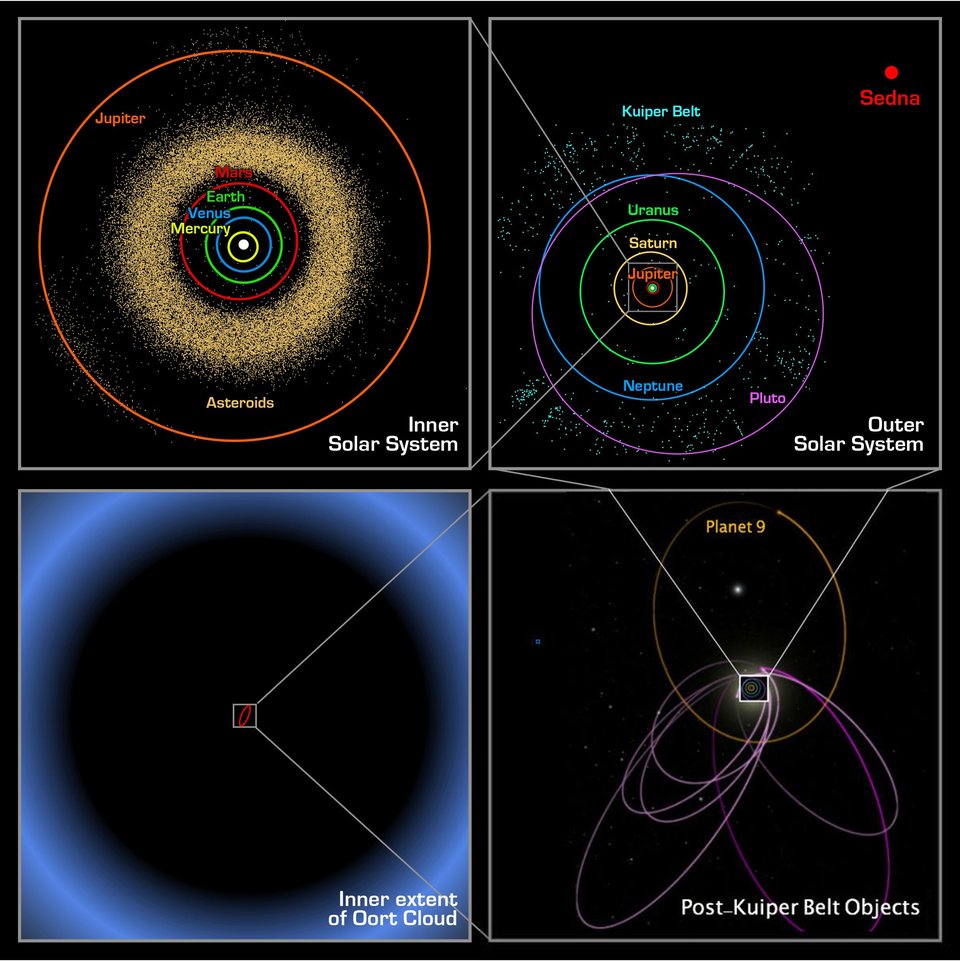
New research has dramatically refined the estimated mass, orbit, and sky location of the long-hypothesized Planet Nine, narrowing the search zone for what would be the Solar System’s first new planet in nearly two centuries. Using classical celestial mechanics rather than computer simulations, a preprint published May 30 on arXiv offers the most precise observational targets yet for the elusive world.
The study, led by Mattia Galiazzo and Robert Finch, analyzes the orbital clustering of a dozen trans-Neptunian objects (TNOs) and concludes that Planet Nine has a mass of 7.1 Earths — squarely in the super-Earth regime — and follows a highly elliptical path that takes it as close as 311 AU to the Sun and as far as about 510 AU. Its orbital period, the researchers calculate, is approximately 11,512 years.
“We wanted to make the reasoning mathematically visible and verifiable,” the authors write. Unlike previous work that relied heavily on large N-body simulations with many free parameters, Galiazzo and Finch built a framework grounded in classical astrophysics — analytic perturbation theory applied to the gravitational sculpting of distant Kuiper Belt objects.
A Growing Body of Evidence
The Planet Nine hypothesis was first proposed by CalTech astronomers Konstantin Batygin and Michael Brown in 2016. They noticed that six of the most distant known TNOs were clustered in space in a way that seemed statistically improbable — their orbits all tilted in roughly the same direction and their perihelia (closest approaches to the Sun) grouped together. The odds of such clustering happening by chance, they argued, were about 0.007 percent.
The hypothesis gained traction as more distant objects were discovered, but the planet itself has remained hidden. Critics have suggested the clustering could be observational bias — telescopes are more likely to find objects in certain parts of the sky — or that alternative gravitational mechanisms could explain the patterns.
Galiazzo and Finch take the evidence base wider. Their analysis includes the original six TNOs from the 2016 CalTech study plus six additional objects selected using similar but broader criteria, giving them a dozen independent data points to work with. Of those, four or five appear to be locked in “mean motion resonance” with the unseen planet — a gravitational relationship in which the TNOs complete an integer number of orbits for every one orbit of Planet Nine, like the orbital choreography between Neptune and Pluto.
The New Numbers
The study’s key parameters provide a far more detailed portrait than previously available:
- Semi-major axis: ~510 AU
- Eccentricity: 0.39 (elongated elliptical orbit)
- Perihelion: 311 AU (closest approach to the Sun)
- Mass: 7.1 Earth masses
- Inclination: +19.5 degrees relative to the Solar System’s ecliptic plane
- Longitude of ascending node: +107.7 degrees
- Argument of perihelion: 307.5 degrees
The orbit is significantly less eccentric than some earlier estimates, which had pushed eccentricity as high as 0.6 or more. The 0.39 figure puts Planet Nine on a path more akin to an elongated but stable planetary orbit rather than the comet-like trajectories of some previous models.
Perhaps most importantly for observers, the new calculations place Planet Nine in the constellation region of lower Taurus and upper Libra — a swath of sky that is about to come under intense scrutiny as the Rubin Observatory’s Legacy Survey of Space and Time (LSST) begins full operations.
“LSST will be a game-changer for the Planet Nine search,” astronomers not involved in the study have noted. The observatory’s 8.4-meter telescope in Chile will survey the entire southern sky every few nights, and its ability to detect faint, slow-moving objects in the 300-500 AU range is unmatched by any previous survey.
Lagrange Points and Gravitational Sculpting
One of the more intriguing aspects of the new work is its focus on the Lagrange points L4 and L5 — gravitationally stable zones that trail and lead a planet’s orbit by 60 degrees. The authors suggest that many of the clustered TNOs are being held in place near Planet Nine’s L4 and L5 points, explaining why their orbits appear coordinated.
This mechanism, well understood from Jupiter’s Trojan asteroids, would naturally produce the kind of orbital clustering observers have detected. If correct, it would mean that the TNOs are not being directly herded by Planet Nine’s gravity in the traditional sense, but rather are trapped in stable gravitational pockets that move with the planet — a subtle but important distinction.
The Trojan-like configuration also helps explain why certain TNOs appear in mean motion resonances with the hypothetical planet. The team identified 4-5 of the 12 TNOs as likely resonant objects, meaning their orbital periods form simple integer ratios with Planet Nine’s 11,512-year orbit — relationships that persist over timescales of millions of years.
What This Means for the Search
The Rubin LSST is expected to begin delivering its first major tranche of discovery data later this year. If Planet Nine is real and located in the lower Taurus / upper Libra region at the distance and brightness implied by a 7.1-Earth-mass object at ~510 AU, the observatory should be able to detect it within its first few years of operation.
The refined parameters also help narrow the search for archival data. Several sky surveys have covered parts of the target region over the past two decades; with a more precise orbit in hand, astronomers can now re-examine those images for a faint, slow-moving point source that might have been overlooked.
Not everyone is convinced the planet exists. A 2021 survey using data from the Dark Energy Survey found no object consistent with Planet Nine in the regions it could search. Alternative explanations for the TNO clustering — including the possibility of a primordial disk instability or even modified gravity theories — remain on the table.
But the Galiazzo and Finch study adds a new layer of analytical rigor. By making every step of their calculation mathematically explicit, they have produced a model that can be tested, refined, or falsified by incoming data — exactly the kind of science that LSST is built to do.
“The beauty of putting your math on the table,” one planetary scientist commented, “is that when the data comes in — whether it confirms or kills the hypothesis — everyone can see exactly what happened.”