

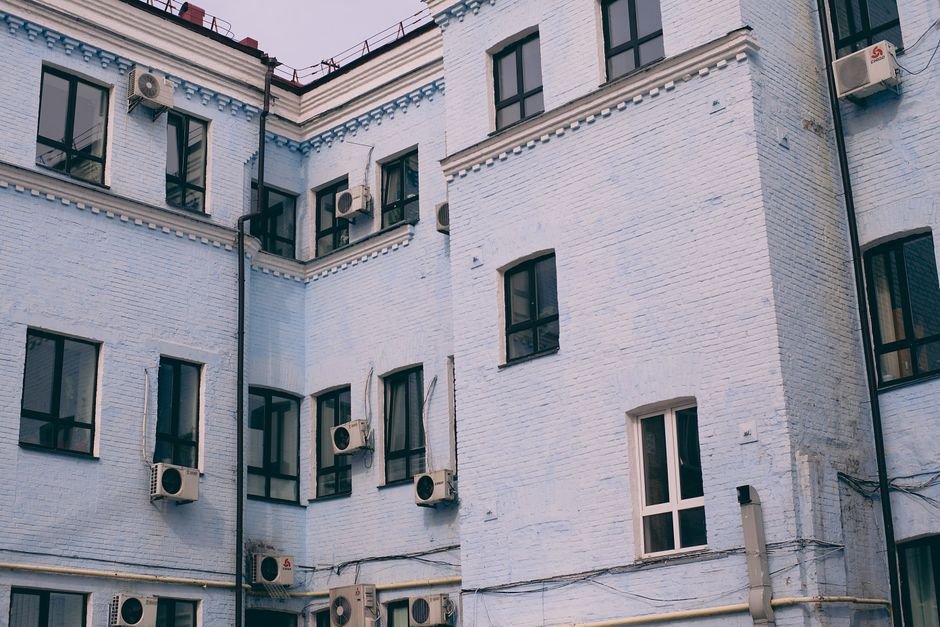
On the hottest days of the year, a split-system air conditioner performs a cruel trick: it pumps heat from inside a room directly into the street outside. The machine works harder, the city gets hotter, the cycle accelerates. This feedback loop is one reason cooling buildings already consumes nearly 10 percent of global electricity, a share climbing faster than any other end use. By 2050, the electricity required for cooling is projected to increase 210 percent above 2024 levels, with associated greenhouse-gas emissions likely to triple over the same period.
That trajectory is both unsustainable and deeply unequal. A fraction of humanity benefits from air conditioning while the rest endures heat extremes worsened by the very emissions those machines produce. A 2021 study in Nature Communications by Pavanello and colleagues projected that as many as 100 million families in India, Mexico, Indonesia, and Brazil will remain unable to afford AC by 2040, even with electricity access. The people who need cooling most, who contribute least to the emissions driving global heat, are the people least able to buy a solution.
This is not a technology gap. It is an equity gap. And a growing body of research suggests the most promising answer may not come from more efficient air conditioners, but from buildings that stay cool without plugging into the grid at all.
The Atmospheric Window
The most exciting development in passive cooling research centers on a quirk of physics known as the atmospheric window. Earth’s atmosphere is mostly opaque to infrared radiation, but it allows wavelengths between 8 and 13 micrometers to pass through almost unimpeded, escaping directly into the cold of outer space. Objects on the ground radiate heat in this band naturally. But they also absorb solar radiation and re-emit much of it into the lower atmosphere, where greenhouse gases trap it.
Passive radiative cooling materials are engineered to do something different: they reflect nearly all incoming sunlight while simultaneously emitting infrared radiation in exactly the 8 to 13 micrometer band where the atmosphere is most transparent. The net effect: a surface can cool below ambient air temperature without consuming a single watt of electricity.
A comprehensive review by Santamouris and Vasilakopoulou, published in Nature Reviews Clean Technology earlier this year (DOI 10.1038/s44359-026-00177-y), catalogs the rapid advance of these technologies and related passive strategies. The paper surveys developments in smart solar control, natural and mechanical ventilation, radiative surfaces, evaporative dissipation, and hybrid systems.
Among them, radiative cooling has drawn the most attention from materials scientists because it promises something that feels almost like magic: a surface that makes itself colder by staring at the sky.
Paint That Beats the Heat
The most practical advances have come in coatings and paints applicable to existing buildings. Researchers have developed multilayer materials that trap microscopic air pockets, creating structures that scatter sunlight while maximizing heat emission. A 2022 study by Hu and colleagues in Composites Part A reported a coating with just such a structure that lowered surface temperature by 5.26 degrees Celsius (9.47 degrees Fahrenheit) and reflected 97 percent of incoming solar energy.
A different approach, described by Zhao and colleagues in Science in 2023, uses paints loaded with microspheres and nanospheres of silicon oxide and aluminum oxide. The two sizes of particles work together: the larger microspheres scatter visible and ultraviolet light, while the smaller nanospheres enhance emission in the critical 8 to 13 micrometer band. The result is a paint manufacturable at scale, applicable with ordinary equipment, requiring no maintenance.
Other groups have pursued radiative cooling through specialized glasses, transparent gels, and flexible films that can be retrofitted onto existing windows. What unites these materials is that they require no ongoing energy input and no moving parts. Once installed, they simply sit on the building envelope, continuously radiating heat to space while the sun beats down.
Beyond Radiative Cooling
Radiative surfaces are the most dramatic innovation, but they are far from the only passive strategy. The review by Santamouris and Vasilakopoulou also highlights advances in automated shading systems, such as blinds and window slats that track the sun’s position, already common in commercial buildings in wealthier countries. Natural ventilation designs that channel airflow through buildings can dramatically reduce internal temperatures. Evaporative cooling, which uses the latent heat of water to absorb thermal energy, remains effective in dry regions. And hybrid systems that pair small amounts of electrical assist with predominantly passive elements may offer the best balance for some settings.
A 2025 study by Kousis and Santamouris in Solar Energy (volume 302, article 114038) examined the long-term effectiveness of these passive strategies under projected climate change scenarios. The analysis found that well-designed passive systems remain effective even as temperatures rise, though their performance degrades under extreme conditions beyond historical norms. This suggests that passive cooling is not a permanent substitute for mechanical systems in every context, but it can dramatically reduce the load that active systems must handle, shrinking both energy demand and equipment costs.
The implications for equity are direct. A family that cannot afford a split-system air conditioner, let alone the electricity to run it, can still benefit from a roof painted with a radiative cooling coating or a building designed with shaded windows and cross-ventilation. These interventions do not require a household to own expensive equipment or pay a monthly utility bill. They are one-time capital improvements, and for many materials, the cost is dropping rapidly as manufacturing scales up.
Still, researchers caution against treating passive cooling as a silver bullet. Dust and pollution can degrade radiative performance over time. Humidity limits evaporative approaches. Dense urban canyons block the sky view that radiative surfaces need. And in the hottest, most humid climates, passive systems alone may not suffice, especially for vulnerable populations such as the elderly or those with medical conditions.
Cooling as Climate Justice
The framing matters. For decades, the dominant assumption in energy policy has been that the solution to rising cooling demand is more efficient air conditioning: tighter seals, better refrigerants, smarter compressors, and grid upgrades to handle the load. These are worthwhile goals, but they assume the problem is a technology gap: making cooling affordable by reducing the cost and energy footprint of machines.
The research tells a different story. The gap is not primarily technological. It is structural. The households least likely to own AC are also those most likely to live in poorly insulated buildings, in heat-island neighborhoods with little tree cover, and in countries with unreliable electricity grids. For these households, a more efficient air conditioner is not a solution if the unit itself is unaffordable.
Passive radiative cooling flips this logic. It addresses the building, not the appliance. It reduces the need for mechanical cooling at its source, lowering the bar for what an air conditioner must achieve when one is needed. In many cases, it may eliminate that need entirely for much of the year. A 2021 paper by Feng and colleagues in Nano Energy found that radiative cooling materials could reduce peak cooling loads by double-digit percentages in warm climates, potentially delaying or avoiding the need to purchase mechanical systems altogether.
The world is on track to add the equivalent of 4,000 gigawatts of cooling capacity by 2050, according to International Energy Agency projections: roughly the entire current electricity generation capacity of the United States. Most of that growth will come from countries in Asia, Africa, and Latin America where temperatures are rising fastest and incomes are lowest. Whether that demand is met with machines or smarter buildings will determine not only emissions trajectories, but also who gets to be cool.
Passive cooling technologies will not replace air conditioning everywhere. They do not need to. What they offer is a different starting point: a world in which cooling is not a commodity to be bought, but a property of the built environment, accessible to anyone beneath a roof.
The equity gap in cooling is not closed by giving everyone the same machine. It is closed by ensuring that the people who need heat relief most have buildings that help them stay cool on their own. That is not a technology problem. It is a design problem, a policy problem, and increasingly a solvable one.