

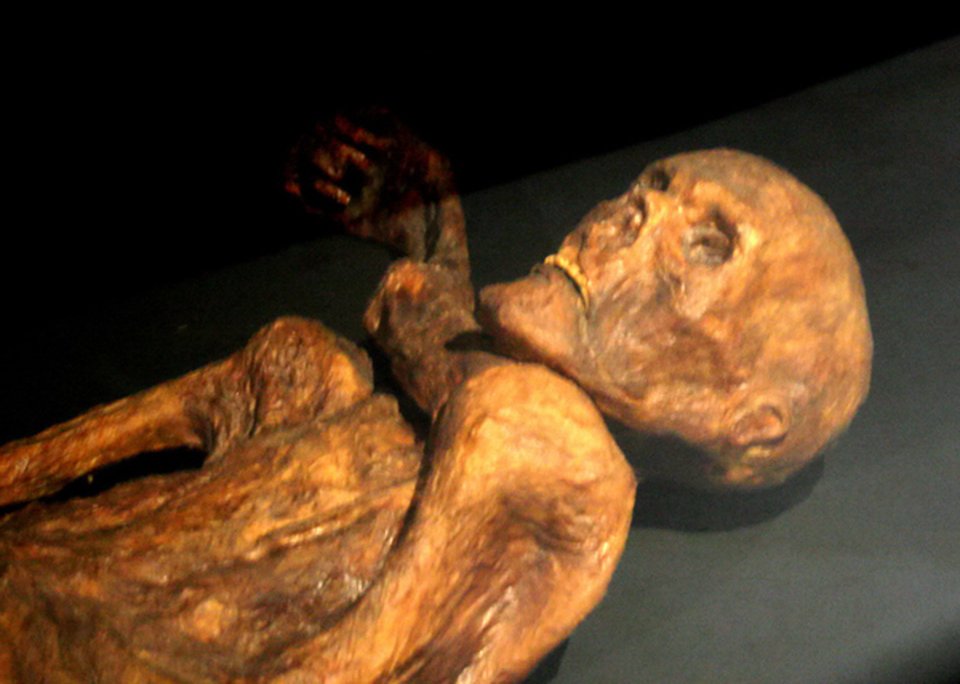
Life After 5,300 Years: Ötzi the Iceman’s Microbes Are Still Growing
Published: June 7, 2026, 15:58 UTC
Ötzi the Iceman has been frozen in the alpine ice of the Ötztal Alps for 5,300 years. Since his discovery by hikers in 1991, scientists have studied his tattoos, his last meal, his clothing, his weapons, and even his genome. But the mummy, housed at -6 degrees Celsius in a sterile chamber at the South Tyrol Museum of Archaeology in Bolzano, Italy, is not merely a preserved corpse.
It is, it turns out, still hosting active microbial life.
In a study published in the journal Microbiome, researchers at Eurac Research’s Institute for Mummy Studies report that viable strains of cold-loving yeast and bacteria are not merely present on Ötzi’s body — they are still alive and actively growing, surviving and multiplying at glacial temperatures inside the conservation facility.
The team, led by microbiologist Mohamed S. Sarhan, took samples from Ötzi’s stomach, meltwater from his storage chamber, and swabs from his skin. They then incubated the samples at refrigerator-level temperatures — around 4-6 degrees Celsius — to see what would grow.
The answer was four species of psychrophilic (cold-loving) yeast: Phenoliferia glacialis, Glaciozyma watsonii, Goffeauzyma sp., and Mrakia robertii. All four are still viable and, in the cold of the conservation chamber, are slowly reproducing.
“These yeasts grow at a glacial pace,” Sarhan said. “We had to incubate them in a refrigerator rather than a standard lab incubator, because they simply would not grow at room temperature.”
The team has since commissioned a custom low-temperature incubator to continue the work.
Ancient or Adapted?
The critical question is whether these microbes are ancient inhabitants of Ötzi’s body, persisting since his death in the Copper Age, or modern colonizers that moved in after his discovery.
The evidence points to a mix of both.
Using shotgun metagenomics — sequencing all DNA fragments in each sample — the researchers found that the yeast genomes contain both heavily degraded (ancient) DNA and well-preserved (modern) DNA. This suggests the yeasts are not simply dormant relics. They are actively reproducing, albeit slowly.
A striking piece of evidence: samples taken from Ötzi in 2010 showed shorter, more heavily damaged DNA fragments. Samples taken in 2019 showed longer fragments and less damage — a clear signature of ongoing multiplication and DNA repair between those years.
Three of the four yeast species can also break down phenol, an antifungal compound applied to Ötzi in 1991 to prevent decay. This ability may have given them a selective advantage over other microbes, allowing them to thrive while competitors were eliminated.
A Sourdough From the Ice Age
In a playful demonstration of the yeasts’ vitality, the team successfully made a sourdough starter and baked bread using cultures of the same yeast species found on Ötzi. The dough rose within 24 hours at room temperature and produced — by all accounts — a “very good” loaf.
(The bread was made from cultures of the same species identified from the mummy, not from direct samples of Ötzi himself, for both ethical and health-safety reasons.)
The Bacterial Community
Beyond the living yeasts, the team reconstructed the ancient gut microbiome of Ötzi using degraded DNA. They identified species including Romboutsia hominis, Clostridium moniliforme, Ruminococcus bromii, and Treponema succinifaciens — a gut community typical of a pre-modern human living in the Alps.
They also identified a living strain of Pseudomonas bacteria that shows genetic divergence from the local soil strain, suggesting it has adapted to the unique environment of the conservation facility.
The Caveats
The study acknowledges several important limitations. The 1991 phenol treatment may have artificially selected for phenol-degrading yeasts, meaning the current microbial community does not fully reflect the original post-mortem ecosystem. Some of the bacteria identified — particularly the Pseudomonas strain and skin-associated Methylobacterium and Sphingomonas — could be modern introductions from the conservation facility itself.
The researchers controlled for this by sampling airborne microbes from the storage room and lab, as well as frozen alpine soil from the discovery site. But they note that the conservation chamber’s sterile conditions — -6 degrees Celsius, 99% humidity, UV-treated water spray — create a unique selective environment that favors some species over others.
Perhaps the most fundamental question remains unanswered: are the yeasts descendants of microbes that have been continuously multiplying on Ötzi’s body for 5,300 years, or did they go dormant and only revive after thawing and transfer to lab conditions? The data supports ongoing growth, but cannot distinguish between these two possibilities with certainty.
What It Means
The study opens a new window into microbial persistence and evolution over archaeological timescales. If microbes can survive — and even slowly reproduce — for millennia in frozen human tissue, it raises questions about the limits of microbial longevity and the role of mummified remains as time capsules of ancient microbial diversity.
For now, the work is a reminder that Ötzi is not just a window into the Copper Age. He is, in a very real sense, still alive with microbial activity — a slow, cold, ancient ecosystem persisting in the heart of a modern museum.
Paper: Mohamed S. Sarhan, Marco Samadelli, Albert Zink, Frank Maixner. “The Iceman’s microbiome: unveiling millennia of microbial diversity and continuity.” Microbiome 14, Article 135 (2026). DOI: [10.1186/s40168-026-02417-6](https://doi.org/10.1186/s40168-026-02417-6)
Lead institution: Eurac Research, Institute for Mummy Studies, Bolzano, Italy
Funding: Not specified in the paper