

Published: June 02, 2026, 01:02 UTC
In 1946, Paul Erdős — the most prolific mathematician in history, with over 1,500 papers to his name — posed a simple question about geometry. Given n points on a flat plane, what is the maximum number of pairs that can be exactly one unit apart? The problem looks like a puzzle for a puzzle’s sake, but it connects to deep questions about the structure of space itself. For 80 years, no human mathematician could resolve it.
In mid-May, OpenAI announced that an internal AI model had disproved the Erdős unit distance conjecture — the first time an AI system has autonomously produced a proof resolving a major open conjecture. The result, covered by Ars Technica’s Kai Williams on June 1, has been called “a milestone in AI mathematics” by Fields Medalist Tim Gowers.
What the AI actually did. The unit distance problem (Erdős problem #90) asks: as the number of points n in a 2D plane grows arbitrarily large, what is the maximum number of pairs that can be exactly one unit apart? Erdős conjectured a specific upper bound in 1946 based on grid-based arrangements, but the exact limit had never been proven or disproven. For eight decades, the best human mathematicians could do was narrow the range between the upper and lower bounds.
OpenAI’s model found a counterexample — a configuration of points that exceeded Erdős’s conjectured maximum by exploiting a more efficient packing pattern than grids allow. Crucially, the AI arrived at this result autonomously: it was not guided by human intuition toward the correct configuration, but discovered it through its own reasoning process, drawing on techniques from several subfields of mathematics that no single human expert would necessarily have combined.
University of Toronto professor Daniel Litt wrote that “this is the first example of a result produced autonomously by an AI that I find exciting in itself, as opposed to as a leading indicator.” Fields Medalist Tim Gowers called it “a milestone in AI mathematics” while noting that the AI’s approach was rooted in existing ideas — applied in a combination that a human had not thought to try.
What it means (and doesn’t mean) for mathematics. The breakthrough is real but nuanced. The AI did not invent a radically new mathematical technique — it applied existing ideas in a novel combination that a human had not thought to try. Human mathematicians have since cleaned up and extended the proof. The Ars Technica analysis frames this as a model for the medium-term future: AIs have broader knowledge of past work than any human alive and more willingness to grind through tedious proof strategies, while humans can still think more deeply about any one problem and ask more interesting questions.
Kai Williams, who holds a PhD in mathematics and wrote the Ars piece, notes that three years ago, LLMs struggled to solve arithmetic problems. “It was only last year that LLMs started acing high school mathematics competitions.” The trajectory of improvement is steep enough that “it’s unclear what role, if any, human mathematicians will play a decade from now.”
The broader pattern. The Erdős breakthrough follows a string of AI mathematical achievements that have accelerated since early 2025. In April 2026, an amateur mathematician armed with ChatGPT solved a separate 60-year-old problem that had stumped experts. OpenAI’s result is different in kind — it was produced autonomously, not by a human prompting a chatbot — but it belongs to the same trend: AI systems are increasingly capable of navigating the open-ended space of mathematical proof.
The implications extend beyond mathematics. The same reasoning capabilities that allow an AI to navigate a proof space could apply to drug discovery, materials science, and software verification — anywhere the search space is too large for exhaustive human exploration but structured enough for AI-guided reasoning.
As Gowers put it, “there is no doubt that the solution to the unit-distance problem is a milestone in AI mathematics.” The question now is how many more milestones follow, and how fast.
Sources: Ars Technica (Kai Williams, Jun 1, 2026); TechCrunch (May 20, 2026)
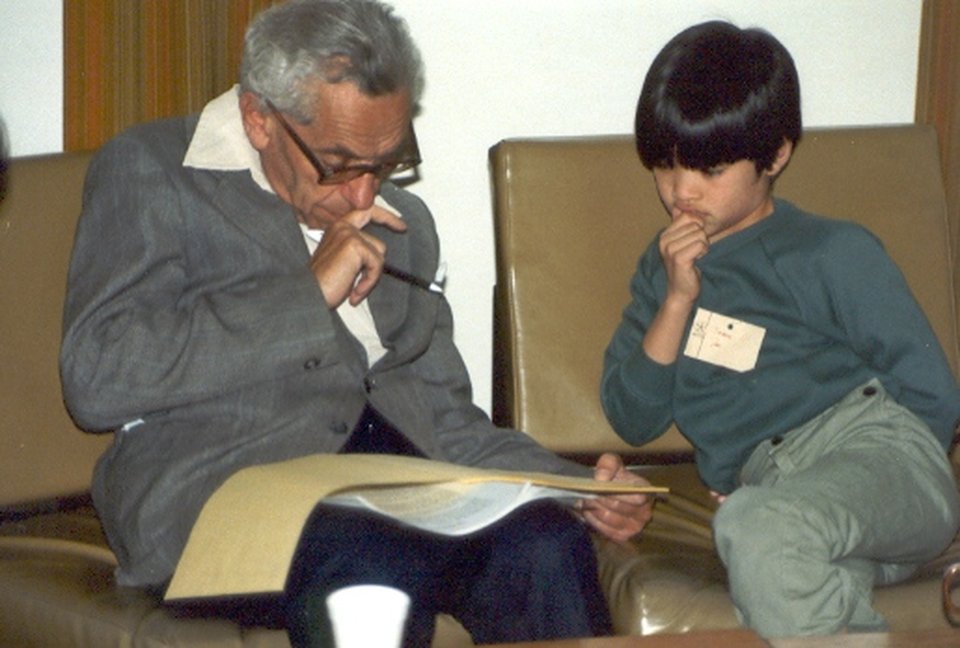
Image: Paul Erdős with Terence Tao, 1985. CC BY-SA 2.0, via Wikimedia Commons.