

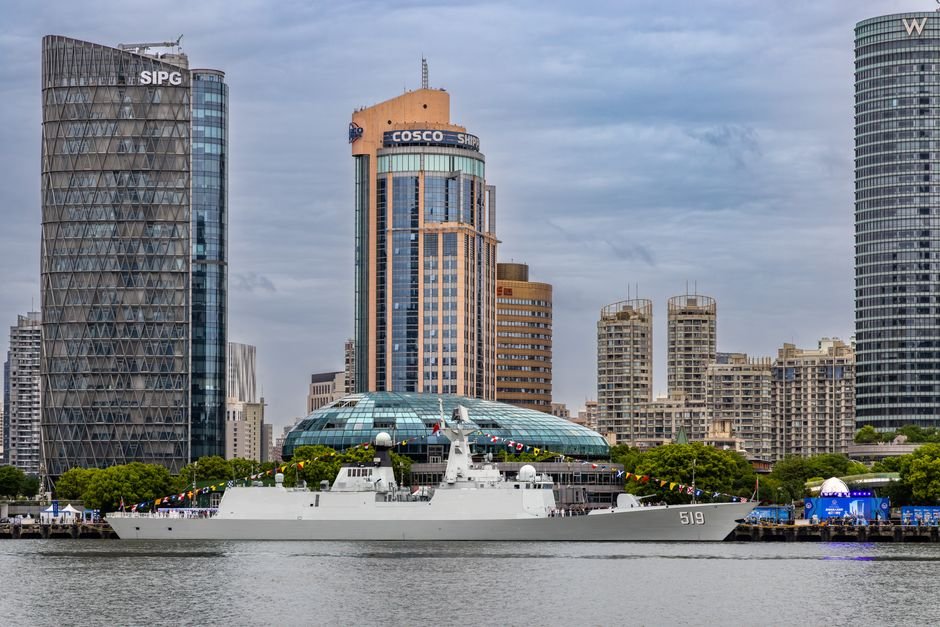
The Choe Hyon is a 5,000-ton guided missile destroyer with 88 vertical launch cells, four-faced phased-array radars, a 127-millimeter main gun, torpedo launchers, and a close-in weapon system derived from Russia’s Pantsir-M. It can fire nuclear-tipped cruise missiles. It was built in about two and a half years.
That last number is the one that should worry South Korea, Japan, and the United States. The previous generation of North Korean warships — the Amnok-class corvettes, roughly 2,000 tons — took more than a decade from start to commissioning. The Choe Hyon, twice the size, was finished in a fraction of that time.
Its sister ship, the Kang Kon, suffered a failed side-launch in May 2025: the vessel tipped to starboard, its bow stuck on the slipway. The cause was “inexperienced command and operational carelessness.” But the ship was raised, towed to Rajin, and relaunched within 22 days. Two more destroyers of the same class are already under construction at the Hambuk Shipyard in Chongjin.
Kim Jong Un has ordered two vessels of this size or larger every year. His goal is at least 12 large surface combatants by the early 2030s, plus a 10,000-ton guided missile cruiser. If North Korea’s shipyards sustain this pace — and everything about the last two years suggests they can — the Korean People’s Army Navy will be a genuinely different force by the end of the decade.
The speed is not homegrown ingenuity. The Choe Hyon’s phased-array radars resemble systems on Russia’s Karakurt-class corvettes. Its CIWS is a Pantsir-M derivative. These are Russian and Chinese technologies, transferred as part of what analysts at the Foundation for Defense of Democracies call the “axis of aggressors” — the informal technology-sharing network among China, Russia, Iran, and North Korea.
For decades, North Korea’s navy was the neglected branch of a military that poured resources into ballistic missiles, artillery, and special operations forces. The KPAN’s most capable ships were a handful of aging corvettes and a submarine fleet that, while sizable, operates boats so old they are as dangerous to their crews as to anyone else.
That is changing. The nuclear-armed navy gives Pyongyang a third strike vector, alongside its land-based missiles and submarine-launched systems. A destroyer on patrol in the Sea of Japan or the Yellow Sea complicates any US-ROK-Japan response to a crisis, because it cannot be pre-targeted the way a known missile base can.
The US, South Korea, and Japan have responded with deepened trilateral exercises and calls for a summit. But the hard question is whether the naval balance in Northeast Asia is shifting faster than the alliance can adapt. North Korea is building warships in years, not decades, with technology it did not develop on its own. That pace of change has its own momentum.