

Newton’s third law is one of the first things you learn in physics: if object A pushes object B, object B pushes back with equal force in the opposite direction. It is intuitive, foundational, and for many real-world systems, it is wrong.
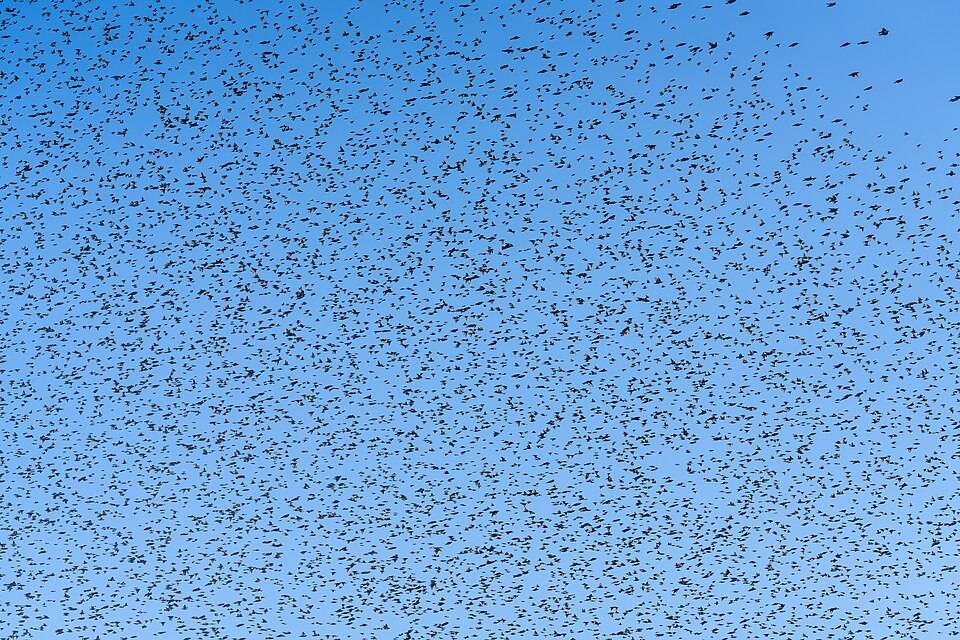
Bird flocks are a classic example. A bird looks forward and aligns with the birds it can see in front of it. Those front birds do not look back at it. The influence is one-way. The same asymmetry appears in bacterial colonies responding to chemical gradients, in swarming insects, in cells migrating through tissue, and in active colloids, tiny self-propelled particles that push through fluids without exerting equal and opposite forces on each other.
These are called non-reciprocal interactions. Until now, physicists lacked a proper mathematical framework to describe them.
The gap
Most of theoretical physics rests on a single powerful tool: the Hamiltonian. A Hamiltonian is a single mathematical function that encodes all the energy of a system. From it, you can derive all the equations of motion, identify conservation laws, calculate temperature and phase transitions, and run efficient computer simulations.
But Hamiltonian mechanics only works when interactions are reciprocal, because energy is shared symmetrically between particles. If A pushes B but B does not push A back equally, the forces don’t come from a shared energy. You cannot write a Hamiltonian. And without one, you lose access to the entire standard toolkit of statistical mechanics, Monte Carlo simulations, and equilibrium thermodynamics.
Physicists had to resort to ad hoc methods for each new non-reciprocal system, slower, less general, and lacking the conceptual depth that the Hamiltonian framework provides. This has been a recognized gap since the birth of classical mechanics in the 17th century.
The fix
A team of physicists from the Max Planck Institute for the Physics of Complex Systems, the Technical University of Dresden, and the Barcelona Institute for Science and Technology, led by Yu-Bo Shi and Marin Bukov, found a mathematical workaround.
They add imaginary partner variables, called auxiliary degrees of freedom, to the system. These are not real; they are purely mathematical inventions. The trick works in two steps:
First, you build a reciprocal Hamiltonian that includes both the real system and the auxiliary variables. Because the auxiliary variables interact reciprocally with the real ones, this combined system obeys Newton’s third law and can be written as a Hamiltonian.
Second, you impose a constraint, a mathematical rule linking the real variables to their imaginary partners. Under this constraint, the dynamics of the real variables alone exactly reproduce the original non-reciprocal behavior.
An analogy: imagine you have a seesaw with unequal weights that won’t balance. You could add a hidden counterweight that makes it balance perfectly, then cover the counterweight so only the original weights are visible. The motion of the visible weights looks exactly like the unbalanced seesaw you started with. The counterweight (the auxiliary variable) is invisible but makes the math work.
What it enables
The new framework, published June 12 in Nature Physics, does three things.
It provides a general method that works for any system with pairwise non-reciprocal interactions. The team demonstrated it on a model of spins (magnetic orientations) with vision-cone interactions, a simplified version of how birds align based on who they can see.
It unlocks the standard statistical mechanics toolkit. Researchers can now apply Monte Carlo simulations, equilibrium thermodynamics, and Hamiltonian analysis to bird flocks, bacterial colonies, and active matter, systems that previously required custom computational approaches.
And it unifies the conceptual picture. Non-reciprocal systems are not fundamentally different from reciprocal ones, the framework shows. They just live in a larger, constrained mathematical space. This is both philosophically satisfying and practically useful.
The specific demonstration showed that Glauber Monte Carlo dynamics on the constrained Hamiltonian reproduces the exact same behavior as the original non-reciprocal system, for both steady states (equilibrium-like) and non-stationary states (time-varying, like a flock changing direction).
The limitations
The auxiliary variables are not physically real, they are mathematical scaffolding, which can make physical interpretation less intuitive. The constraint linking real and auxiliary variables adds a layer of technical overhead. The framework is proven for pairwise interactions; higher-order (three-body) non-reciprocal interactions may need extensions. And adding auxiliary variables doubles the dimensionality of the system, increasing computational cost, though the payoff is that the Hamiltonian structure enables algorithms that more than compensate.
The framework is currently classical. Extending it to quantum non-reciprocal systems would be the next step.
For now, the result closes a gap that has been open since Newton. The systems where push does not equal pull, the birds, the bacteria, the swarms, are no longer mathematical orphans.
Source: Shi, Y.-B., Moessner, R., Alert, R., & Bukov, M. (2026). Hamiltonian description of non-reciprocal interactions. Nature Physics. DOI: 10.1038/s41567-026-03317-0. arXiv: 2505.05246