

On 19 June 2026, wildlife veterinarians in New Zealand received the news they had been dreading. Highly pathogenic H5N1 (clade 2.3.4.4b) had been confirmed in a brown skua on a beach in Western Australia. Within weeks, six other birds along roughly 3,000 kilometers of Australia’s southern coast tested positive, including several giant petrels.
For New Zealand, whose endemic avifauna evolved in the absence of mammalian predators and with no natural immunity to highly pathogenic avian influenza, the detection in migratory seabirds just across the Tasman Sea was an existential threat. The government’s Department of Conservation (DOC) activated an emergency vaccination plan for five critically endangered species, the first of its scale for a wild bird population.
The species at stake
Five species with fewer than 500 surviving individuals each are being targeted:
| Species | Population status | Key challenge |
|———|——————-|—————|
| Kākāpō | ~325 total (235 adults, ~90 chicks) | Flightless, nocturnal, cannot be bred in captivity; lives on remote predator-free islands |
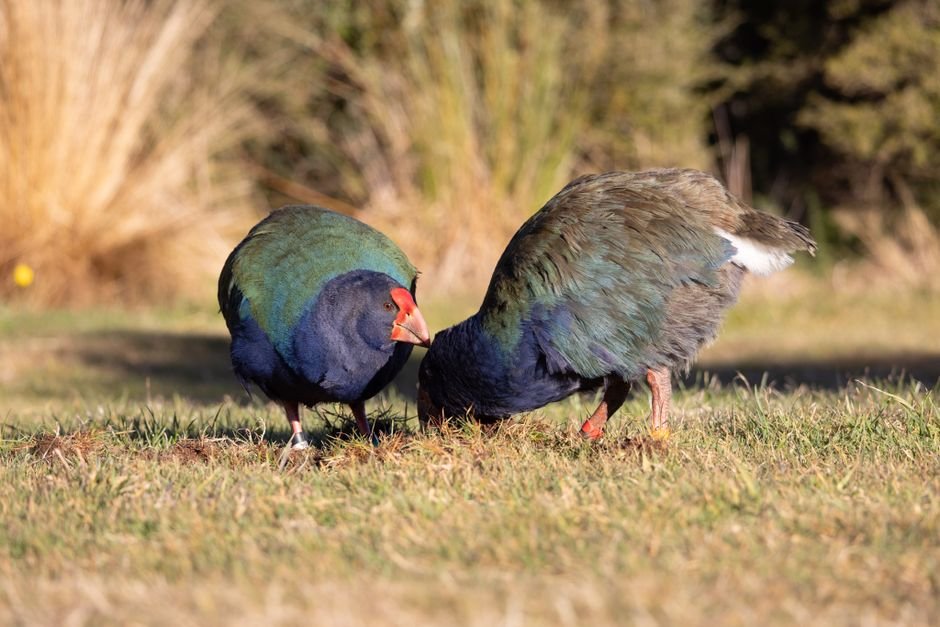
| Takahē | <500 | Flightless rail, purple-blue plumage |
| Kakī (black stilt) | <500 | Antibody levels dropped after 3 months in trial, requiring a tailored regime |
| Kākāriki karaka (orange-fronted parakeet) | <500 | Used as trial surrogate |
| Tchūriwat’/tūturuatu (shore plover) | <500 | Found on offshore islands |
The goal is to vaccinate approximately 300 core breeding birds across all five species, creating what DOC calls “insurance populations” large enough to rescue and revive each species if H5N1 hits hard.
The vaccine
The tool is a Zoetis inactivated H5N2 vaccine called Poulvac Flufend RG, originally developed for poultry. It contains killed low-pathogenicity virus and cannot cause the disease. Birds receive two doses one month apart. DOC is using an improved version of a formula trialed in 2024-2025, when approximately 10 birds per species received the two-dose regimen and maintained elevated antibodies for at least six months, with the exception of kakī, which required a different schedule.
The logistical challenges are formidable. Kākāpō cannot be bred in captivity and live on remote offshore islands accessible only by helicopter. Each bird wears a radio transmitter, but they are extremely well camouflaged and can climb 40-meter trees. Researchers may need to wait until the next day to catch a specific individual. Migrating seabirds (brown skuas, giant petrels) visit these islands in summer, and if an infected seabird enters a kākāpō burrow, the parrot defends itself with beak and talons, increasing its exposure risk.
“No efficacy challenge has been possible,” Dr. Kate McInnes, the senior science advisor and wildlife veterinarian leading the program, noted in the DOC’s planning documents. Because the species are too rare to risk exposing them to live virus, the program relies on blood antibody levels as a proxy for protection.
A global precedent
The vaccination plan was inspired by an earlier campaign: after 21 California condors died from H5N1 in 2023, the U.S. Fish and Wildlife Service vaccinated captive and free-flying birds. That effort directly informed McInnes’s approach.
New Zealand’s trial, which involved five species over a year, was the first of its kind globally. The 2024-2025 results are being prepared for scientific publication.
“If H5N1 reaches New Zealand,” McInnes said, DOC will consider vaccinating approximately 24 more bird species, including those on the Chatham Islands, 900 kilometers east of the mainland. The government’s Ministry for Primary Industries has approved the plan, and a team of DOC vets and specially trained staff are now administering the vaccine in a rolling campaign timed to avoid breeding season and ensure full immunity before spring.
The vaccination program will not reach every endangered bird. But for species with fewer than 500 individuals remaining, the margin for error is zero. A single H5N1 incursion onto a kākāpō island could erase decades of conservation work in weeks.
Sources
1. Science AAAS, “As flu virus threatens its unique bird species, New Zealand pins hopes on a vaccine” (7 July 2026). https://www.science.org/content/article/flu-virus-threatens-its-unique-bird-species-new-zealand-pins-hopes-vaccine
2. New Zealand Department of Conservation, “H5N1 vaccination plan for taonga species” (August 2025).