

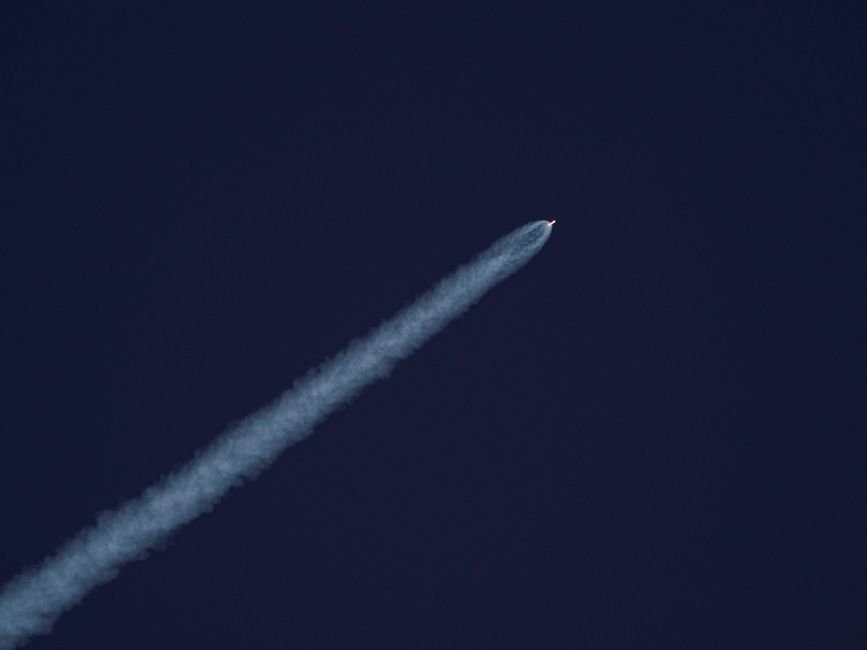
Somewhere over the North Atlantic west of Iceland on Wednesday, two people in pressurized suits will fly a 1960s-era NASA research jet into the path of the Moon’s shadow, throttle up to stay inside it, and buy themselves nearly three minutes of artificial night. The mission, flown from Keflavík airport with a crew of two in NASA’s WB-57 high-altitude aircraft, is chasing tomorrow’s total solar eclipse, the first to cross Europe since 1999, and with it, one of the oldest unsolved puzzles in solar physics: why the Sun’s outer atmosphere is hotter than the Sun.
The corona, the wispy white halo visible only when the Sun’s disk is fully blocked, reaches temperatures above one million degrees Celsius (1.8 million degrees Fahrenheit). The Sun’s visible surface is a comparatively cool 6,000°C (10,800°F). Something heats the corona to hundreds of times the temperature of the surface below it, and nobody has definitively proven what. The leading suspect is a population of tiny, frequent magnetic explosions called nanoflares, predicted in 1972 by astrophysicist Eugene Parker but never directly observed.
The window that lasts minutes
The eclipse’s path of totality sweeps across Russia, Greenland, Iceland, Spain and Portugal, and the Moon’s shadow moves faster than any aircraft can fly. On the ground at the path’s center, totality lasts at most about 2 minutes 18 seconds. The two NASA aviators, pilot Tom Parent and sensor equipment operator Cary Klemm, both from NASA’s Johnson Space Center in Houston, plan to do better.
Their route, described in NASA’s mission preview, takes them north from Keflavík toward Greenland before banking south on a gently curving course about 64 kilometers (40 miles) off Iceland’s west coast. The jet climbs to roughly 15,000 meters (50,000 feet), above about 90 percent of the atmosphere, and flies at about 740 km/h (460 mph) while the shadow races past at several thousand km/h (several thousand mph). By getting ahead of the shadow and letting it overtake them, then pushing the throttles to stay inside it, the crew extends their totality to nearly three minutes, about 25 percent longer than the maximum possible on the ground.
Why fly at all
Ground observers in Iceland face a more mundane obstacle than the shadow’s speed: clouds. The island sits under some of the most changeable weather in the North Atlantic, and a single cloud bank would erase the view. That altitude puts the WB-57 above most of the cloud cover and above nearly all of the water vapor, dust and turbulence that blur ground-based observations. The thin air also opens the infrared part of the spectrum, where the corona emits light that is largely absorbed at lower altitudes, measurements that have been captured only a handful of times in history.
The instrument mounted in the jet’s nose is called SAMI, the SCIFLI Multispectral Airborne Imager, built by the team at NASA’s Langley Research Center. It is a suite of four cameras imaging in visible and infrared wavelengths at 20 or more frames per second, aimed at the corona’s structure, its outflows, prominences, and the rapid changes that occur during the brief minutes of totality. The same cameras flew on the April 2024 eclipse; for 2026, engineers adjusted exposure times that overexposed bright features last time and sped up the data-processing software. Onboard storage lets the aircraft record terabytes of imagery, far more than a space telescope could downlink in the same window.
A tradition of airborne eclipse science
Flying into the shadow is nearly as old as aviation itself. The US Navy tried with a fleet of biplanes in 1923, with modest success. The most spectacular early attempt came in 1973, when a prototype Concorde chased the shadow over the Sahara at twice the speed of sound, staying in totality for about 74 minutes with roof windows cut into the fuselage at scientists’ request.
NASA’s modern version began with the 2017 total eclipse, when two WB-57 jets tag-teamed the shadow over Illinois, and continued in 2024 with the first flight of SAMI. This year is different in one respect: only a single WB-57 is available. The other two aircraft in NASA’s small fleet are in maintenance, making 2026 a one-jet mission. The longest airborne totality of the modern era still belongs to the flight crew that threads the shadow correctly.
The mission is led scientifically by Amir Caspi of the Southwest Research Institute, with program management from Kelly Korreck at NASA headquarters. Their goal is not just pretty pictures. Confirming nanoflares would resolve the coronal heating problem that has survived more than half a century of theorizing, and the corona’s behavior also governs the solar wind that bathes Earth’s space environment.
Weather, timing and the limits of totality
The mission carries inherent uncertainty. Iceland’s weather on Wednesday is the obvious risk: if the jet cannot reach the intercept point in clear air, the multi-year preparation ends with a data gap. And even at nearly three minutes, totality remains a short window for instruments capturing 20 frames per second. The corona’s fastest changes happen on timescales of seconds, so every fraction of a minute counts.
For the people who live with the eclipse, the airborne mission is a reminder that the event is also a scientific instrument. Reykjavík will see about a minute of totality; the jet will see three. In that handful of minutes, four cameras will try to answer a question that has outlasted every aircraft that has chased it.
Sources:
- The Guardian, “NASA mission total solar eclipse Iceland sun nanoflares” (Aug 9, 2026): https://www.theguardian.com/science/2026/aug/09/nasa-mission-total-solar-eclipse-iceland-sun-nanoflares
- NASA Science, “NASA Science Soars During August Total Solar Eclipse” (updated Jul 30, 2026): https://science.nasa.gov/science-research/heliophysics/nasa-science-soars-during-august-total-solar-eclipse/
- NASA SVS video and transcript (names the pilots): https://svs.gsfc.nasa.gov/15065
- Forbes, “Why NASA Is About to Fly Into Iceland’s Total Solar Eclipse” (Aug 1, 2026): https://www.forbes.com/sites/jamiecartereurope/2026/08/01/why-nasa-is-about-to-fly-into-icelands-total-solar-eclipse/
- The Aviationist, “NASA WB-57 Heads to Iceland” (Aug 10, 2026): https://theaviationist.com/2026/08/10/nasa-wb-57-heads-to-iceland/
- Iceland Review (Aug 10, 2026): https://www.icelandreview.com/news/nature-travel/nasa-iceland-total-eclipse-flight/