

NASA’s bold proposal to send a fleet of three next-generation helicopters to Mars aboard a nuclear-powered spacecraft has planetary scientists deeply divided: the technology is tantalizing, but the lack of cost transparency and the risk of cannibalizing funding for other Mars missions has fueled a roiling controversy within the science community.
Unveiled in March 2026, SkyFall would pack three identical helicopters into a capsule aboard Space Reactor-1 Freedom, NASA’s first nuclear fission-powered interplanetary spacecraft, targeting launch in late 2028. Once at Mars, the helicopters would deploy in a novel mid-air maneuver — a NASA first — before fanning out to scout terrain, map subsurface ice, and monitor dust activity across the Martian surface.
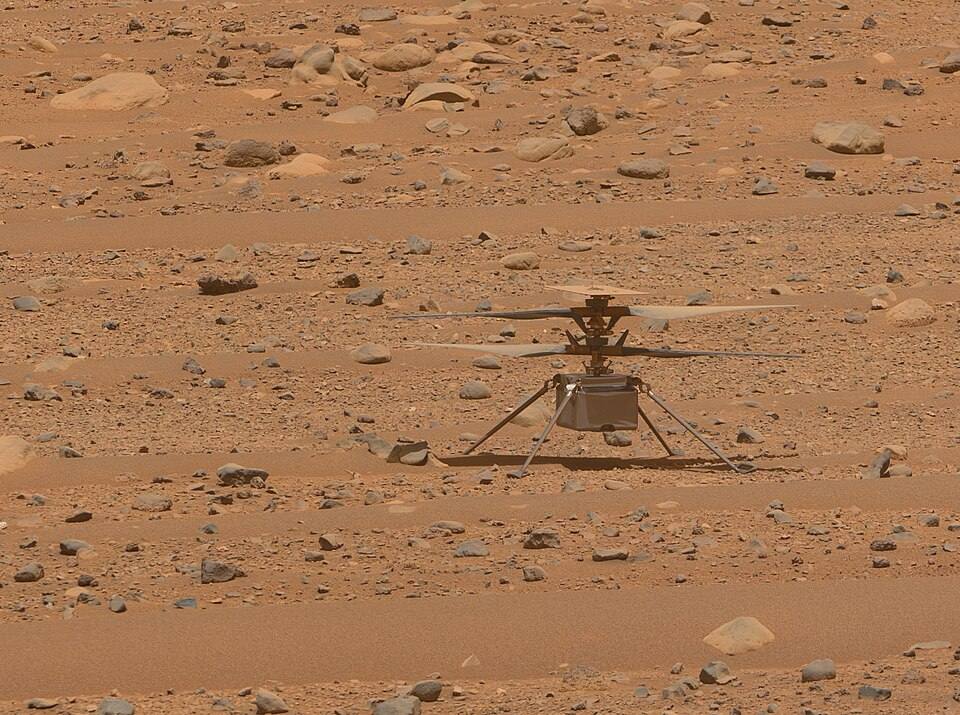
The helicopters themselves are a significant upgrade from Ingenuity, the trailblazing rotorcraft that completed 72 flights over almost three years before its final flight in January 2024. Where Ingenuity weighed just 1.8 kilograms (4 pounds) and carried only a basic navigation camera, SkyFall’s aircraft are larger, carry a science-grade camera, basic weather instruments, and ground-penetrating radar, and offer substantially more lift capacity for extended flights. NASA’s Ames Research Center has already pushed SkyFall rotor blades past Mach 1 in ground tests, demonstrating the aerodynamic performance needed for heavier payloads.
But for many planetary scientists, the question is not whether SkyFall can fly — it is what gets grounded to pay for it.
No Price Tag, Deep Unease
NASA has not released an official cost estimate for SkyFall. The agency says “cost estimates are currently in development,” and no relevant budget documents have been published. That silence is alarming to researchers who recall how the Mars Sample Return (MSR) program ballooned from an initial estimate of $4 billion to $5 billion to between $8 billion and $11 billion before Congress effectively cancelled it in January 2026.
The White House’s fiscal year 2027 budget request allocates just $110 million for the “future missions” line within NASA’s Mars Exploration Program, out of $248 million total for Mars research. SkyFall’s upfront costs, one scientist warned, could “eat the entire Mars Exploration Program budget for the foreseeable future.”
“It’s a lot of money up front,” said Vicky Hamilton, a planetary scientist at the Southwest Research Institute who co-authored a memo from the Mars Exploration Program Analysis Group (MEPAG) warning of the mission’s budgetary impact. “The chances are quite high that more than one currently operating mission at Mars will be terminated and their funds redirected to supporting SkyFall.”
Hamilton also expressed doubt about the mission’s scientific pedigree. “SkyFall is a demonstration mission; it’s not really a science mission,” she told Scientific American. “It’ll do some science, but it’s not what we’d intended.”
Aging Fleet, Frozen Priorities
The concern is sharpened by the precarious state of NASA’s existing Mars infrastructure. The agency’s Red Planet fleet is showing its age. Mars Odyssey arrived in 2001, the Mars Reconnaissance Orbiter in 2006, Curiosity in 2012, and Perseverance in 2021. MAVEN, the Mars orbiter that studied the upper atmosphere, lost contact with Earth in December 2025. No major new science missions are currently in the pipeline.
Mars Sample Return is effectively dead after Congress declined to fund it, leaving the samples that Perseverance has carefully collected and cached on the Martian surface with no ride home. A proposed orbiter for European Space Agency’s Rosalind Franklin rover, a concept for a Mars Telecommunications Network, and a public-private weather payload targeting 2028 are the only reinforcements on the horizon — none of them flagship science missions.
Phil Christensen, a planetary scientist at Arizona State University, summed up the dilemma. “We’re in this tough spot of, when someone offers you something, it’s hard to say, ‘No thank you, I don’t want it,'” he told Scientific American. “You say, ‘Sure, we can do great science with that.'”
But his deeper fear is that SkyFall could become a decadal bottleneck. “I hope SkyFall doesn’t become ‘Well, okay, that’s your Mars mission for the decade’ — that would be too bad.”
Transparency Concerns
The planetary science community has also taken issue with how SkyFall has been advanced. Jack Kiraly, director of government relations at The Planetary Society, described the process as opaque. “This has been a very opaque process,” he said.
NASA has offered few details about how SkyFall would be funded within the Science Mission Directorate’s planetary science budget. The House draft appropriations bill includes supportive language for SkyFall, but final funding is pending as the fiscal year begins October 1.
The Ingenuity Shadow
SkyFall’s bold pitch inevitably invites comparison to Ingenuity, which captured global attention as the first powered aircraft to fly on another world. Designed for just five flights over 30 days, Ingenuity flew 72 times over nearly three years, logging about 17 kilometers (10.5 miles) and proving that rotorcraft could scout terrain ahead of rovers and reach areas inaccessible to wheeled vehicles.
SkyFall’s advocates argue that the fleet model scales that success. Three helicopters operating simultaneously could cover vastly more ground, identify potential landing sites for future human missions, and search for subsurface water — a critical resource for any long-term presence on Mars. The nuclear-powered carrier spacecraft itself is a technology demonstration with implications for deep-space propulsion.
But the scale of investment required, compounded by the MSR collapse, has left many wondering whether NASA is building the future on a foundation of cancelled priorities.
What Comes Next
Congress will determine SkyFall’s fate in the coming appropriations cycle. If funded, the mission would mark a dramatic departure from the rover-and-orbiter model that has defined Mars exploration for two decades. If it falters — or if its costs prove as elastic as MSR’s — the damage to Mars science could take a generation to repair.
For now, the community watches and waits. As Christensen put it: “When someone offers you something, it’s hard to say no.” But the silence from NASA on the price tag is making a lot of scientists wish they had a number to argue about.