

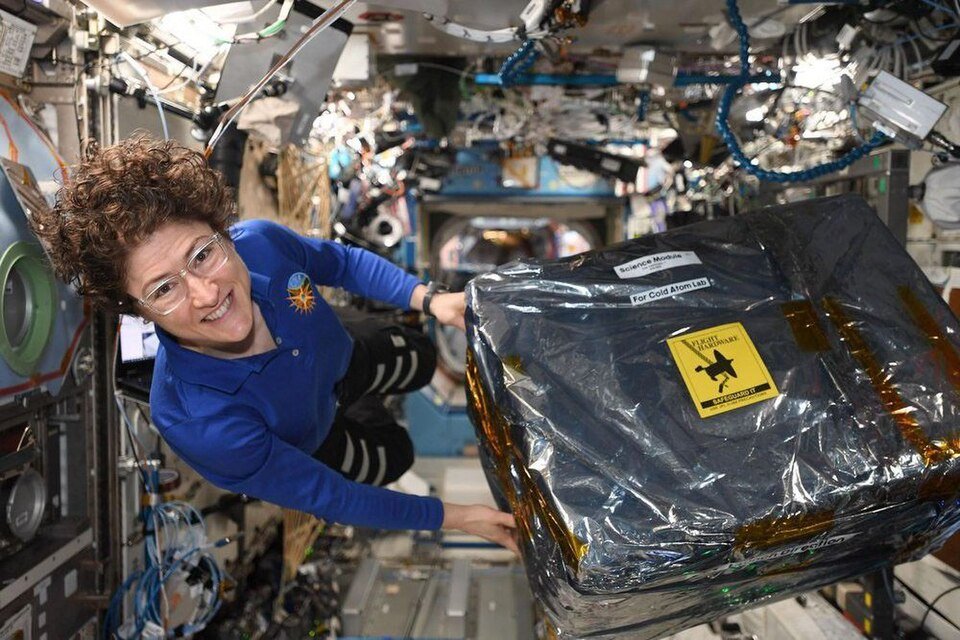
A refrigerator-sized physics facility aboard the International Space Station has quietly been producing some of the coldest matter in the universe for over five years. NASA’s Cold Atom Lab, operated remotely from the Jet Propulsion Laboratory in California, uses lasers and magnetic fields to cool clouds of rubidium and potassium atoms to within a few billionths of a degree above absolute zero, forming Bose-Einstein condensates, a fifth state of matter where thousands of atoms lose their individual identity and behave as a single macroscopic quantum wave.
On Earth, gravity limits how long these fragile quantum states can be observed, typically a fraction of a second before the atoms fall. In microgravity, BECs can be held and studied for much longer, enabling experiments that are fundamentally impossible on the ground.
What the lab can do that Earth labs cannot
In microgravity, the Cold Atom Lab has already achieved several milestones that have no terrestrial equivalent. It created hollow spherical shells of ultracold atoms, which collapse under gravity on Earth. It produced quantum gas mixtures of different atomic species, and achieved temperatures as low as 52 picokelvin using delta-kick cooling.
The facility has executed over 100,000 experiments since its 2018 launch, traveling more than 800 million miles aboard the station.
Its core capability is atom interferometry: using the wave nature of atoms as ultra-precise sensors for acceleration, rotation, and gravity. In space, atom interferometers can operate with dramatically longer interrogation times than on Earth, potentially enabling tests of Einstein’s equivalence principle at the quantum scale, searches for dark matter and dark energy, and gravitational mapping of Earth and other planetary bodies.
The April 2026 upgrade
The fourth major upgrade to the facility, called Science Module 3X, launched on April 11, 2026 aboard a Northrop Grumman Cygnus resupply mission. Astronaut Jessica Meir installed the module on May 8, and the lab was back online by mid-June.
The upgrade includes a redesigned magnetic trap that can produce variable-shaped “mesoscale” quantum gas clouds, enabling experiments that were impossible with the previous fixed-geometry trap. The atom source strips have also been redesigned for more reliable production of rubidium and potassium gas clouds. The physics package was built by Infleqtion, the quantum technology company formerly known as ColdQuanta.
The new module can produce BECs up to five times larger than previous versions and enables simultaneous dual-species quantum gases for atom interferometry experiments.
Five teams, five Nobel laureates
The original flight research teams were selected by NASA in 2013 and include three Nobel laureates among their ranks. Nicholas Bigelow at the University of Rochester leads a consortium studying quantum gas mixtures. Nathan Lundblad at Bates College is using the microgravity environment to study ultracold atomic bubble geometries. Eric Cornell at JILA, who shared the 2001 Nobel Prize for the first experimental BEC, is studying few-body and many-body quantum physics. Cass Sackett at the University of Virginia is developing atom interferometry protocols. Jason Williams at JPL is investigating fundamental interactions for quantum sensing.
The long view
The Cold Atom Lab is a proving ground for technologies that could eventually enable quantum sensors operating from orbit. Atom interferometers in space could map groundwater aquifers, detect subsurface magma chambers, measure changes in polar ice mass, and test fundamental physics at unprecedented precision.
The science team is actively working toward demonstrations that the techniques developed on the ISS could be adapted for free-flying spacecraft, opening the door to quantum sensing of Earth and other planets from orbit.
Source: NASA Jet Propulsion Laboratory. Science Module 3X upgrade to the Cold Atom Laboratory on the International Space Station (June 2026).