

Quizzing Melds Similar Memories, a Nap Holds the Line: EEG Dissects Two Kinds of Consolidation
For years, memory scientists have leaned on a tidy equivalence: actively testing yourself on learned material and sleeping are two routes to the same destination, both consolidating memories faster and more durably than passive review. A new study that watched memory representations change in real time, using EEG phase patterns recorded across the two processes, suggests the tidy equivalence is wrong. Over the same two hours, retrieval practice caused the brain’s representations of similar objects to converge into each other, while a nap left those representations largely untouched, preserving their distinctness.
The experiment
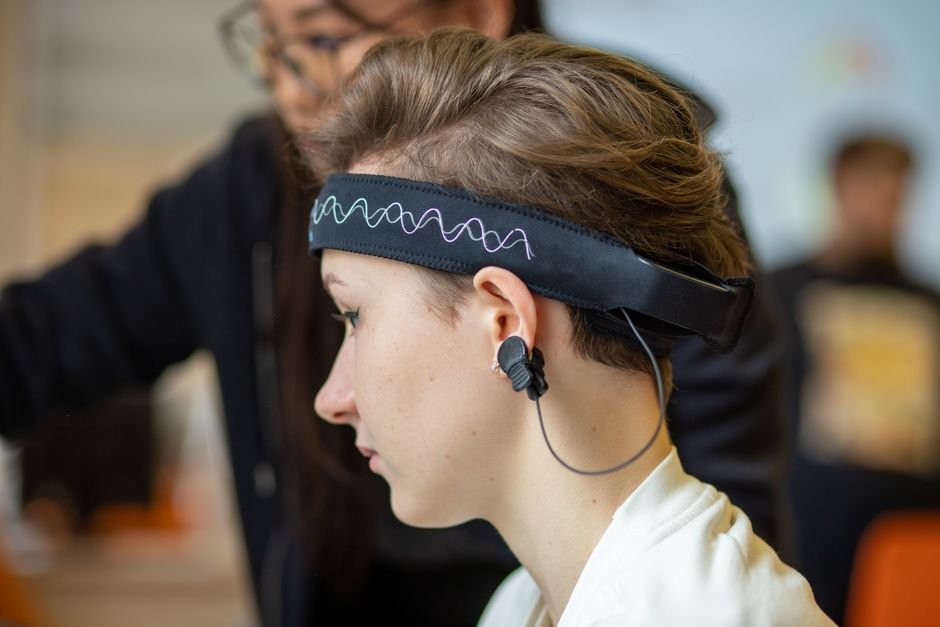
Researchers at the University of Adelaide, the University of Glasgow, and New York University recruited 30 young adults, aged 18 to 34, and had each complete four separate 4.5-hour sessions. In every session, participants learned 104 object-word pairs, took an immediate recognition test, then spent 120 minutes in one of four conditions: retrieval training (rounds of cued recall with feedback), restudy of the same pairs, a monitored nap opportunity, or supervised wakefulness. A delayed recognition test followed. The objects came from the Mnemonic Similarity Task, a stimulus set built around pairs of images that look alike, so the test could measure whether similar memories drifted together or stayed apart. EEG was recorded across all phases except wakefulness.
The neural measure was phase similarity: whether the timing of oscillatory activity evoked by one object became more aligned with the activity evoked by its look-alike, relative to unrelated objects. Convergence between similar objects, called representational merging, is the EEG signature of memories being integrated rather than kept separate.
What they found
Behaviorally, retrieval training produced the best delayed recognition accuracy, followed by restudy, then sleep, then wake. But the pattern of errors told a more interesting story. Retrieval training uniquely boosted identification of original pairs while improving discrimination of similar look-alike lures significantly less, the classic signature of rapid gist extraction: the memory gets the gist of an item at the expense of its specific details. Wakefulness, by contrast, degraded the ability to tell similar lures apart more than any other condition, the signature of episodic decay.
The EEG results sharpened the picture. Across the encoding shift, from learning to immediate recognition, similar objects already showed converging phase patterns in the theta band, in a late 400-700 ms window, with sources in occipital cortex (p = .002). During the intervention shift, from immediate to delayed recognition, only retrieval training produced additional representational merging, in the alpha band over left parieto-occipital regions (p = .005). Restudy (p = .964), sleep (p = .545), and wakefulness (p = .888) showed no significant convergence.
The most counterintuitive result came last. One might expect that blending similar memories together would make them harder to tell apart. At the level of individual items, the opposite happened: the more an item’s representation merged across retrieval training, the more likely participants were to correctly reject its similar lure (odds ratio 1.03; a 3.49 percent increase in the chance of a correct rejection per unit of merging; 82.2 percent of items correctly classified). Control models ruled out a generic link between merging and overall accuracy. Merging, the authors argue, may reflect the brain organizing similar traces into shared neocortical networks in a way that preserves the information needed to discriminate them.
Why it matters
The finding challenges the assumption that retrieval practice is simply “sleep-like” consolidation executed faster. On identical timescales, the two processes left different traces: retrieval training drove rapid gist extraction and neocortical integration, while sleep selectively maintained both episodic and semantic details relevant to the task. The authors note that sleep-based consolidation is often task-specific and sometimes needs more time, whereas retrieval-mediated effects appear rapid and robust across tasks.
There is also a practical edge. If quizzing and napping reorganize memories differently, then study strategies and clinical interventions that rely on one cannot automatically assume the benefits of the other. For the memory field, the result is a reminder that representational merging is not inherently a loss of information; it can coexist with, and even support, finer discrimination.
Limits
The sample was predominantly female (27 of 30), the nap opportunity was a single two-hour window, and scalp EEG constrains how precisely sources can be localized. Sleep effects on representational similarity have been mixed across paradigms, so the absence of merging after one nap does not prove sleep never merges memories. The authors also note that item-specific reactivation during consolidation was not directly measured, leaving open how individual memories are selected for integration.
Bottom line
Sleep and retrieval practice are not interchangeable consolidation machines. On the same clock, one blends similar memories together while the other keeps them apart, and the difference matters for how memory research is designed and how study advice is given.
Source
Caldwell HB, Chatburn A, Lushington K, Hanslmayr S, Michelmann S. Phase similarity between similar objects indicates representational merging across retrieval training but not sleep. Imaging Neuroscience. 2026;4:IMAG.a.1321. doi: 10.1162/IMAG.a.1321. PMID: 42549201.