

Scientists discover mystery molecule on Pluto and Saturn’s moon Titan: ‘We cannot say what it is’
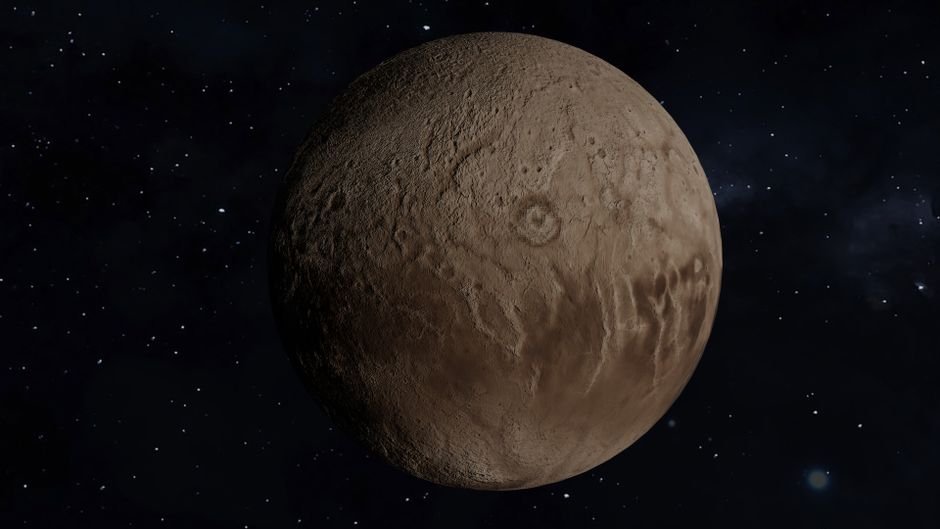
The James Webb Space Telescope (JWST) has detected an identical, unexplained chemical signature on two distinctly different worlds, Saturn’s smoggy moon Titan and the dwarf planet Pluto, and scientists cannot yet identify what is causing it.
“It’s rather mysterious,” said Bruno Bezard of the Paris Observatory, lead author of the study accepted for publication in Astronomy & Astrophysics. “We cannot say what it is.”
A shared fingerprint
The mystery began when Bezard spotted an unusual signal in Titan observations from November 2022, taken with Webb’s NIRSpec and MIRI instruments. The feature appeared at the 5-micron wavelength in the infrared range, a region where simple ices and known compounds do not produce such a signal. Two different instruments confirmed the feature was real, not a hardware artifact.
Bezard contacted his colleague Emmanuel Lellouch to check whether Pluto, which shares a similar nitrogen-methane atmosphere, showed anything comparable in observations from May 2023. It did, the exact same signature appeared on the dwarf planet, billions of kilometers away.
The crucial control came from Ganymede, Jupiter’s largest moon, which lacks a nitrogen-methane atmosphere. It showed no such signal, confirming the compound is linked to atmospheric chemistry rather than being a universal surface feature.
Not a biosignature, but something new
The researchers emphasize that the mystery molecule is not a sign of life. Instead, it likely forms through prebiotic photochemistry, ultraviolet sunlight breaking apart molecular nitrogen (N2) and methane (CH4) in the upper atmospheres of both worlds. The reactive fragments reassemble into complex organic compounds that eventually condense and “snow” down onto the surface.
Allenes, a family of hydrocarbons, are currently the leading candidate. These compounds have strong absorption bands in the 5-micron range where the mystery signal appears. However, only the simplest allenes have fully cataloged spectra. It is possible that a more complex variant, or a mixture of several allene-like compounds, produces the observed feature.
Alternatively, the signal could come from a known molecule whose spectral fingerprint has shifted due to interactions with other ices that have not yet been fully characterized in laboratory settings.
How do we know it is on the surface?
Several lines of evidence point to a surface origin rather than an atmospheric one. A disk scan of Titan showed the signal weakening from the center toward the limb, the pattern expected for a surface source. For Pluto, the atmosphere is too thin to produce the observed absorption depth, making the surface the only plausible location.
Ganymede’s absence of the signal reinforces the mechanism: the compound requires a nitrogen-methane atmosphere to form, then settles onto the surface where it accumulates.
What comes next
New JWST observations are already being analyzed. By mapping the signature across Titan’s surface as it rotates, researchers hope to link the mystery molecule to specific geological features, perhaps the organic-rich dune fields that cover large portions of the moon.
The ultimate answer may come from NASA’s Dragonfly mission, a car-sized rotorcraft set to launch in 2028 and arrive at Titan in the mid-2030s. Dragonfly will carry a mass spectrometer capable of “tasting” organic molecules on Titan’s surface, potentially identifying the exact compound or compounds responsible for Webb’s puzzling observation.
“It’s always exciting when you discover something that was not seen before,” Bezard said. “It’s really the nicest part of our job.”
The study is available as a preprint on arXiv.