

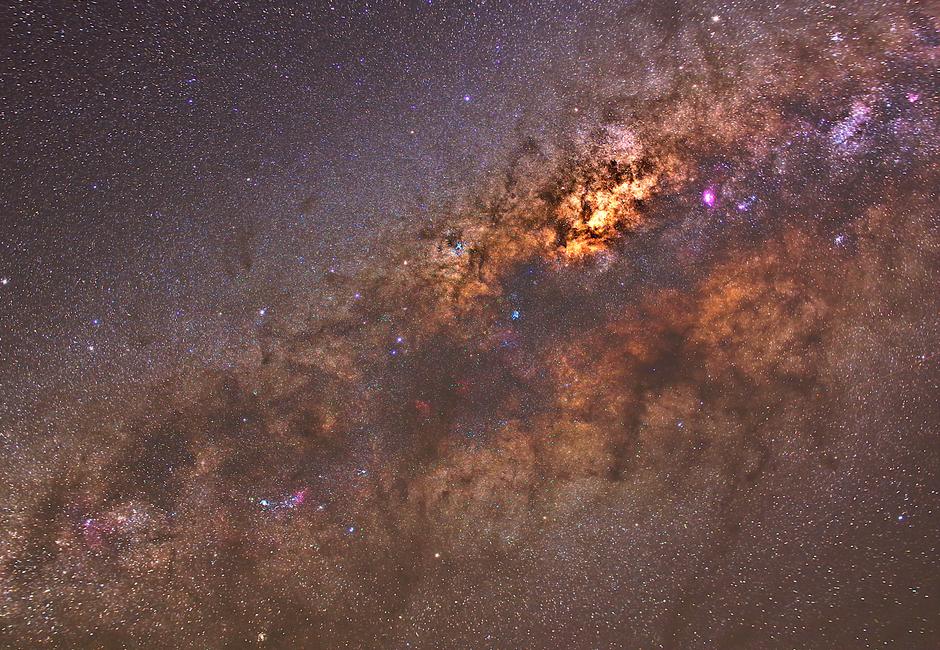
The Milky Way just got a little bigger. New measurements from NASA’s Chandra X-ray Observatory and ESA’s XMM-Newton show that our galaxy’s outer spiral arms may extend roughly 10% farther from the galactic center than previously thought, a finding that could force astronomers to revise the estimated mass and structure of our home galaxy.
The discovery, published June 19, 2026, in the journal Astronomy & Astrophysics, comes from a team led by Beatrice Vaia, a PhD student in a joint program between Scuola Universitaria Superiore IUSS Pavia and the University of Trento in Italy. The researchers used a clever geometric technique, measuring X-ray “light echoes” from three powerful gamma-ray bursts (GRBs) that occurred far beyond the Milky Way.
When a gamma-ray burst erupts — the most energetic type of explosion in the universe, triggered by collapsing massive stars or merging neutron stars — it sends out a flash of X-ray light. Some of that light travels across the cosmos and scatters off dust clouds in the Milky Way’s spiral arms, creating expanding rings of X-rays that can be detected by space observatories. The diameter of each ring reveals the distance to the dust cloud: larger rings come from clouds closer to Earth.
“This is a very direct way, relying only on geometry, to precisely measure distances to the Milky Way’s spiral arms,” Vaia said in a NASA statement. “Most other methods rely on assumptions about how the Milky Way rotates, which become increasingly uncertain in the outer regions of our galaxy.”
The team measured three spiral arms along the line of sight of one gamma-ray burst: the Perseus arm, the Outer arm and the Outer Scutum-Centaurus arm. They found that the two outermost arms are about 10% more distant than earlier models suggested. For example, the Outer Scutum-Centaurus arm was previously estimated at 19,000 parsecs (62,000 light-years) from Earth. The new data places it at roughly 20,900 parsecs (68,200 light-years) away.
The measurement also revealed that the dust cloud in the most distant arm spans about 1,073 parsecs (3,500 light-years) across, confirming that the technique captures the full thickness of the spiral arm rather than an isolated clump of material.
“The differences are small, but any revision of these distances is important because they are so fundamental for understanding our galaxy,” said co-author Ilaria Fornasiero, also a PhD student in the same program. “For example, this could mean that astronomers have to revise estimates of the mass of the galaxy, because that affects how wide the arms stretch.”
If the arms extend farther, the total mass of the Milky Way may be larger than currently estimated. That would ripple through models of galactic rotation, the distribution of dark matter, and theories of how the Milky Way formed and evolved over billions of years.
The technique is not without limitations. Bright gamma-ray bursts that shine through the dense dust and gas of the galactic plane are extraordinarily rare. Over 25 years of observations, the team has found only a handful of usable events.
“We’re relying on the universe to provide us with these events, and so far, over 25 years, we’ve only found a handful that we can use,” said co-author Andrea Tiengo of Scuola Universitaria Superiore IUSS Pavia. The team plans to continue searching for more gamma-ray bursts to refine their measurements of additional spiral arms.
Despite the small sample size, the results represent one of the most precise distance measurements ever made to the outer regions of the Milky Way. Previous estimates of the Outer Scutum-Centaurus arm were accurate to only about 10%. The new technique improved that to roughly 1%.
For astronomers trying to map the Milky Way from inside it — an exercise often compared to trying to map a forest while standing among the trees — every improvement matters. The updated picture of our galaxy shows its outer arms more loosely spiraled, with more open space between them, painting a subtly different portrait of the cosmic neighborhood we call home.