

The idea of a plastic that disappears when you want it to has obvious appeal in a world producing more than 400 million tonnes of plastic waste per year, much of it persisting for centuries. A team of researchers from the Shenzhen Institutes of Advanced Technology (SIAT), Chinese Academy of Sciences, and the Harbin Institute of Technology has demonstrated a proof of concept that brings that vision closer: a “living plastic” film embedded with engineered bacterial spores that, when triggered, germinate and cooperatively degrade the material to completion within six days.
Published on April 9, 2026, in ACS Applied Polymer Materials (DOI: 10.1021/acsapm.5c04611), the work led by corresponding authors Zhuojun Dai (SIAT), Dianpeng Qi (Harbin Institute of Technology), and Jin Geng represents a significant refinement of an approach first reported by the same group in Nature Chemical Biology in 2024.
How two microbes, working together, eat a plastic
The plastic in question is polycaprolactone (PCL) — a biodegradable polyester already used in 3D printing filament and dissolvable surgical sutures. PCL is among the more enzyme-susceptible plastics, which makes it a logical starting point, though it constitutes only a small fraction of global plastic waste.
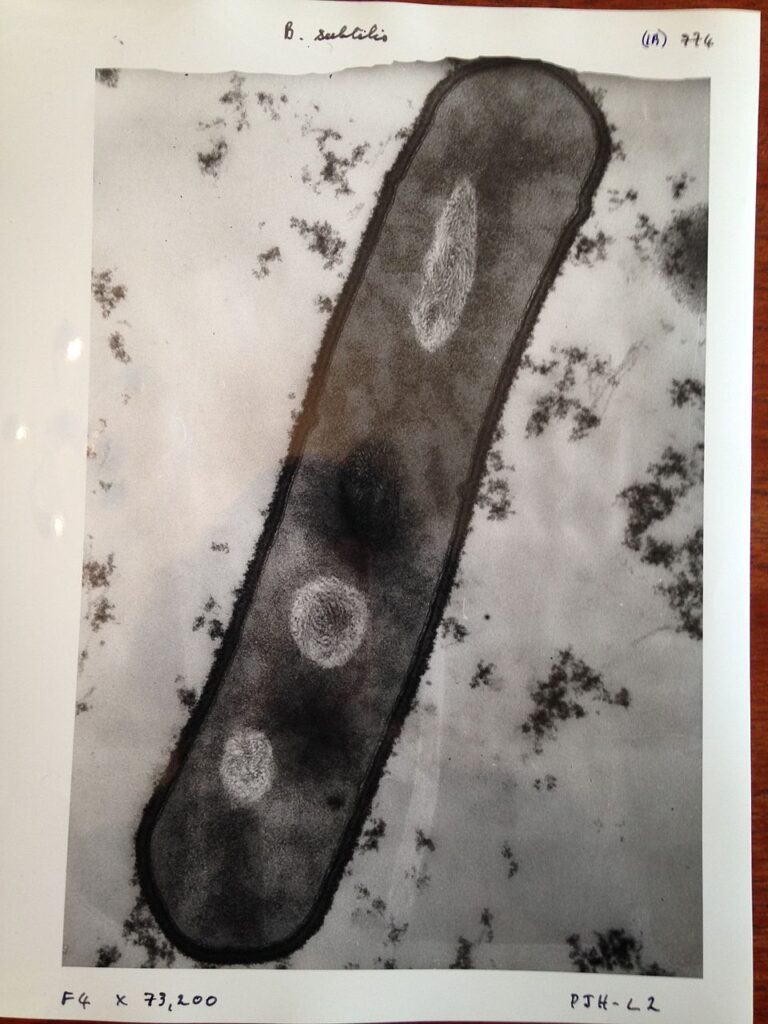
The innovation lies in how the team approached degradation. Rather than embedding a single microbe, they engineered two separate strains of the non-pathogenic soil bacterium Bacillus subtilis, each equipped with an inducible gene circuit that produces a different enzyme:
- Strain A secretes Candida antarctica lipase B (CALB), an endo-acting enzyme that snips polymer chains at random internal points. This generates many new chain ends throughout the material — a scattershot approach that “unlocks” the solid plastic matrix.
- Strain B secretes Burkholderia cepacia lipase (BC-lipase), a processive enzyme that latches onto exposed chain ends and ratchets along the polymer, cleaving off monomers one by one.
Solid PCL is semicrystalline — most chain ends are buried inside the material, inaccessible to a processive enzyme acting alone. The random-scission enzyme solved that problem by creating new accessible ends, which the processive enzyme then chewed to completion. The two-strain consortium degraded PCL films fully within six days, compared with limited degradation using either enzyme alone.
Gel permeation chromatography and liquid chromatography–mass spectrometry confirmed the disappearance of polymer peaks and the appearance of small molecules under 500 daltons — monomers and short oligomers. No microplastic fragments accumulated.
Spores that survive plastic processing
The production method is as notable as the degradation mechanism. The team dissolved both spore populations into a toluene solution of PCL pellets and cast the mixture into films. Bacillus subtilis spores proved remarkably resilient: they survived a 24-hour toluene soak and brief exposure to 100°C heat without losing viability — conditions that would kill vegetative bacteria. The living PCL films had tensile strength and melting temperature comparable to ordinary PCL films, meaning the spores did not compromise the material’s structural performance during normal use.
The trigger: heat and nutrients
Degradation requires two conditions to be met simultaneously:
1. Temperature of approximately 50°C (122°F), which softens the PCL matrix and releases the spores from the polymer
2. Liquid nutrient broth containing a sugar inducer, which triggers germination and activates the enzyme gene circuits
The dual-condition requirement means accidental degradation during normal use is unlikely — a plastic cup sitting on a shelf at room temperature will not spontaneously disintegrate, nor will one exposed to water alone. The system must be both heated and fed.
The team demonstrated a practical proof of concept: a living PCL-based wearable EMG electrode with copper circuitry that performed comparably to conventional polyimide electrodes, even after one month of storage. After 12 days in the trigger conditions, the plastic had fully degraded, and the copper traces were recoverable — a potential e-waste recycling benefit.
Important limitations
The system’s novelty should be weighed against its limitations, several of which the authors acknowledge directly.
Polymer scope. PCL is among the most easily degraded polyesters. Extending this approach to polyethylene (plastic bags, bottles), polypropylene (packaging, textiles), or PET (beverage bottles) — which together account for the vast majority of plastic waste — would require entirely different enzymes and degradation pathways. The paper does not demonstrate degradation of any plastic beyond PCL.
Impractical real-world trigger. The requirements of 50°C heat plus liquid nutrient broth make the current system unsuited to the settings where most plastic pollution accumulates — oceans, rivers, and landfills. The team explicitly states that developing a water-based, ambient-temperature trigger is necessary before this could address environmental plastic pollution.
Lab scale only. The films were cast in laboratory conditions. Industrial-scale manufacturing methods such as injection molding or extrusion have not yet been tested with living spores embedded.
No ecotoxicity data. While the degradation products are small molecules under 500 daltons, the paper does not report ecotoxicity assays on the end products.
The sober bottom line
What the team has demonstrated is a clever and principled advance in engineered living materials. The two-strain consortium strategy — inspired by natural microbial communities that divide labour in decomposition — solves a real biochemical problem (semicrystalline polymer resistance to single-enzyme attack). The spore resilience to organic solvents and heat is an elegant engineering solution to the challenge of incorporating living organisms into industrial materials.
But a biodegradable PCL film that degrades in six days under lab conditions, while a useful research platform, is not yet a solution to the global plastic waste crisis. The important next steps — extending the approach to commodity plastics, developing triggers that work at ambient temperature in water, scaling manufacturing, and assessing environmental safety — are all unsolved.
The living plastic works. The harder part — making it work where it matters — remains ahead.
Sources:
- Tang C, Sun J, Wang Q et al. “Degradable Living Plastics Programmed by Engineered Microbial Consortia.” ACS Applied Polymer Materials, April 9, 2026. DOI: 10.1021/acsapm.5c04611
- Dai Z, Qi D et al. “Living plastic degradation by engineered Bacillus subtilis.” Nature Chemical Biology, 2024. DOI: 10.1038/s41589-024-01713-2 (precursor study)