

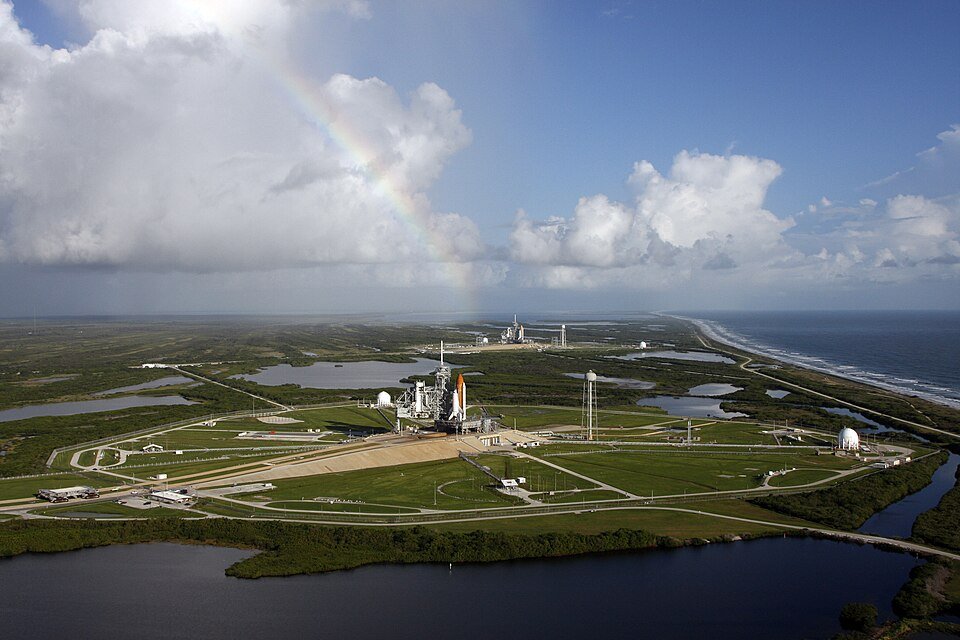
NASA’s Kennedy Space Center, long considered the crown jewel of American spaceports, is facing a quiet but accelerating crisis: its 1960s-era infrastructure is buckling under the weight of commercial super heavy rocket operations, and the agency lacks the funding to keep up.
A new report from NASA’s Office of Inspector General (IG-26-010) paints a stark picture of facilities built for the Apollo and Space Shuttle eras struggling to support the planned launch surge from SpaceX’s Starship and Blue Origin’s New Glenn. The report warns that by late 2028 or 2029, the number of annual launches and static fire tests could exceed the number of days in a year.
“This is a success already, just from the fact that we’re even going to try this,” the report states in its opening, borrowing a NASA official’s assessment — before detailing a litany of structural deficiencies that threaten to derail that success.
Gaseous nitrogen shortages create scheduling gridlock
The most immediate bottleneck is KSC’s gaseous nitrogen (GN2) pipeline system. The report found that the existing infrastructure cannot support simultaneous launches of Blue Origin’s New Glenn at Space Launch Complex 36 and United Launch Alliance’s Vulcan Centaur at Space Launch Complex 41. Blue Origin officials told the OIG that this created “a major scheduling challenge” during New Glenn’s maiden flight preparations in January 2025.
The problem extends to NASA’s own Space Launch System. During future SLS launches from LC-39B, the report warns there could be one- to two-month blackout periods during which no other vehicle can launch from the affected pads due to GN2 unavailability. A $25 million fix has been identified but remains unfunded.
Power grid from the 1960s
Kennedy’s electrical distribution system dates to the Apollo program. Components such as duct banks and transformers, now six decades old, are at risk of catastrophic failure. If a feeder or transformer fails, the report warns it could cause month-long launch delays across the center.
NASA has a $136 million project to replace the aging duct banks and transformers, but work will not begin until late fiscal year 2026 at the earliest. SpaceX has already deployed Tesla Megapacks providing 3.9 megawatts each as a stopgap measure to cover power shortages at LC-39A.
Overall, deferred maintenance across NASA stands at $4.7 billion agency-wide, with approximately $1 billion of that concentrated at Kennedy Space Center alone. The agency’s facility renewal rate is once every 260 years — far short of its target of once every 66 years.
Traffic jams on Apollo-era roads
The infrastructure challenge is not limited to launch pads. Some 231 miles of paved roads at KSC date to the 1960s and are rated in “marginal to poor condition.” The Banana River Bridge, also built in the 1960s, has exceeded its design life.
Starship operations alone are expected to generate roughly 19,000 additional heavy truck trips per year as SpaceX moves propellant tanks, vehicle stages, and support equipment across the center. The OIG recommended that Kennedy conduct a study on heavy vehicle traffic impacts on roadways and establish a mitigation plan.
Demand projections outpace supply
The report’s demand projections highlight how quickly the situation is deteriorating. SpaceX told NASA it plans to launch Starship every eight days from LC-39A for propellant depot operations, with an overall target of 120 annual Starship launches from all Florida pads by 2035. Blue Origin projects a similar 120 annual New Glenn launches by the same year.
Kennedy’s launch cadence has already climbed from 31 launches in 2020 to 109 in 2025 — a 252 percent increase. The OIG projects 268 annual launches by 2030. Wallops Flight Facility in Virginia has seen an even steeper climb, from 3 launches in 2020 to 17 in 2025, a 467 percent increase, but does not face the same super-heavy-lift infrastructure constraints.
Blue Origin has expressed interest in building a third New Glenn pad north of NASA’s existing launch complexes, but the potential site is a protected wetland that would require lengthy federal and local environmental reviews. Space for additional super-heavy-lift pads at Kennedy is extremely limited.
Budget shortfalls compound physical decay
Since 2021, NASA’s construction and maintenance budgets have declined between 11 percent and 47 percent in inflation-adjusted terms. The center received $250 million from the H.R. 1 reconciliation bill, but KSC officials estimate at least $1 billion is needed for a comprehensive upgrade.
Existing laws further complicate the situation by making it difficult for NASA to accept commercial contributions for shared infrastructure. The OIG recommended that Kennedy analyze whether additional indirect rates should be charged to commercial partners using NASA’s facilities.
As Ars Technica senior space editor Eric Berger summarized the report’s bottom line: “NASA’s launch facilities are aging and increasingly under high stress due to commercial activity. Those commercial launch activities, in terms of the largest and most impactful rockets, are only at the beginning of what is likely to be an exponential growth curve.”
The OIG made three formal recommendations to the Kennedy Space Center director: conduct a study on heavy vehicle traffic impacts and establish a mitigation plan, prioritize funding for common-use launch infrastructure (power, gas, transport), and analyze whether additional indirect rates should be charged to commercial partners. NASA concurred with all three recommendations.