

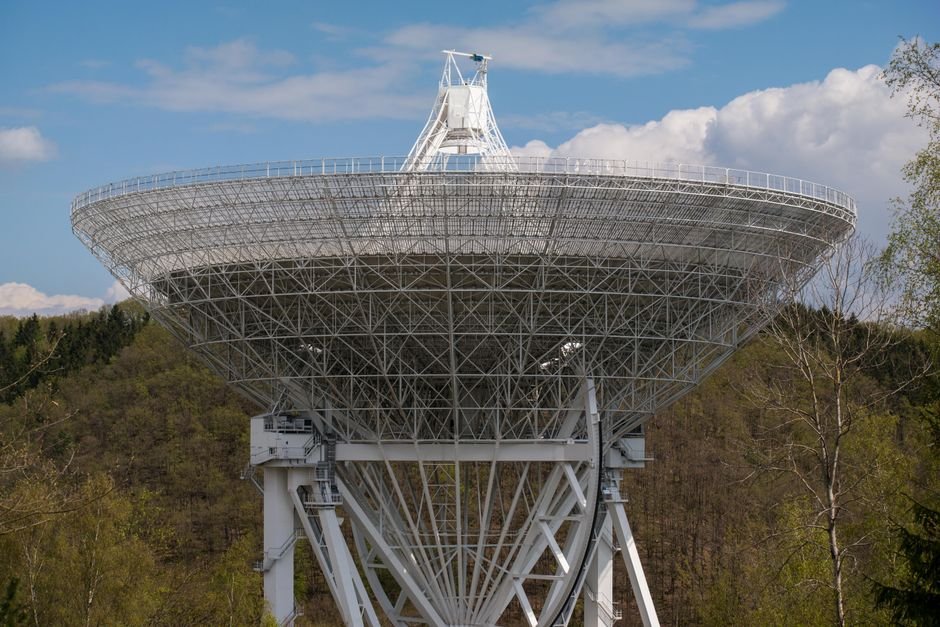
The Knockin radio telescope in Shropshire, a 25-meter dish that forms part of the UK’s national e-MERLIN interferometer network, may be forced to close as the Science and Technology Facilities Council seeks 162 million pounds in savings by 2029-30, according to a BBC report published July 2. The cuts, which have been described by physicist Professor Brian Cox as potentially reaching 30 percent of the UK’s particle physics, astronomy, and nuclear physics research budget, represent the most severe funding crisis for UK radio astronomy in a generation.
The Knockin dish is one of seven sites in the e-MERLIN network, operated by the University of Manchester on behalf of STFC and headquartered at Jodrell Bank Observatory in Cheshire. When combined, the seven telescopes spread across 217 km act as a single radio telescope the size of England, delivering angular resolution comparable to the Hubble Space Telescope at centimeter wavelengths with micro-Jansky sensitivity. The array is also a core component of the European VLBI Network, providing micro-arcsecond resolution for some of the sharpest astronomical observations available from Earth.
“There’s a real concern that the researchers that use those radio telescopes will be the people that get the chop,” said Helen Morgan, Liberal Democrat MP for North Shropshire, who is leading a campaign to preserve the facility alongside Professor Cox. “That equipment will fall out of use, and we will lose all that talent and all that kind of world-leading research from Britain.”
The financial pressure stems from STFC’s costs exceeding its flat cash budget allocation from UK Research and Innovation. The council was first briefed on a “transformation programme” in September 2025, and letters from STFC Executive Chair Professor Michele Dougherty in January 2026 disclosed the scale of the required savings. UKRI’s overall budget is nominally rising, but internal reallocation between curiosity-driven and strategic research “buckets” has squeezed STFC’s share.
Robert Massey of the Royal Astronomical Society described a 30 percent cut as “the worst outcome for the field in decades.” The UK ranks third globally in astronomy by citation impact and hosts the headquarters of the Square Kilometer Array Observatory at Jodrell Bank. A funding reduction of this scale would prevent the UK from harvesting scientific returns on its investments in both SKA and the European Southern Observatory.
The e-MERLIN network produces research across a range of fields including deep high-resolution continuum imaging, pulsar timing, fast radio burst searches, evolved star studies, and gravitational lensing. MP Morgan noted that the Knockin site also contributes to research with “proper application in the real world,” including nuclear physics and technology spin-offs.
The STFC has stated it is “preparing to detail how we will achieve financial sustainability while protecting world-leading science and delivering the greatest long-term impact,” but no final proposal has been published. The campaign to save the telescope is ongoing.