

The eye of the new cosmos: A retrospective on the James Webb Space Telescope’s record-breaking five years
On Christmas Day 2021, a rocket rose from Kourou in French Guiana carrying a folded-up observatory on a journey to the edge of the Earth-Sun system. Five years and roughly $10 billion later, the James Webb Space Telescope has handed us a new understanding of the cosmos — most dramatically in the discoveries of 2025 and 2026 that are rewriting astronomy textbooks in real time.
The long deployment: a mechanical triumph (Dec 2021 – July 2022)
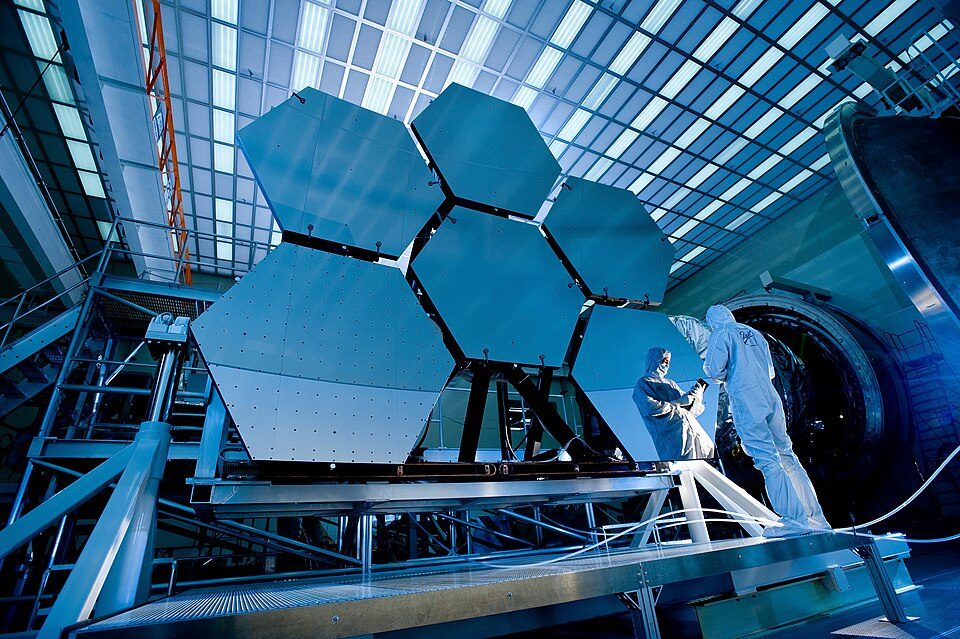
JWST arrived at the Sun-Earth L2 Lagrange point on January 22, 2022, 1.5 million km (930,000 miles) from Earth. Over the next five weeks, it performed a sequence of deployments as complex as any robotic mission in history: unfolding a five-layer sunshield the size of a tennis court, releasing the 6.5-meter (21-foot) primary mirror made of 18 gold-coated hexagonal segments, and aligning each segment with nanometer precision — in space, autonomously, for the first time.
On July 12, 2022, NASA released JWST’s first full-color images. The deep-field view of galaxy cluster SMACS 0723 — Webb’s “First Deep Field” — showed a universe far more crowded, luminous, and detailed than the deepest Hubble exposures had ever revealed. President Biden unveiled the image to the world. Webb had entered the public consciousness in a single moment.
The first year of icons
JWST’s early months produced a rolling showcase of astronomical icons: the Carina Nebula with its “Cosmic Cliffs” of star-forming gas and dust; the Southern Ring Nebula with a dying star peering through its own cosmic bubble; Stephan’s Quintet of five galaxies locked in a gravitational dance; the Pillars of Creation in October 2022, revealing hundreds of hidden protostars through the dust with stunning infrared transparency; and the Crab Nebula in October 2023, exposing a web of filamentary dust and energy radiating from the pulsar at its heart.
Each image drew the same conclusion from scientists: Webb could see deeper, further, and more clearly than any instrument in history.
Rewriting the early universe (2023-2024)
The earliest scientific revolutions came from Webb’s ability to peer into the early cosmos. JWST teams discovered dozens of massive, mature galaxies that appeared just 300-700 million years after the Big Bang — far larger and more structured than existing models predicted. Theory said the early universe should have been full of small, chaotic galaxies that took billions of years to grow. JWST found massive ones almost immediately — a “cosmic crisis,” in the words of astronomers.
The JADES (JWST Advanced Deep Extragalactic Survey) campaign mapped thousands of early galaxies. In 2024, the team announced two of the most distant galaxies ever confirmed: JADES-GS-z14-0 and JADES-GS-z14-1, whose light has traveled over 13.4 billion years to reach us. Follow-up observations with ALMA in March 2025 detected oxygen in JADES-GS-z14-0 — proving that heavy elements, forged in the first stars, were already abundant just 300 million years after the Big Bang, far earlier than any model predicted.
The pinnacle: 2025-2026, the years everything changed
A potentially habitable world — K2-18 b
In April 2025, an international team led by the University of Cambridge announced what may be the most impactful exoplanet discovery in decades. Webb’s MIRI spectra of K2-18 b, a “Hycean” world roughly 120 light-years away, detected water vapor, carbon dioxide, and — critically — dimethyl sulfide (DMS) and dimethyl disulfide (DMDS). On Earth, DMS is produced almost exclusively by marine phytoplankton. The team cautioned this is not proof of life, but the detection at 3-sigma significance sent shockwaves through the scientific community.
“The signal is strong and clear. But we need to be cautious — this is not proof of life, it is a clue that demands more investigation,” said Nikku Madhusudhan, lead researcher at Cambridge.
The oldest galaxy ever observed
JADES-GS-z14-0 dates back to when the universe was just 300 million years old — the most distant and oldest galaxy ever confirmed. It is surprisingly bright and massive for its age, spanning over 1,600 light-years across. The ALMA oxygen detection challenges existing models: the first generations of stars must have lived, fused elements, and died far more rapidly than previously believed.
Organic molecules in a planet-forming disk
Using its MIRI instrument, Webb detected complex organic molecules — including polycyclic aromatic hydrocarbons and simple amino acid precursors — within a planet-forming disk around a young star approximately 1,300 light-years away. The finding strengthens the hypothesis that the building blocks of life are delivered to planets during formation, not through later surface chemistry.
A temperate Saturn-sized world — TOI-199 b
In May 2026, Webb turned its spectrograph toward TOI-199 b, a Saturn-sized planet orbiting a star over 330 light-years away. The result was unexpected: a methane-rich atmosphere with temperatures remarkably similar to Earth’s. This “temperate giant” offers a rare window into how planetary atmospheres evolve across different masses.
Supermassive black hole “seeds”
How did supermassive black holes grow so large so quickly in the early universe? Webb observations in 2025 revealed a new class of ultra-compact, high-redshift objects that appear to be “heavy seeds” — massive black holes formed directly from collapsing primordial gas clouds. The most compelling candidate, found in the “Infinity Galaxy” — the result of two colliding spiral galaxies — provides the strongest evidence yet for the direct-collapse model.
Doomed star, unhidden
In October 2025, an international team used Webb to identify the progenitor star of a supernova for the first time at mid-infrared wavelengths — a star hiding in thick dust, seen in the moment before its explosive death.
300 galaxies at the edge
In August 2025, scientists from the University of Missouri used Webb’s infrared images to find 300 massive, mature galaxies at redshifts where none were expected — galaxies that “shouldn’t exist” according to prevailing models.
Mapping the cosmic web
In May 2026, astronomers led by UC Riverside used JWST data from the COSMOS-Web program to produce the most detailed map of the cosmic web ever made — the universe’s skeleton-like framework of galaxy filaments and voids stretching billions of light-years, traced back to when the universe was just one billion years old.
Uranus in 3D
In early 2026, Webb mapped the upper atmosphere of Uranus in three dimensions for the first time, tracking temperatures and charged particles thousands of kilometers above the cloud tops and revealing glowing auroral bands shaped by the planet’s wildly tilted magnetic field.
Black holes outpacing their galaxies
In May 2026, astronomers announced the discovery of two early-universe galaxies where central supermassive black holes appear to have grown far faster than their host galaxies. Separately, ESA/Webb confirmed an actively growing supermassive black hole inside a galaxy just 570 million years after the Big Bang.
Why this matters
JWST’s achievements in five years represent what previous telescopes accomplished in three to four decades:
- Early galaxies: Rewritten. Massive galaxies formed earlier, and star formation began faster, than predicted.
- Exoplanet atmospheres: DMS detection on K2-18 b shifts the search for life from theoretical to actionable.
- Star formation: Webb sees through dust in ways Hubble could not, revealing billions of hidden stars.
- Black hole seeds: First evidence for “heavy seeds” in the early universe, explaining supermassive black hole growth.
- Cosmic web: First large-scale mapping at infrared wavelengths, clarifying structure formation.
- Solar system: Uranus atmosphere mapped, the Helix Nebula imaged in unprecedented detail.
- Public impact: JWST images are among the most shared, discussed, and downloaded in history.
What comes next
As of May 2026, JWST is performing flawlessly. Its fuel supply is expected to last well into the 2040s. Upcoming observation cycles will focus on mapping the atmospheres of dozens more exoplanets, studying the first generation of stars (Population III), probing the nature of dark energy through wide-field surveys, and continuing the JADES deep-field campaigns to chart the first 500 million years of cosmic history.
The universe, it turns out, is even more extraordinary than we imagined — and Webb is proving it one infrared photon at a time.
Sources: NASA JWST; Madhusudhan N, et al. ApJL (2025); ALMA Observatory (March 2025); JADES-GS-z14-0; UC Riverside (May 2026); TOI-199 b methane atmosphere (May 2026); JADES collaboration; ESA/Webb press archive; NASA/ESA/CSA Webb Science Releases