

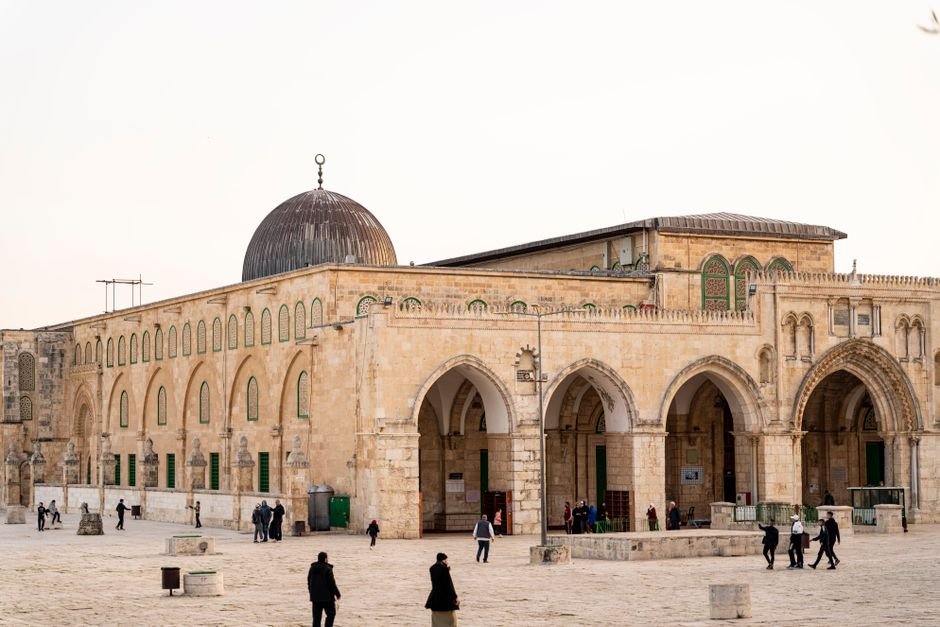
Jordan is the most cautious state in the Middle East: it has a peace treaty with Israel, security coordination with it, and a dependence on it for water. When it says a red line is about to be crossed, it is not posturing. On Wednesday it convenes the foreign ministers of the Arab and Islamic world in Amman to discuss what it calls the imminent threat of an Israeli takeover of the Al-Aqsa compound in Jerusalem, the site Muslims know as the Haram al-Sharif and Jews as the Temple Mount, Islam’s third holiest place and Judaism’s holiest. Jordan warns that such a move could trigger a religious conflict.
The trigger is a date. On July 23, Tisha B’Av, the Jewish day of mourning for the destroyed Temples, more than four thousand Israelis entered the compound in one of the largest incursions in years, by Al Jazeera’s count. Among them was the national security minister, Itamar Ben Gvir, who has now stormed the site more than a dozen times since taking office, leading hundreds of followers in prayers at a place where the decades-old rules say Jews may visit but not pray. The status quo, the arrangement that has governed the site since Israel captured East Jerusalem in 1967, holds that Jordan’s religious trust administers the compound and Muslim worship continues uninterrupted. On July 23, the status quo took another beating. Israeli flags had already been raised on the steps of the Dome of the Rock in June, and Ben Gvir has been open about the goal. After his visit he said Jews praying there feel like the rightful owners and that there was more to do.
The erosion by accumulation
This is how the takeover would happen, if it happens: not by a single decree, but by accumulation. Each storming is a small test of the arrangement, each one slightly larger, each one followed by a statement that the government’s policy on the status quo is unchanged. The policy is unchanged; the ground under it is not. The government’s far-right partners are explicit about wanting Jewish prayer rights at the site, and they have the numbers in the coalition to press it. Even the head of the Shin Bet, Israel’s internal security agency, marked his arrival by putting the Temple Mount on the agency’s computer backgrounds, a gesture that was walked back as an accident after internal protest. The steps are small. The direction is not.
Jordan’s alarm is existential, and it is the alarm of the custodian. The Hashemite monarchy’s legitimacy is tied to the guardianship of Jerusalem’s holy sites, a role it has held for a century and that was confirmed in its peace treaty with Israel. A takeover of Al-Aqsa would be, for Amman, both a religious catastrophe and a political one: the end of the custodianship, and with it the monarchy’s claim to be the defender of Islam’s holy places. Jordan has made this calculation before. When Ariel Sharon walked onto the compound with more than a thousand police in September 2000, the result was the Second Intifada. The men now pushing the farthest are not Sharon; they are the people who admire him for it.
The case for restraint
The skeptic’s case deserves its weight. The Israeli government publicly maintains that the status quo is unchanged, and Netanyahu has reined in Ben Gvir before when the cost of his provocations got too high. Jordan has made warnings like this in the past, and the meeting in Amman may produce another communique and nothing else, because the Arab and Islamic world has no mechanism to enforce a red line in Jerusalem. And the word takeover is Jordan’s framing: Israel would say it is managing access to a site under its sovereignty, not seizing control of anything. A religious war serves nobody’s interest, which is the only real guarantee that one will not start.
But the accumulation is the fact, and the meeting in Amman is what a country does when quieter options are exhausted. The red line in Jerusalem is not a border. It is a walled courtyard on a hill, governed by an arrangement held together by mutual exhaustion for nearly sixty years. Every storming, every flag, every minister’s visit is a test of whether the arrangement still holds. Jordan is saying it is about to break, and it is calling the whole Islamic world to witness. The world is watching the war in Iran and the bombs in Gaza. Jordan is watching the courtyard where the next war would begin, and it is worried.
Source
- The Guardian: Jerusalem’s most important religious site facing ‘imminent’ threat of Israeli takeover, warns Jordan
- The Nation: Jordan convenes emergency Arab-Islamic foreign ministers conference
- Al Jazeera: More than 4,200 Israelis storm Al-Aqsa Mosque in Jerusalem
- Dawn (AFP): Far-right Israeli minister Ben Gvir storms Al-Aqsa mosque compound with hundreds of followers
- Arab News: Arab, Islamic nations condemn storming of Al-Aqsa Mosque by Israeli settlers