

🔴 LATEST: Peace Deal “Largely Negotiated”
Diplomatic efforts to reopen the Strait of Hormuz have entered their most decisive phase yet, with President Trump claiming on May 23 that a deal with Iran is “largely negotiated” and could be announced soon.
According to AP sources, regional officials say the United States is close to a final agreement that would:
- Reopen the Strait of Hormuz without tolls
- Establish a 60-day ceasefire to allow de-escalation
- Resume nuclear negotiations at a later stage
- Lift the U.S. naval blockade on Iranian ports
Iran has reportedly conveyed the proposal through Pakistani mediators. The deal framework mirrors an earlier offer made by Tehran in April to open the strait in exchange for a postponement of nuclear talks.
However, a major sticking point remains: Iran’s hardline Islamic Revolutionary Guard Corps (IRGC), through the state-linked Fars News Agency, has insisted the strait must remain under Iranian sovereignty — a condition Washington has repeatedly called a non-starter.
🟠 Background: How War Closed the Strait
February 28, 2026 — Israel and the United States launched a series of strikes against Iranian nuclear and military sites, triggering a full-scale conflict.
March 2026 — In retaliation, the IRGC seized control of the Strait of Hormuz, laying sea mines, boarding foreign tankers, and asserting sovereignty over more than 22,000 km² of adjacent waters. Iran launched missile and drone salvos against U.S. bases, Israeli cities, and Gulf state oil infrastructure.
Within days, the strait — through which approximately 20% of globally traded oil and significant LNG volumes pass — was effectively sealed. Ship-tracking data showed zero commercial vessels transiting, down from the typical 140 daily passages. Oil prices spiked dramatically. Iran later announced selective access for certain allied nations, but in practice the waterway has remained effectively closed to all but a handful of sanctioned humanitarian shipments.
April 18 — The IRGC formally declared the strait “fully closed until the end of the U.S. blockade on Iranian ports.”
April 23 — Trump ordered U.S. forces to “shoot and kill” Iranian small boats threatening shipping, escalating the standoff to its highest point.
May 6 — Trump announced a pause in “Project Freedom” — the U.S. military operation to clear mines and reopen the strait — citing “great progress” in talks.
Late May — Details of a potential framework deal emerged as both sides signaled willingness to negotiate, though IRGC hardliners continue to resist any settlement that cedes control of the strait.
🔵 What’s at Stake
The Strait of Hormuz crisis has sent shockwaves through global energy markets:
- ~20% of global oil supply disrupted
- Brent crude swung wildly, reaching peaks well above $150/barrel
- War-risk insurance premiums for Gulf shipping soared
- The UAE’s bypass pipeline to Fujairah accelerated construction, now 50% complete
- Iran has threatened to target undersea internet cables crossing the strait — a new frontier of leverage
The outcome of current negotiations will shape not only the immediate trajectory of U.S.-Iran relations, but the broader security architecture of the Persian Gulf for years to come.
Sources: AP News, CNBC, Al Jazeera, Wikipedia (2026 Strait of Hormuz crisis, 2025–2026 Iran–U.S. negotiations). Last updated May 25, 2026 — 05:00 UTC.
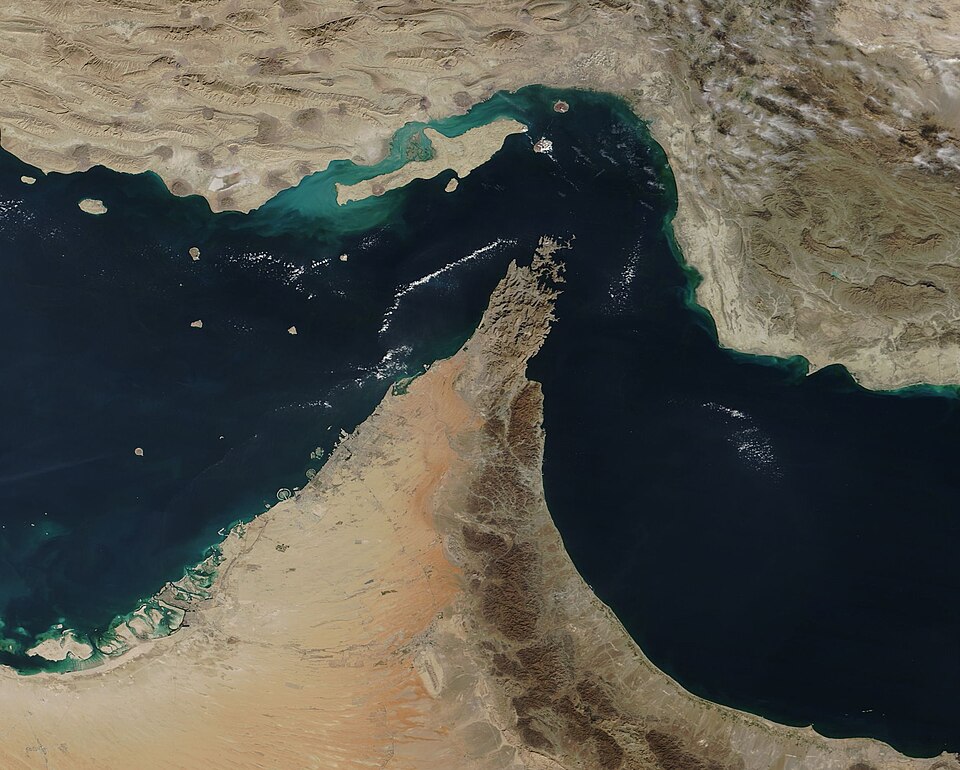
Image: NASA Terra / MODIS — Strait of Hormuz and Musandam Peninsula (Public domain)