

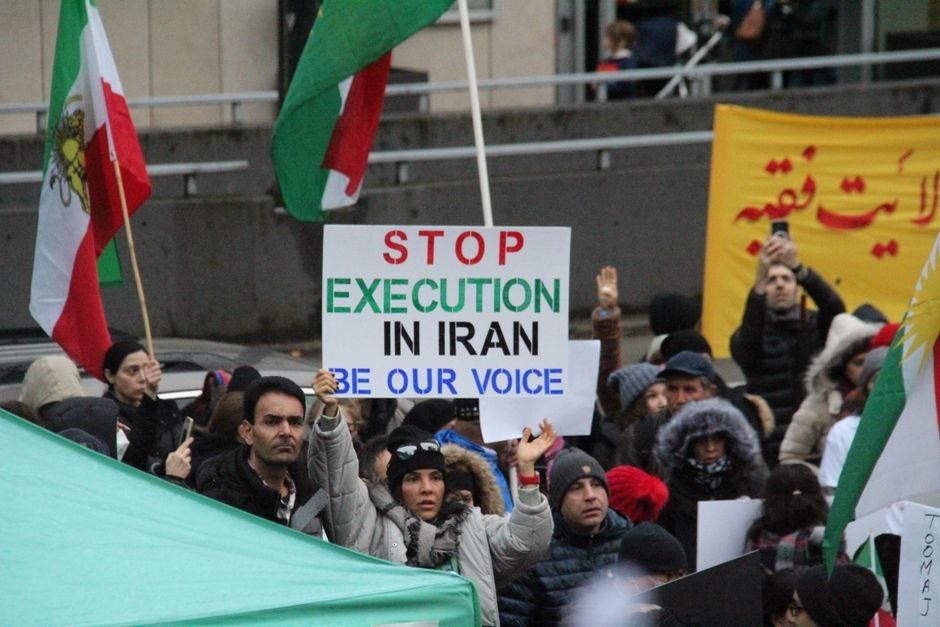
Iran executed three men this week, and the judiciary used the occasion to warn the country about “infiltrators.” The message was clear: the war with the United States and Israel is not the only fight the regime is waging.
Mehdi Khanaki was put to death Wednesday after a revolutionary court convicted him of being an “active element of a terrorist group.” State television showed security forces raiding a home in Karaj, near Tehran, where they claimed to have found handguns, ammunition, and explosives. He was arrested during the nationwide protests that erupted in January and charged with “operational action in favor of the Zionist regime, the United States and hostile groups.”
Two other men were executed Sunday in a separate case involving 16 defendants tied to the deadly protests in Isfahan on January 8. Authorities said they had roles in killing police officers. Foreign-based activists disputed the state account, alleging lack of due process and torture.
The bigger picture
These executions are not isolated. They are part of a pattern of internal repression that has accelerated since the US-Israeli war began on February 28. The protests that started in central Tehran on December 28, driven by economic grievances, grew into a nationwide challenge to the establishment. Thousands of people were killed, mostly on January 8 and 9. The regime describes the unrest as a coup orchestrated by the United States and Israel. The evidence for that claim is thin, but it serves a purpose: it turns domestic dissent into an act of foreign aggression, which justifies the security response.
Chief Justice Gholam-Hossein Mohseni-Ejei, speaking in a televised meeting Monday with President Masoud Pezeshkian and senior clerical judges, urged unity and warned against “alarmists, rumor-spreaders, hypocrites and infiltrators.” His language was careful. He said such people could disguise themselves as insiders and attempt to set people against one another. It is the vocabulary of a regime that fears the enemy within more than the enemy outside.
Mojtaba Khamenei’s call
The supreme leader’s son, Mojtaba Khamenei, called for “sacred unity” among the population and political factions. The phrase itself is revealing. The fact that the leadership has to ask for unity means it knows unity is fraying.
The media blacklist
On July 13, the Ministry of Intelligence published a list of dozens of media networks, 61 individual “human-media” figures, and 310 online accounts that it considers “hostile.” The warning was explicit: sending photographs, video, or information to any listed entity can result in prison and permanent exclusion from public employment, unless a more serious charge is invoked. It is a law that criminalizes journalism itself, and it was announced under the security law passed after last year’s 12-day war with Israel.
The timing matters. Iran is fighting a war on multiple fronts: a military war with the United States and Israel, an economic war of sanctions and oil blockades, and an internal war against a population that took to the streets in the largest protests since the 1979 revolution. The regime is executing people, blacklisting journalists, and warning of infiltrators because it cannot afford to look weak. The question is whether that strategy holds when the war is not going well.