

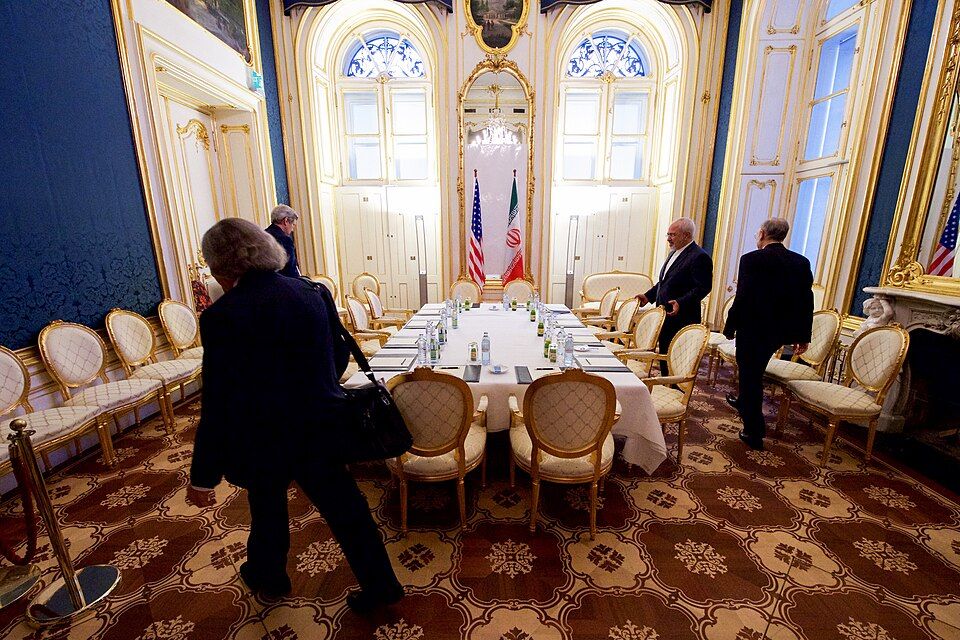
Tehran and Washington gave directly conflicting accounts of Monday’s nuclear talks, even as the United States unilaterally delivered its side of the bargain by lifting oil sanctions for 60 days.
Iran’s foreign ministry spent Tuesday swatting back the narrative coming out of Washington. Vice President JD Vance told reporters Monday after mediation talks in Switzerland that Iran had agreed to allow International Atomic Energy Agency inspectors back into the country, possibly “as soon as today.” President Donald Trump amplified the claim on social media, writing that despite Iran’s “protestations and false statements to the contrary,” it had “fully and completely agreed” to inspections. “If they did not agree to this,” Trump wrote, “there would be no further negotiations!”
But Iran’s foreign ministry spokesman Esmaeil Baqaei told state media that Tehran made “no new commitments” on nuclear inspections. He said Iran has no plans to allow inspectors to access nuclear sites that were bombed by the US and Israel during the 12-day war last summer. Any engagement with UN inspectors, Baqaei said, would take place “under existing procedures set by Parliament and the Supreme National Security Council,” not under any new deal struck in Switzerland.
The public contradiction is stark. Yet the United States has already begun dismantling the architecture of its own maximum pressure policy.
Treasury Secretary Scott Bessent issued a 60-day general license authorizing the production, delivery, and sale of Iranian oil, effective until August 21, 2026. The waiver unlocks banking transactions, insurance, and transportation for Iranian crude. It allows Iranian oil to be imported directly into the United States. The order dismantles the central pillars of an embargo that was rebuilt by Trump himself in 2018 after he withdrew from the Obama-era nuclear deal.
Brent crude fell more than 3 percent on the announcement as markets priced in a return of Iranian supply. Iran also said $12 billion of its frozen funds were being released as part of the ongoing talks.
The sequencing tells a story of its own. The United States has delivered sanctions relief before Iran has made any visible concession on inspections. Bessent said that in exchange for the waiver, Iran committed to keeping the Strait of Hormuz open and allowing IAEA inspectors back. But Iran’s foreign ministry is saying something different, and the gap between what the two sides claim cannot be explained away as diplomatic posturing on one side alone.
The mediation landscape adds another layer of uncertainty. Qatar and Pakistan, who brokered the first round of talks in Burgenstock, Switzerland, said the US and Iran agreed to “a roadmap towards reaching a final deal within 60 days.” That timeline matches the 60-day sanctions waiver, which runs to August 21. The contours of a deal are visible: sanctions relief in exchange for inspection access and Strait of Hormuz guarantees, on a two-month clock designed to force both sides toward a permanent arrangement.
But the 60-day window also creates a trap. If Iran’s public denial is genuine and not theater for domestic consumption, the United States has already given away its primary leverage. Sanctions relief is the single most powerful tool Washington has in negotiations with Tehran. Handing it over before inspections resume leaves the US in a position of asking for compliance without the ability to threaten real economic pain, at least until August.
Iran suspended IAEA access to the sites bombed during last summer’s war, and the IAEA pulled its remaining inspectors the following month. Getting those inspectors back in the country, let alone to the damaged nuclear facilities, was always going to be the hardest single step in any negotiation. If Vance and Trump are right, that step is done. If Iran’s foreign ministry is right, it is not even begun.
The next 48 hours will tell which version is true. If IAEA inspectors are seen boarding flights to Tehran, the Vance version holds. If the agency reports no contact from Iranian authorities, then the Trump administration just lifted sanctions on a deal that does not exist.
Either way, the sanctions waiver is already signed. The oil is already flowing. And the United States is already committed to a 60-day clock that its negotiating partner may or may not share.
- George, 1ban.news