

Hayabusa2 Captures Stunning Image of Two-Headed Asteroid Torifune 100 Million Kilometers from Earth
Date: 2026-07-07
Japan’s Hayabusa2 probe has beamed home a remarkable image of asteroid Torifune, revealing it as a contact binary : two distinct lobes fused together in a peanut shape : captured during a high-speed flyby 100 million kilometers (62 million miles) from Earth on July 5.
The image, taken by the spacecraft’s Optical Navigation Camera (ONC-T), shows the roughly 450-meter-wide asteroid in crisp detail: two similar-sized lobes joined at a neck, covered in boulders of varying sizes. The shape confirms what ground-based photometry had previously suggested, but the flyby images are the first direct visual confirmation of Torifune’s contact binary nature.
!ONC-T optical image of asteroid Torifune showing the contact binary two-lobed shape
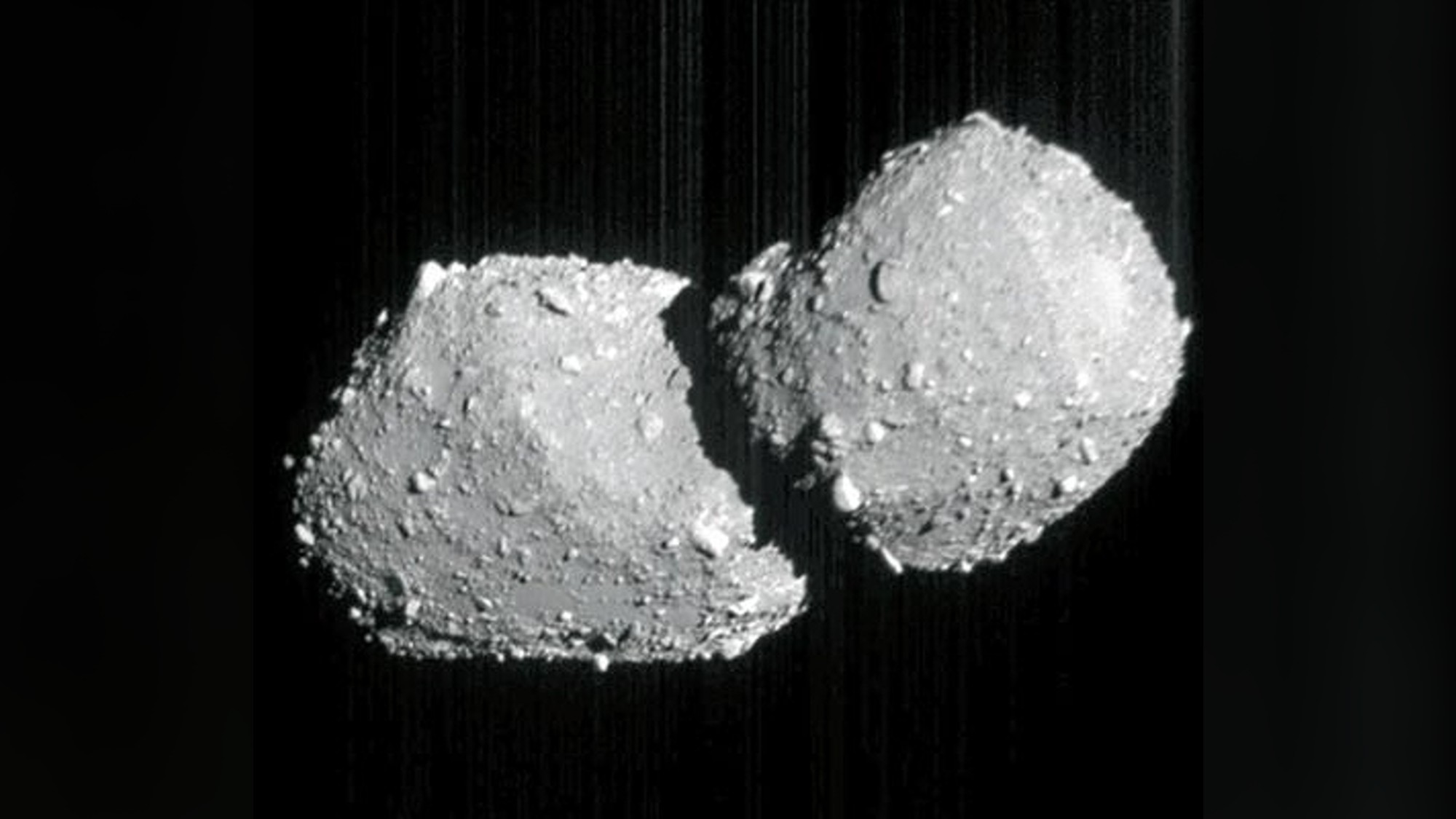
ONC-T visible-light image of Torifune, revealing two fused lobes covered in boulders. Credit: JAXA / University of Tokyo / Chiba Institute of Technology / Institute of Science Tokyo / AIST / Paris Observatory / IAC
JAXA also released a thermal infrared image from the TIR instrument, showing temperature differentials across the asteroid’s surface : cooler regions in shadowed crevices near the neck, warmer patches on sun-facing surfaces.
!TIR thermal infrared false-color image of Torifune showing temperature gradients
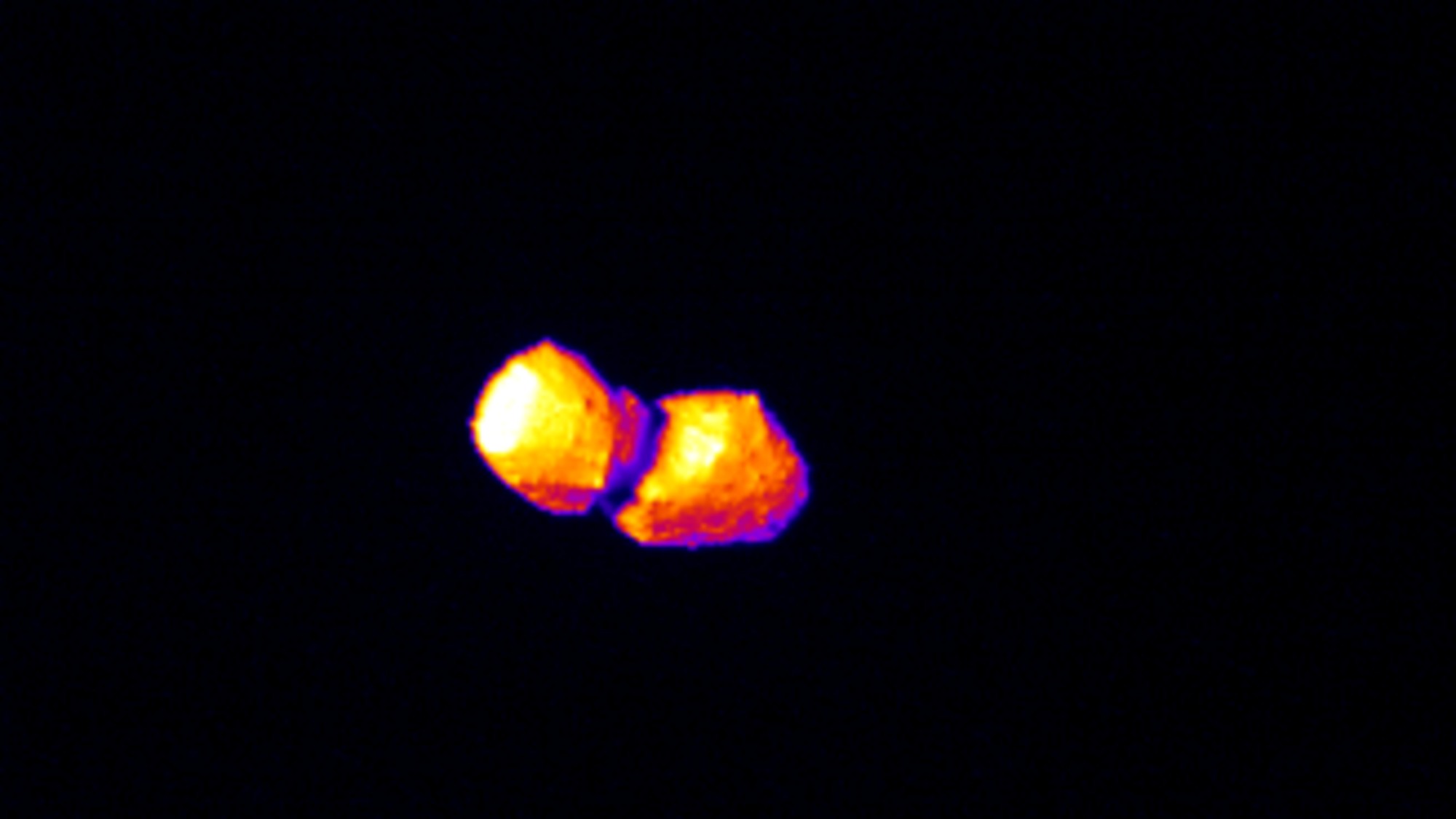
TIR mid-infrared false-color image showing temperature gradients across Torifune. Credit: JAXA / Maebashi Institute of Technology / Chiba Institute of Technology / University of Aizu / Hokkaido University of Education / AIST
The original JAXA source image is also available from the Hayabusa2 project website: JAXA Torifune image page.
A precision shot from 100 million kilometers
The flyby was one of the closest-ever high-speed asteroid encounters, with the spacecraft passing approximately 10 kilometers from the asteroid’s center at a relative velocity of 5 kilometers per second (11,180 miles per hour). JAXA operations team head Yuya Mimasu described the challenge as roughly equivalent to “shooting a 1 yen coin in the northern main island of Hokkaido from the southernmost Okinawa island prefecture.”
“I’m just utterly moved that it was able to take such a beautiful image,” Mimasu said at a JAXA press conference on July 6. “I have goosebumps.”
The spacecraft used four instruments during approach: ONC-T (optical camera), TIR (thermal infrared imager), NIRS3 (near-infrared spectrometer), and LIDAR (laser altimeter). Only optical and thermal images have been downlinked so far; remaining science data will be transmitted in future operations.
From Ryugu to Torifune and beyond
Hayabusa2 launched in December 2014 and delivered 5.4 grams of samples from asteroid Ryugu to Earth in December 2020. The Torifune flyby is the first major milestone of its extended mission, designated Hayabusa2# (also called “Sharp”). The spacecraft has traveled approximately 10.7 billion kilometers since launch.
Torifune : designated (98943) 2001 CC21 before being named after a Japanese deity meaning “divine ship” : is an S-type (stony) near-Earth asteroid in the Apollo group with a rotation period of roughly 5 hours. The flyby also served as a technology demonstration for planetary defense, testing the high-speed optical navigation techniques that would be needed for future kinetic impactor missions.
The next target for Hayabusa2# is the tiny asteroid 1998 KY26, measuring roughly 30 meters across with an extremely fast rotation period of 5 to 10 minutes. The spacecraft is expected to arrive around July 2031 after two Earth swing-bys in 2027 and 2028. If successful, 1998 KY26 will become the smallest asteroid ever visited by a spacecraft.