

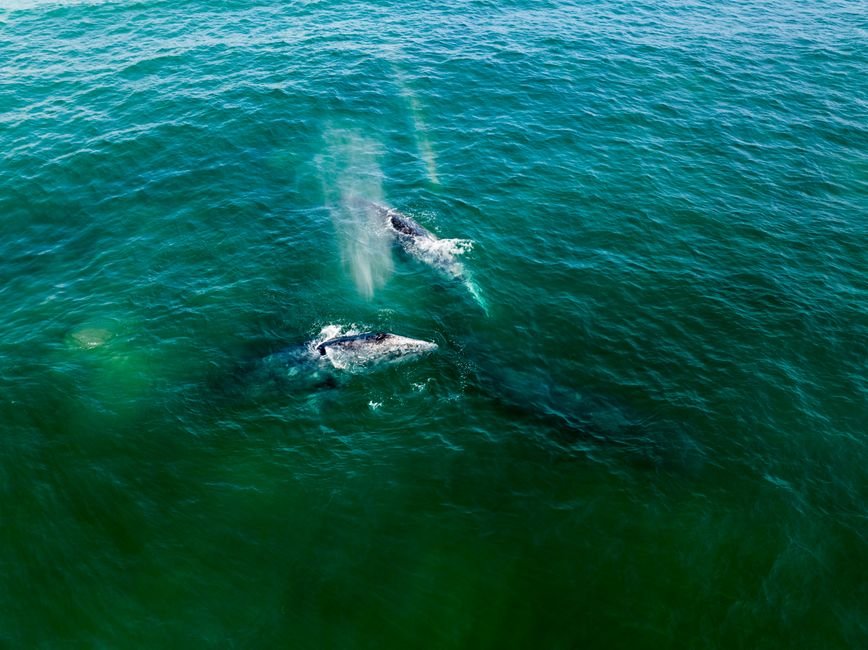
The eastern Pacific gray whale was once considered a conservation success story. Recovered from near-extinction after the end of commercial whaling, the population surged to roughly 27,000 animals by 2016. Now, a decade later, that number has been cut in half — and scientists say this time is different.
The population estimate for 2025 stands at approximately 13,000 whales (range: 11,700 to 14,500), the lowest since systematic counts began in the late 1960s. In 2026 alone, at least 145 stranded whales have been reported along the Pacific coast.
A Science AAAS investigation published July 13 traces the collapse to a climate-driven regime shift in the Bering Sea, where the whales’ primary food source — lipid-rich amphipod crustaceans — has sharply declined.
The food web unravels
Gray whales are bottom-feeders. In the Chirikov Basin of the northern Bering Sea, they rely on dense beds of ampeliscid amphipods — thumb-sized burrowing shrimp that build mud-tube structures on the seafloor. For decades, the amphipod biomass was immense. “The size of a pizza,” is how Jackie Grebmeier of the University of Maryland described it to Science.
By 2018, that biomass had shrunk to “a slice.”
The chain of causation traces back to sea ice. Winter ice in the Bering Sea triggers blooms of ice algae, which sink to the seafloor and feed the benthic food web. As Arctic warming reduces seasonal ice cover, fewer algae reach the bottom. Warmer ocean currents have also swept away the fine silt that amphipods need to build their tubes. By 2010, amphipod biomass in the Chirikov Basin had declined to just 9% of 1984 levels.
The 2018-2019 marine heatwave in the North Pacific compounded the damage, reducing Arctic ice further and triggering a mass die-off of snow crabs as well. Gray whales, forced to shift northward into the Chukchi and Beaufort Seas, found those waters equally impacted.
A different kind of crash
Gray whale populations have experienced boom-bust cycles before. A 2023 Science paper by Stewart et al. (DOI: 10.1126/science.adi1847) documented crashes in 1987 and 1999, each lasting a few years before the population rebounded. Those were natural fluctuations.
“This time is different,” the scientists told Science.
The current decline has been sustained since 2016, with no sign of a reversal. Strandings remain elevated across all age classes. Necropsies reveal starvation: whales with “peanut heads” — severe fat loss behind the skull — and intestines packed with indigestible wood fragments from desperate feeding attempts in nearshore habitats.
“It’s a whole lot of bad happening at once,” said Jessie Huggins of the Cascadia Research Collective.
Behavioral adaptation has limits
Whales are diversifying their diets in response. In Alaska, they are eating herring eggs. In Washington, ghost shrimp — a high-risk strategy because it increases tidal stranding risk. In Oregon, zooplankton. About 200 whales now skip the Arctic migration entirely, feeding along the California coast year-round.
But the narrow continental shelf off California and the Pacific Northwest cannot support the population at scale. And the nutritional quality of these substitute prey is far lower than the lipid-rich amphipods of the Bering Sea.
“It’s looking like some kind of tipping point to me,” said Sue Moore of the University of Washington.
Management gaps
Gray whales were delisted from the Endangered Species Act in 1994 after recovering from commercial whaling. They are not currently listed, though an open letter from scientists in 2025 urged the IUCN to reassess. A 2019-2023 Unusual Mortality Event (UME) covering 690 strandings was closed in March 2024, but NOAA has not declared a new UME for the 2026 strandings.
“We don’t have a good prediction of where the prey supply will be in the future,” said Joshua Stewart of Oregon State University.
The most recent NOAA abundance estimate (2025/2026) shows an apparent uptick to 15,930-20,530 whales, but the agency explicitly cautions that this “exceeds expected growth rates for baleen whales and has occurred during periods of low calf production,” suggesting it may reflect shifting migration patterns or sampling error rather than genuine recovery.
“The environment may now be changing at a pace or in ways that is testing the time-honored ability of the population to rapidly rebound while it adjusts to a new ecological regime,” said David Weller of NOAA’s Southwest Fisheries Science Center.
Sources
Cornwall W. “As the Arctic warms, gray whale boom turns into a bust.” Science (July 13, 2026). DOI: 10.1126/science.zhb21jp
Stewart et al. “Boom-bust cycles in gray whales linked to Arctic conditions.” Science 382:207-211 (2023). DOI: 10.1126/science.adi1847
NOAA Technical Memorandum NMFS-SWFSC-724 (2025).