

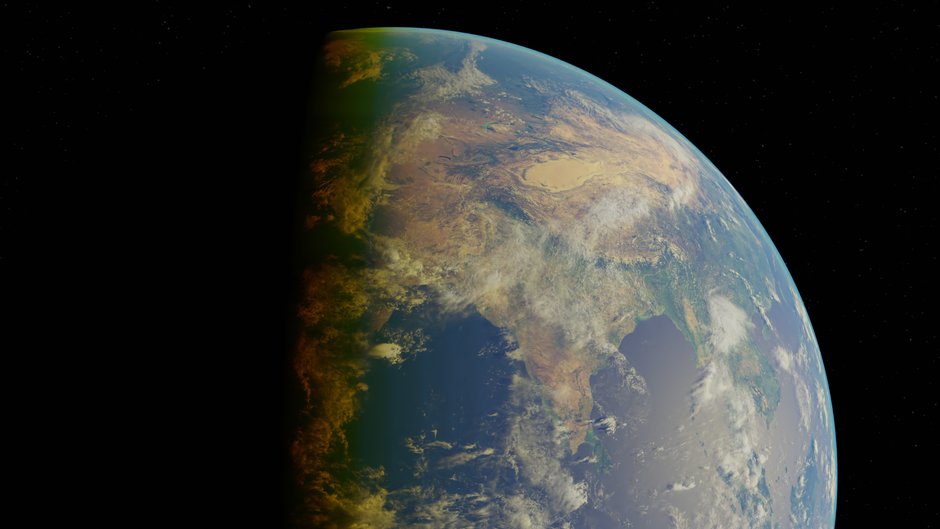
Nearby super-Earth GJ 3378b may be more habitable than first thought
A planet 25 light-years away that was once thought to be too massive to support life has received a dramatic revision. New measurements show GJ 3378b is a rocky super-Earth with only 2.3 times Earth’s mass, placing it squarely within the habitable zone of its star and making it one of the most promising nearby targets in the search for life beyond the solar system.
The discovery, published in the Astrophysical Journal, comes from a team led by Paul Robertson of the University of California, Irvine, using data from four independent instruments across three observatories.
GJ 3378b orbits an M4V red dwarf star in the constellation Camelopardalis (the Giraffe), completing one orbit every 21.45 days at a distance of roughly 0.097 astronomical units (14.5 million kilometers, or 9 million miles). That is about 10% of the Earth-Sun distance, but because the host star is a dim red dwarf, the planet receives only about 90% of the stellar radiation that Earth gets from the Sun.
The result is an equilibrium temperature of roughly 272 Kelvin, or about -1 degree Celsius (30 degrees Fahrenheit). While not balmy by terrestrial standards, that places GJ 3378b comfortably within the conservative liquid-water habitable zone of its star.
A significant revision
The planet was first identified as a candidate in 2024 by a team using the SPIRou spectrograph in France, which reported a mass of about 5.26 Earth masses and an orbital period of 24.73 days. At 5 Earth masses, the world was teetering on the boundary between rocky super-Earths and volatile-rich mini-Neptunes, with the possibility that a thick, crushing atmosphere would rule out any chance of surface habitability.
Robertson’s team combined data from four instruments: the Habitable-zone Planet Finder (HPF) on the Hobby-Eberly Telescope at McDonald Observatory in Texas, the NEID spectrograph on the WIYN telescope at Kitt Peak in Arizona, plus data from CARMENES in Spain and SPIRou in France. The combined dataset, spanning multiple years, allowed the team to refine the mass down to 2.3 Earth masses (plus or minus 0.4) and the orbital period to 21.45 days.
“This revision makes GJ 3378b a fundamentally different kind of planet than we thought,” Robertson said in a statement from UC Irvine. “At 2.3 Earth masses, it is almost certainly a rocky world, not a gas-dominated planet. And its orbit puts it right in the sweet spot for liquid water.”
The research paper is titled “A Revised Mass and Period for the Habitable Zone super-Earth GJ 3378b: A Planet Straddling the Cosmic Shoreline.”
The cosmic shoreline problem
Despite the promising numbers, GJ 3378b faces a major challenge: its host star is a red dwarf, and red dwarfs are notorious for violent stellar activity, especially in their first billion years. Intense X-ray and ultraviolet radiation during that early phase can strip the atmospheres of close-orbiting planets, leaving them as airless rocks.
GJ 3378b sits right on what astronomers call the “cosmic shoreline,” the theoretical boundary between planets that retain atmospheres and those that do not. Mars, in our own solar system, sits on the wrong side of this line: it has only a trace atmosphere, and any liquid water on its surface would quickly boil away or freeze.
The UC Irvine team plans follow-up observations using the James Webb Space Telescope and the upcoming Extremely Large Telescope (ELT) to search for atmospheric signatures around GJ 3378b. If the planet has retained an atmosphere, it would become one of the strongest candidates for biosignature searches in the next decade.
A target for future observatories
At 25 light-years (7.7 parsecs), GJ 3378b is one of the closest potentially habitable exoplanets known. Its proximity makes it an ideal target for the next generation of ground-based and space-based observatories.
The Habitable Worlds Observatory, a NASA flagship mission currently in early planning, is designed specifically to image and characterize Earth-like exoplanets around nearby stars. GJ 3378b’s position, brightness, and revised mass make it a high-priority target for that mission.
“GJ 3378b is exactly the kind of planet the Habitable Worlds Observatory was designed to study,” Robertson said. “It is close, it is bright, and it sits in the habitable zone. Now we need to find out if it has an atmosphere.”
Featured image: [Artist’s impression of a super-Earth orbiting a red dwarf star; credit: NASA/JPL-Caltech]
Sources: Universe Today, McDonald Observatory, UC Irvine, The Astrophysical Journal (arXiv:2605.16499), NASA Exoplanet Archive