

The gardenia flower is best known for its creamy white petals and sweet fragrance. But inside the fruit of this evergreen shrub lies a compound that, according to new research, may hold clues for treating one of Parkinson’s disease’s most overlooked symptoms.
In a preprint posted July 21 on bioRxiv, neuroscientists at Haverford College report that genipin, a compound derived from the gardenia fruit, reversed sleep abnormalities in fruit flies engineered to carry the hallmark protein of Parkinson’s disease. The finding extends genipin’s known protective effects beyond motor function into the domain of sleep, suggesting that a single natural molecule might address multiple facets of the disorder.
Sleep and Parkinson’s: the overlooked connection
Parkinson’s disease has long been defined by its motor symptoms: tremor, rigidity, slowness of movement. But non-motor symptoms are just as debilitating, and none is more common than sleep disruption. Up to 90 percent of people with Parkinson’s report sleep problems, including fragmented sleep, insomnia, and daytime drowsiness. These disturbances often appear years before the classical motor signs, and they significantly erode quality of life.
Current treatments for Parkinson’s motor symptoms, primarily dopamine replacement therapy, do little for sleep. And the biology underlying sleep disruption in the disease remains poorly understood, making it difficult to design targeted therapies.
The molecular culprit, researchers believe, is alpha-synuclein, a protein that clumps into toxic aggregates in the brains of Parkinson’s patients. When alpha-synuclein misfolds and accumulates, it damages neurons, particularly the dopamine-producing cells whose loss causes motor impairment. But whether and how alpha-synuclein directly causes sleep deficits has been less clear.
A tiny brain, a big question
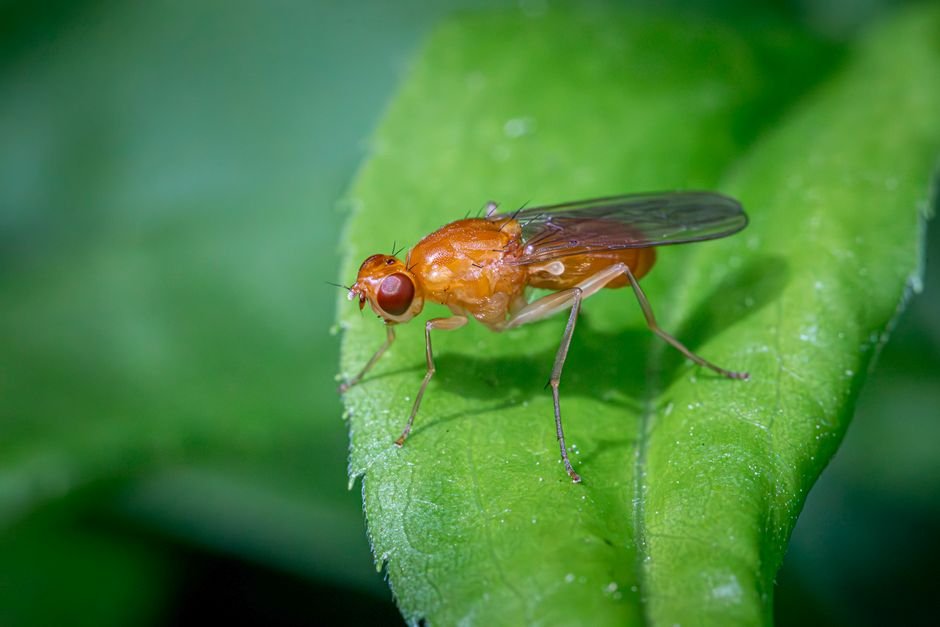
The Haverford team, led by Olivia M. Davis and Robert Fairman, turned to an unlikely model organism: the fruit fly, Drosophila melanogaster. Flies sleep. Their sleep shows many of the same features as mammalian sleep, consolidated periods of inactivity, increased arousal thresholds, and homeostatic regulation, and the molecular pathways controlling sleep are broadly conserved across evolution.
The researchers used a well-established transgenic fly line that expresses human alpha-synuclein throughout the nervous system. These flies are a standard Parkinson’s model; prior work has shown they develop progressive motor deficits and shortened lifespan. The new study added a sleep-focused lens.
Using a high-throughput activity monitoring system, Davis and her colleagues measured sleep behavior in the alpha-synuclein flies and compared it to healthy controls. The results were striking. Flies expressing alpha-synuclein showed significantly less total sleep and more fragmented sleep, particularly during the nighttime period when flies are normally consolidated. The protein’s toxic effects were not limited to motor neurons; they were actively disrupting the brain’s sleep machinery.
Gardenia’s gift
Enter genipin. This iridoid compound, abundant in the fruit of Gardenia jasminoides, has a long history in traditional East Asian medicine as an anti-inflammatory and neuroprotective agent. In recent years it has attracted scientific attention for its ability to cross the blood-brain barrier and modulate protein aggregation.
The same group had previously shown that feeding genipin to alpha-synuclein flies improved their motility and extended their survival. The new experiment asked whether the compound could also fix the sleep deficits.
When the researchers supplemented the food of alpha-synuclein flies with genipin, sleep patterns shifted toward normal. Treated flies slept more overall and showed better consolidation of nighttime sleep compared to untreated alpha-synuclein flies. The effect was specific: genipin did not simply sedate the flies or alter their general activity levels. It appeared to counteract the specific sleep-disrupting effects of alpha-synuclein toxicity.
The exact mechanism is not yet pinned down, but the authors point to several possibilities. Genipin is known to inhibit the aggregation of alpha-synuclein into toxic oligomers. It also reduces oxidative stress and inflammation, both of which are elevated in Parkinson’s brains and are known to impair sleep-regulating circuits. The compound may be acting at multiple nodes in the same pathological network, simultaneously protecting the neurons that control movement and those that regulate sleep.
Why this matters
The finding is important for several reasons. First, it demonstrates that sleep deficits in this model are directly downstream of alpha-synuclein toxicity, the same protein that drives motor degeneration. This suggests that therapies targeting alpha-synuclein could potentially improve both motor and non-motor symptoms with a single intervention.
Second, genipin is a natural compound already used in traditional medicine, with a known safety profile in humans (it is used as a food additive and herbal remedy in parts of Asia). While much work remains to establish safe and effective dosing for Parkinson’s, the compound’s availability and tolerability make it an attractive candidate for further study.
Third, the Drosophila model offers a fast, cost-effective screening platform. Because flies have short lifespans and well-characterized sleep behavior, researchers can rapidly test compounds for sleep-protective effects before moving to mammalian models.
Caveats and next steps
This is a preprint and has not yet been peer-reviewed. The work is in Drosophila, not humans, and the compound’s effects on sleep in mammalian Parkinson’s models remain to be tested. Genipin’s bioavailability, metabolism, and potential toxicity at therapeutic doses need careful evaluation before human trials could begin. The authors declare no competing interests.
Still, the results add to a growing body of evidence that sleep disruption in Parkinson’s is not merely a secondary consequence of motor disability but a primary feature of the disease’s molecular pathology. And they suggest that the gardenia’s fruit, long valued in traditional medicine, may yet yield a modern therapeutic harvest.
Source
Davis OM, Sappenfield AH, Fairman R. “Genipin Alleviates Sleep Deficiencies Caused by alpha-Synuclein Toxicity in a Drosophila melanogaster Model of Parkinson’s Disease.” bioRxiv, July 21, 2026. DOI: 10.64898/2026.07.16.738995. Licensed under CC-BY 4.0 International.