

Gamma-Ray Bursts Reveal the Faint Galaxies That Reionized the Universe
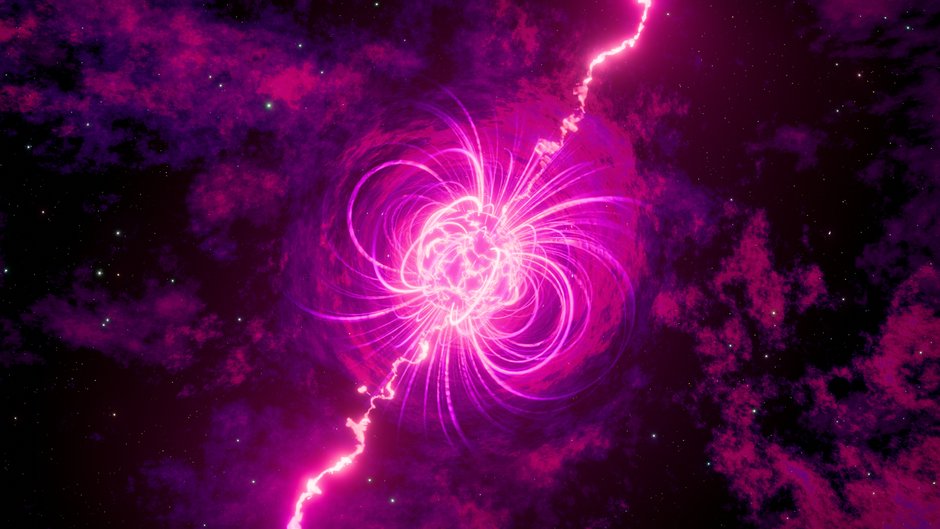
Featured image: An artist’s impression of a long gamma-ray burst and its host galaxy; credit: NASA/Swift/Cruz deWilde
One of the most persistent questions in cosmology is what caused the reionization of the universe, the epoch when neutral hydrogen gas was stripped of its electrons by intense ultraviolet radiation, allowing light to travel freely through space for the first time. Star-forming galaxies are the leading candidate, but astronomers have struggled to determine whether the brightest, most easily observed galaxies did the work, or whether a vast population of faint, barely detectable galaxies was responsible.
A new study published in the Astrophysical Journal Letters provides the strongest evidence yet for the faint galaxy hypothesis. Using two decades of data from NASA’s Swift satellite, a team of astronomers has shown that long gamma-ray bursts (LGRBs) can serve as unbiased tracers of star formation across cosmic time, revealing galaxies too dim for even the James Webb Space Telescope to see.
Gamma-Ray Bursts as Cosmic Probes
Long gamma-ray bursts are the most luminous electromagnetic events in the universe, produced when massive stars collapse directly into black holes. Because they are so bright, they are detectable across cosmic distances regardless of the size or brightness of their host galaxies. This makes them an ideal statistical tool for measuring star formation activity in both bright and faint galaxies.
The team, led by Jing-Meng Hao of the University of Padua and including researchers from Chinese Academy of Sciences, INAF, and the Scuola Normale Superiore of Pisa, analyzed Swift LGRBs detected in the redshift range 4 to 10, corresponding to the period when the universe was between 500 million and 1.5 billion years old.
The key result: the cosmic star formation rate density inferred from LGRBs can naturally explain the observed state of hydrogen reionization without requiring extreme assumptions about how efficiently galaxies produce ionizing photons or how easily those photons escape.
The Missing Faint Galaxies
Standard deep field surveys from JWST and the Hubble Space Telescope can only detect galaxies above a certain brightness threshold. The LGRB method bypasses this limitation entirely, because gamma-ray bursts shine through their hosts.
From their LGRB-inferred star formation rates, the team calculated the limiting magnitudes of the faint galaxies responsible for reionization. At a redshift of roughly 6 (about 1 billion years after the Big Bang), the faintest contributors had magnitudes between -14 and -15, roughly 100 times fainter than the Milky Way. At redshift 10 (500 million years after the Big Bang), those magnitudes dropped to between -10 and -11, fainter than any galaxy ever directly observed.
This is independent evidence for a large population of faint galaxies at redshifts greater than 6 that collectively supplied the ionizing photons needed to reionize the universe. The result complements JWST’s deep field surveys, which can see the brightest early galaxies, by filling in the population that lives below the detection threshold.
The paper is accepted for publication in Astrophysical Journal Letters and is available on arXiv under reference 2607.07610.