

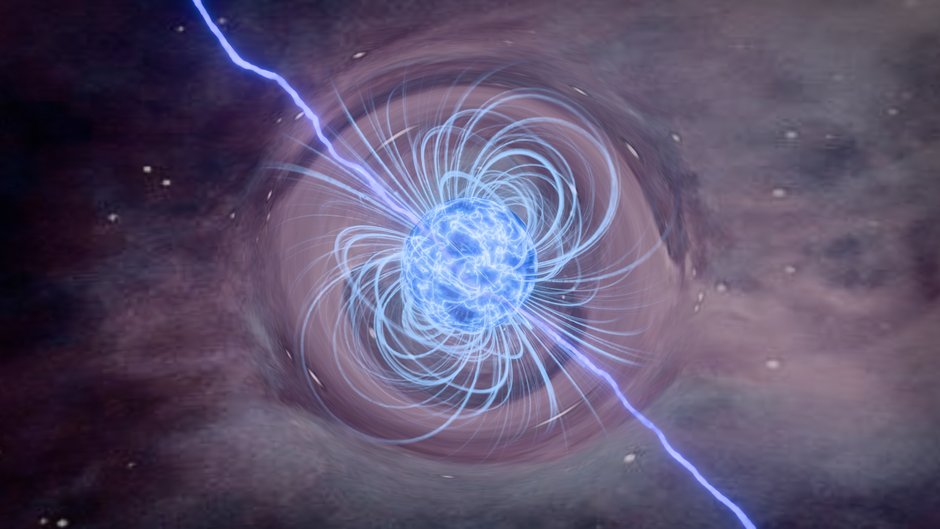
Astronomers map an entire galaxy cluster’s magnetic field for the first time
For the first time, scientists have reconstructed the magnetic field of an entire galaxy cluster, from its dense core to its diffuse outer halo, revealing how invisible forces shape the largest structures in the universe.
The achievement came from the deepest-ever radio observations of Abell 2255, a cluster roughly 1 billion light-years from Earth, using the Low Frequency Array (LOFAR) in Europe. By collecting 224 hours of radio data as part of the LOFAR Galaxy Cluster Ultra-Deep Field project, the team created a record-breaking map that shows how magnetic fields are woven through the cluster’s million-light-year-wide expanse.
Why magnetic fields in space matter
Galaxy clusters are the most massive structures in the universe held together by gravity, immense cities of hundreds or thousands of galaxies immersed in hot gas and permeated by magnetic fields. These fields are not passive features. They influence how cosmic rays travel, how gas cools and forms stars, and how energy from black holes and supernovae disperses through intergalactic space.
But until now, astronomers could only infer the presence of these fields. They had never directly mapped their shape and orientation across an entire cluster.
Andrea Botteon of Italy’s National Institute for Astrophysics (INAF), who led the study, said the work was driven by a fundamental question: “How are electrons accelerated to relativistic speeds and magnetic fields amplified on large cosmic scales?”
A field shaped by chaos and collision
The map revealed that the cluster’s magnetic field is not a random tangle. In some regions, the field lines follow specific radial directions, aligned with extended radio emissions. In areas dominated by shock waves, where gas slams together as the cluster continues to form, the fields are oriented tangentially, stretched and compressed by the turbulence of ongoing collisions.
This is the first observational evidence that the same violent processes building galaxy clusters, mergers, gas inflows, shock waves, also shape their magnetic fields.
“We believe that the mechanism that turns on these gigantic radio emissions is linked to the formation process of galaxy clusters,” Botteon said. “The coherence of the magnetic field lines observed in some regions suggests that the morphology of the field is intimately linked to the dynamics of the gas in which it resides.”
What comes next
The study, accepted for publication in Astronomy & Astrophysics, demonstrates that LOFAR’s ultra-deep observing capability can unlock magnetic field structures that were previously invisible. The same technique could now be applied to other clusters, building a picture of how magnetism evolves as the universe’s largest building blocks assemble over cosmic time.
The findings help answer a longstanding puzzle: how magnetic fields that are far too weak to detect directly with conventional instruments become amplified to the strengths observed in clusters today. The answer, it appears, lies in the same gravitational violence that creates the clusters themselves.