

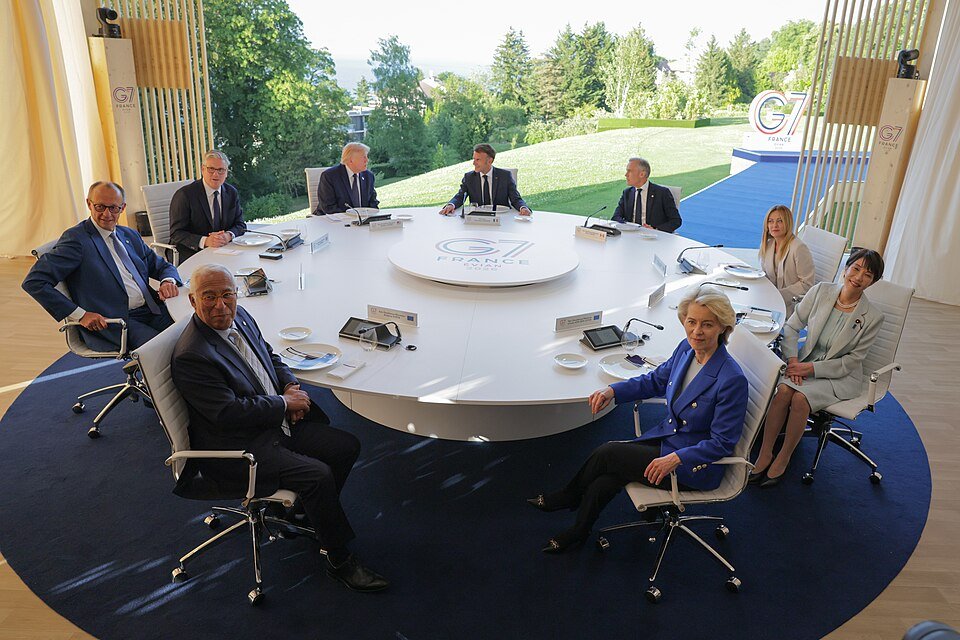
Evian-les-Bains is hosting a summit with two agendas, and the gap between them is the real story of this G7. European leaders arrived determined to keep Ukraine at the center of the conversation, but President Trump has made clear his focus lies elsewhere: closing out the Iran nuclear file and pressing allies on trade imbalances. French President Emmanuel Macron, host of the 52nd G7 and the man trying to hold the room together, is simultaneously pushing Ukraine talks and offering France’s most powerful naval asset to secure the Strait of Hormuz.
The three-day summit, which opened June 15 in the French Alpine resort town, was supposed to confront global economic imbalances, the grinding war in Ukraine, and the Iran nuclear standoff. Instead, it has become a study in diverging priorities between the United States and its European partners, with Macron working both sides of the table.
European allies scramble to keep Ukraine on the agenda
For Europe, Ukraine remains the existential question. With the war now in its fourth year and Russian forces pressing along multiple front lines, European members of the G7 have spent the opening sessions trying to refocus Trump’s attention on Kyiv. Diplomatic sources told Reuters and the Guardian that leaders from France, Germany, and the United Kingdom have urged Trump to host direct negotiations between President Volodymyr Zelensky and Russian President Vladimir Putin on U.S. soil.
The push reflects a growing European anxiety that Washington’s attention is drifting. Without sustained American military aid and political backing, European capitals worry that Ukraine’s defensive positions could buckle. Trump, for his part, struck a conciliatory tone in public but downplayed the war’s direct impact on the United States, telling reporters, “I’ll do whatever I can,” while offering no new commitments on aid or weapons.
Trump’s Iran pivot
Trump’s focus on Iran has been the most visible point of friction. The president wants to use the G7 as a platform to declare the Iran nuclear deal effectively resolved and to shift the burden of Gulf security onto regional partners. European leaders, however, view the Iran file as far from closed. They argue that Tehran has not met core verification demands and that a premature declaration of victory could destabilize the broader Middle East.
The tension was on full display during the closed-door sessions on June 15. European diplomats described Trump as resistant to expanding the summit’s Ukraine-focused working groups, preferring instead to steer discussion toward Iran sanctions and trade imbalances with the European Union.
France offers the Charles-de-Gaulle for Hormuz security
Into this two-front summit, Macron has injected a dramatic military offer. France is ready to deploy combat aircraft, a frigate, and the aircraft carrier Charles-de-Gaulle to secure the Strait of Hormuz, according to a report from Franceinfo. The French carrier strike group had already transited the Suez Canal in May and moved toward the Red Sea, positioning it for a potential Hormuz mission.
The offer builds on Macron’s earlier proposal, reported June 15, to use the Charles-de-Gaulle as part of a reopened international security framework for the strait, through which roughly 20% of the world’s oil passes. France and the United Kingdom had already proposed a joint Hormuz security mission earlier this year. The deployment would serve dual purposes: reassuring Gulf allies of Europe’s commitment to freedom of navigation while sending a signal to Iran that the G7 is prepared to back diplomacy with military posture.
Zelensky and Trump meet face to face
On June 16, Trump, Macron, and Zelensky held a closed-door trilateral meeting on the summit sidelines. It was the first face-to-face encounter between Trump and Zelensky in four months, and European officials had been pressing for it since the summit began. The meeting produced no major breakthroughs. Zelensky pressed for continued U.S. air defense support and urged Trump to use American leverage to bring Putin to the table. Trump listened but offered no new package, according to aides who briefed reporters afterward.
The tension at the table
What is emerging in Evian is not a divided summit in the traditional sense, but a fundamentally asymmetrical one. European leaders are negotiating from a position of strategic dependence, needing American security guarantees for both Ukraine and the Gulf while facing a U.S. administration that sees both theaters as primarily European responsibilities. Macron is trying to bridge the gap by offering European assets to fill the void, offering French naval power for Hormuz and French diplomatic hosting for Ukraine talks. But whether one carrier group and one summit can resolve the underlying divergence remains an open question.
As the G7 enters its final day on June 17, the core dynamic is unchanged: Europe needs America’s attention, and America’s attention is elsewhere. The Charles-de-Gaulle may secure a strait, but holding the alliance together requires something the agenda alone cannot provide.