

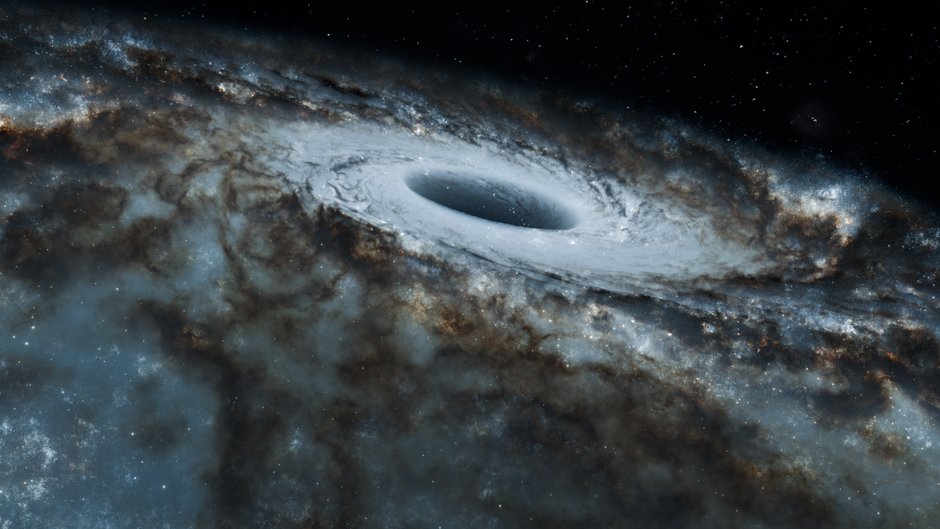
The gap between stellar-mass black holes and the supermassive giants at the centers of galaxies has been a persistent hole in the cosmic inventory. Intermediate-mass black holes, ranging from hundreds to tens of thousands of solar masses, have been frustratingly elusive.
Now a team of astronomers has found two promising candidates hiding in the dynamic spectra of fast radio bursts.
Using data from the CHIME/FRB Catalog 2, researchers led by Huan Zhou developed a pipeline to search for gravitational microlensing signatures in FRB signals. When an FRB passes near a massive compact object, the object’s gravity bends and focuses the radio waves, creating interference patterns in the burst’s dynamic spectrum that reveal the lens’s mass.
Two Candidates
The team identified two such signatures. FRB 20190131D appears to have been lensed by an object of 280 to 467 solar masses. FRB 20211115A points to a lens of 539 to 609 solar masses. Both fall squarely in the intermediate-mass regime, bridging the gap between stellar-mass black holes of roughly 10 solar masses and the million-plus solar masses of supermassive black holes.
If no intervening galaxies lie along the line of sight to these FRBs, the two objects may be isolated intermediate-mass black holes of primordial origin, meaning they formed shortly after the Big Bang rather than through stellar collapse. In that scenario, primordial black holes in this mass range would account for roughly 4% of dark matter.
A Clean Probe
FRB microlensing offers a clean way to detect dark, compact objects that would otherwise be invisible to telescopes. Unlike traditional searches for intermediate-mass black holes that rely on gravitational wave signatures or X-ray emissions from accretion, microlensing works regardless of whether the black hole is actively feeding.
The technique does come with caveats. The team cautioned that a deeper understanding of whether FRB emission mechanisms can produce lensing-like signals will be essential before the method can be fully established as a standard tool.
If the candidates are not genuine lensing events, the upper limit on intermediate-mass primordial black holes above 300 solar masses stands at roughly 13% of dark matter at 95% confidence.
The findings were published as a revised preprint on arXiv on July 23.