

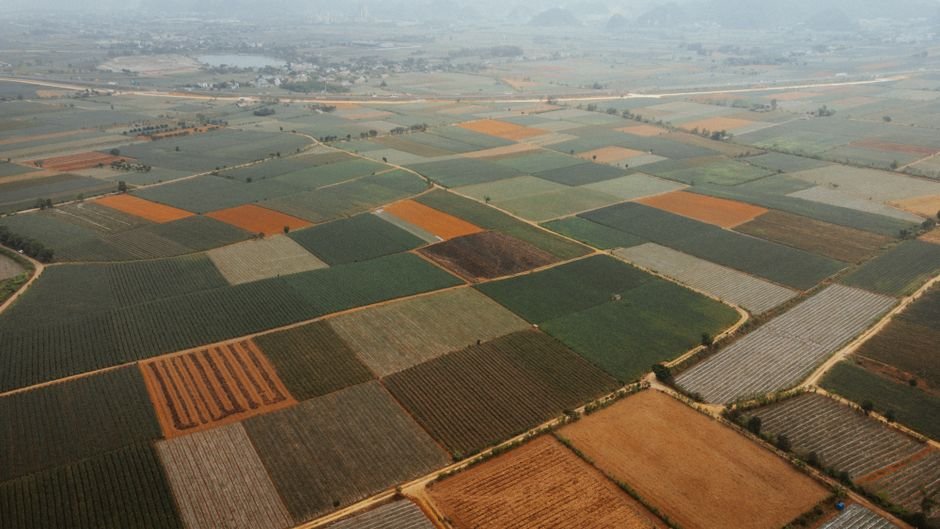
The global food system is caught in a paradox: it produces enough calories for a growing population, yet contributes roughly a third of greenhouse gas emissions, drives deforestation, and leaves more than half the world’s population unable to afford or access healthy diets. The hidden costs of current food production have been estimated at US$10–20 trillion annually, a figure that includes environmental damage, biodiversity loss, and diet-related disease.
A new study published in Nature by an international team of modelers led by Gibson and colleagues asks what would actually happen if the world got serious about changing course. Their answer, drawn from a 10-model ensemble, is that a full transformation would fundamentally restructure global agriculture, breaking with historical trends in land use, livestock production, and emissions.
The scenario
The study models a “transformed food system” built on three pillars: universal adoption of the EAT-Lancet 2.0 reference diet (a predominantly plant-based dietary pattern emphasizing vegetables, fruits, legumes, nuts, and whole grains, while limiting red meat, sugar, and saturated fats); continued agricultural productivity improvements; and a 50% reduction in food loss and waste.
The scenario, labeled EL2, was run through 10 global economic and biophysical models, including MAgPIE, GLOBIOM, IMAGE, and AIM, each with different assumptions about land productivity, trade responses, and consumer behavior. The ensemble approach is designed to capture the range of plausible outcomes rather than a single projection.
What the models found
The results are striking in both scale and direction. Under the EL2 scenario by 2050:
- Agricultural land shrinks by 274 million hectares, the largest absolute decline in more than 2,000 years, bringing global farmland back to approximately 1970s levels.
- Ruminant meat production falls by 53% (range across models: 77% to 15%), with the total number of ruminant animals dropping to 1996 levels, 400 million fewer animals than in 2020.
- Non-ruminant meat (poultry, pigs) declines by 14%.
- Dairy production drops 27%, though dairy animal numbers fall only 3% due to improved yields.
- Cereal and sugar crop production decline by 23% and 34% respectively.
- Vegetables, fruits, nuts, and legumes increase by 23% on average, though the range across models is wide (from a 45% decline to a 53% increase), reflecting uncertainty about how quickly production systems can pivot.
- Non-CO₂ greenhouse gas emissions from agriculture fall 34% below business-as-usual and 20% below 2020 levels, a reduction of 1.2 gigatons of CO₂-equivalent.
The structural shift in agricultural output value is even more dramatic. Under the transformation scenario, the livestock sector’s share of total agricultural value falls from 36% (business-as-usual) to 20%, while the VFN sector (vegetables, fruits, nuts, and legumes) rises from 34% to 58%. Ruminant meat’s value drops by 81%, lower than any year since 1961.
Regional winners and losers
The model projections are not uniform across the globe. Sub-Saharan Africa sees a 60% increase in agricultural output value under EL2, driven largely by higher VFN demand and improved productivity. India’s value rises 40%.
China and Brazil, by contrast, see substantial declines of 42% and 35% respectively, reflecting their roles as the world’s largest animal feed producers and livestock exporters. Europe and the United States increase ruminant exports as a share of production, while South and Central America’s export share falls.
A break with history
The most striking finding, the authors emphasize, is that the transformation would break with historical trends that have been stable for decades. Agricultural land has been shrinking gradually in some regions, but the 274-million-hectare reduction under EL2 is unparalleled in the modern era. Grazing land contracts at roughly 2.5 times the rate observed between 2000 and 2020.
The authors note that this scale of transformation would require a paradigm shift in the role of farmed animals in the global food system. It would also generate new challenges: approximately 65% of currently grazed land is unsuitable for crop production and could be abandoned, raising questions about rural livelihoods, land management, and ecosystem restoration.
Caveats and uncertainties
The study is a scenario analysis, not a prediction. It assumes costless dietary preference shifts, the models do not account for behavioral inertia, cultural resistance, or industry opposition. The real challenge of moving hundreds of millions of people toward a different diet, particularly in food environments dominated by ultra-processed products, is acknowledged by the authors as a significant barrier.
The hidden-cost estimates of current food systems, US$10–20 trillion annually, come from the EAT-Lancet 2.0 Commission (The Lancet, 2025) and include health costs from diet-related disease, environmental damage, and biodiversity loss. The Nature study models the production-side transformation but does not independently estimate these co-benefits.
Agricultural employment declines by a median of 28% in both scenarios, though the composition shifts: crop-sector employment is 17% higher under EL2 than business-as-usual, while livestock employment is 36% lower. The authors caution that policies to support transitioning workers and communities will be essential.
Sources:
1. Gibson, M. et al. “Food systems transformation would reshape global agriculture.” Nature (2026). DOI: 10.1038/s41586-026-10775-2
2. EAT-Lancet 2.0 Commission. The Lancet 406(10512), 1625–1700 (2025). DOI: 10.1016/S0140-6736(25)01201-201201-2)