

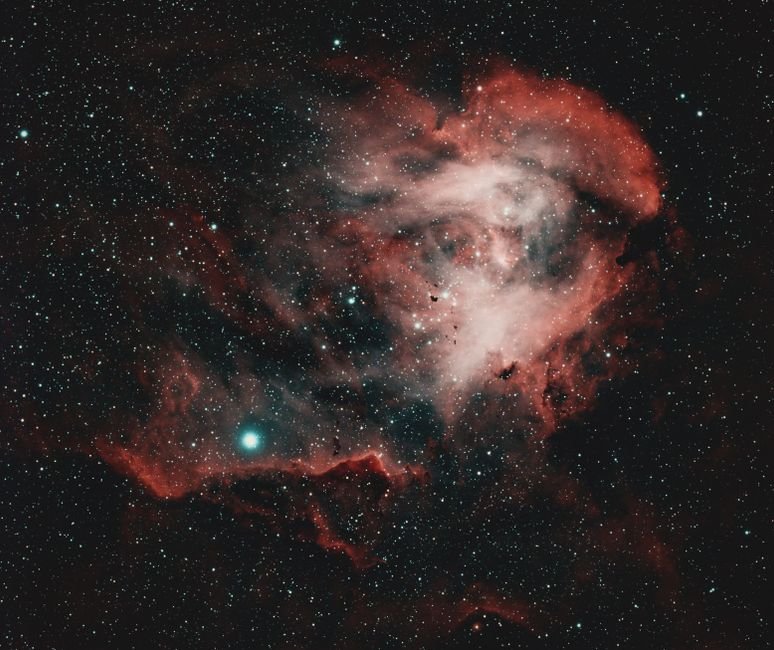
Euclid discovers the most ancient quasar ever seen, at 670 million years after the Big Bang
ESA’s Euclid space telescope has discovered the most distant quasar ever observed, a supermassive black hole-powered beacon shining when the universe was just 670 million years old, about 5% of its current age of 13.8 billion years.
The quasar, designated EUCL J172902.75+641018.1, has a redshift of 7.77, surpassing the previous record of 7.64 set in 2021 by about 15 million years. Its light has traveled for more than 13 billion years to reach Euclid’s mirror.
The discovery is part of a haul of 31 new quasars announced on July 6 in Astronomy & Astrophysics, including a second record-breaker at redshift 7.69 and 12 objects at redshift 7 or higher. Before Euclid, astronomers had found only about nine quasars at those extreme distances over more than a decade of searching. Euclid matched that total in about a single year of observations.
“The Euclid team has taken a true census of quasars at the dawn of the universe for the first time,” said Antonio La Marca, an ESA Research Fellow and co-author of the study.
How Euclid found them
Euclid’s unique combination of capabilities makes it the first telescope able to conduct a wide and sensitive search for the earliest quasars. It will eventually cover more than one-third of the sky through its Euclid Wide Survey, uses sharp space-based imaging free from atmospheric distortion, and sees in the near-infrared wavelengths where light from the most distant objects has been stretched by the expansion of the universe.
The detection pipeline used machine learning applied to Euclid’s optical and near-infrared images to identify “dropout” signatures, the telltale spectral break that marks high-redshift quasars. Ancillary data from the Subaru Telescope’s Hyper Suprime-Cam, the Dark Energy Survey, and LOFAR helped narrow the field. Ground-based spectroscopic follow-up using the Keck Observatory, Magellan telescopes, and the Large Binocular Telescope confirmed 31 quasars with a success rate of about 30%, about 10 times better than previous survey efforts.
“Euclid is a true game changer,” said Daming Yang of Leiden University, lead author of the study. “It lets us search far more efficiently to capture much fainter light. It is a unique tool for quasar hunting.”
Why it matters
Quasars are supermassive black holes at the centers of galaxies, actively consuming surrounding gas and shining with the light of trillions of stars. Finding them at redshifts above 7 means probing a time when the universe was undergoing its last major transition: the epoch of reionization, when cold, neutral hydrogen was broken apart by the first stars and galaxies, making the universe transparent for the first time.
These quasars act as cosmic beacons, illuminating conditions during that era. But the bigger question is how supermassive black holes reached millions or billions of solar masses in less than 700 million years. The leading theories propose either direct collapse of massive gas clouds or rapid growth from stellar-mass seeds, and a statistically meaningful sample of early quasars is the key to distinguishing between them.
“This is one of the greatest mysteries in astrophysics,” Yang said. “By finding and studying these quasars, we can better understand how these enormous systems formed and grew so quickly.”
A glimpse inside an early quasar
The second-most distant quasar in the haul, at redshift 7.69, was studied in detail by a companion paper led by Silvia Belladitta of the Max Planck Institute for Astronomy. The observations show it embedded inside a dusty, gas-rich galaxy that is furiously forming new stars, providing the first detailed view of the host environment of an early supermassive black hole.
“Discovery is only the first step,” Belladitta said. “Observing these objects across the full electromagnetic spectrum allows us to characterize the environments of these quasars and their host galaxies.”
Euclid launched in July 2023 aboard a SpaceX Falcon 9 and began routine science operations in February 2024. Its Data Release 1, expected in late 2026, will be the largest space-based map of the universe ever produced. The full six-year survey is expected to uncover hundreds more high-redshift quasars, possibly including the first examples above redshift 8.
“Ancient quasars are rare discoveries,” said Valeria Pettorino, ESA Euclid Project Scientist. “They are interesting in themselves, but also time machines that enable us to explore the early universe.”
Sources: ESA, Astronomy & Astrophysics (D. Yang et al., DOI: 10.1051/0004-6361/202658883), Phys.org, Euclid Consortium