

The hat is a shape that should not exist. Discovered in 2023 by the amateur geometry enthusiast David Smith and collaborators, it is a 13-sided polykite that can tile an infinite plane with no gaps and no repetition, the first single shape, or monotile, to solve the so-called einstein problem that had stood for half a century. Mathematicians studied it for its own sake; physicists have now carved it into silicon, where it does something no ordinary crystal can: scatter light with a handedness, or chirality, that a repeating structure could never produce.
The experiment, reported in Nature Communications by researchers at the Institute of Industrial Science of the University of Tokyo, NTT, and the Institute of Science Tokyo, began with the observation that the hat tiling has a peculiar symmetry. The lattice of tile centers has perfect threefold rotational symmetry but no mirror symmetry, making it chiral, with left and right genuinely different, unlike conventional quasicrystals such as the Penrose tilings, which typically carry mirror symmetry.
Holes in a film, light on a screen
The team fabricated a 350-nanometer (13.8-microinch)-thick film of silicon nitride on a silicon substrate and used electron-beam lithography to pattern roughly 372,100 circular holes, each 100 nanometers (3.9 microinches) in radius, into the shape of a six-generation hat tiling over an area about half a millimeter (0.02 inches) across. A mirrored counterpart was made for comparison.
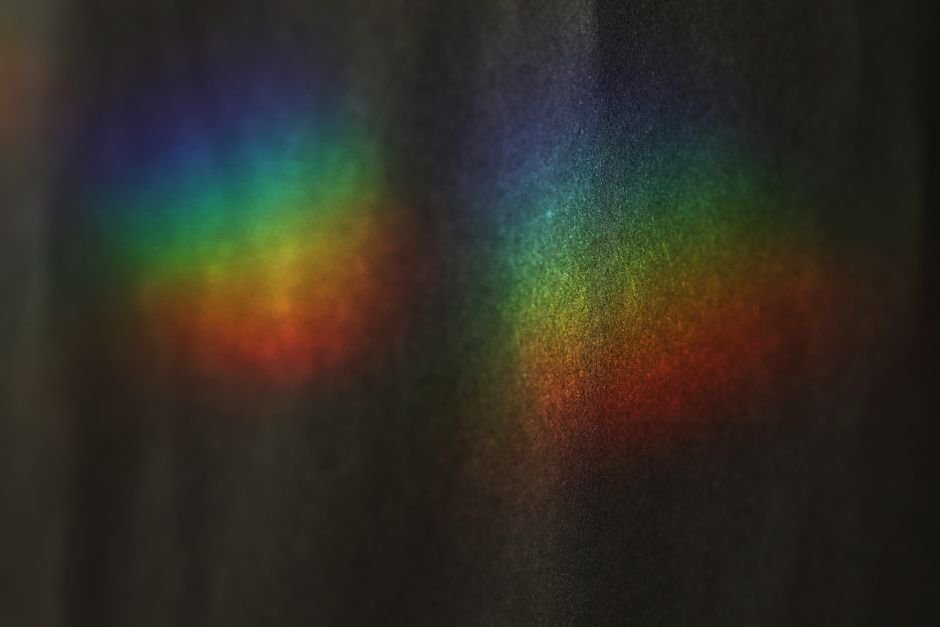
When a green laser shone onto the structure at normal incidence, the reflected diffraction pattern projected onto a screen showed sharp Bragg peaks whose positions did not depend on where the beam struck, experimental confirmation that the arrangement has long-range quasiperiodic order, like a quasicrystal. Under white light, the pattern became a pinwheel that lacked mirror symmetry, twisting in a single direction, with the twist angle reported around 15.5 degrees. Etching the mirrored tiling reversed the pinwheel’s handedness, confirming that the effect came from the structure itself.
The chirality is a two-dimensional structural property (the absence of in-plane mirror symmetry) rather than the three-dimensional handedness of a molecule. Because the structure lacks mirror symmetry, the scattered field inherits that handedness, and left- and right-circularly-polarized light scatter differently. Mirror-symmetric quasicrystals, the authors argue, cannot produce this effect.
From bathroom floor to photonics
The einstein tile’s name is a pun on the German ein Stein, one stone, with no connection to Albert Einstein. The discovery capped a search begun with Roger Penrose, who in 1974 needed two shapes to tile aperiodically. Smith’s hat, built from the honeycomb lattice, was the first single shape to do it; a strictly chiral single-tile variant called the spectre followed.
The new work is a proof of concept rather than a device. The polarization dependence was described as subtle, and the experiments measured light scattered from the surface, not light guided inside a chip. But the demonstration establishes chiral quasiperiodic structures as a platform beyond conventional quasicrystals, with potential relevance to polarization control, optical communications, and optical computing. The lead researcher, Yuto Moritake, plans next to apply the pattern to control light inside photonic-chip waveguides, toward optical communications and computing devices.
The mathematical groundwork came from J. E. S. Socolar, who computed the hat tiling’s diffraction analytically in 2023 and established its quasiperiodicity. The new experiment realizes that structure in silicon and reads its optical signature. For a shape that began as an answer to a pure-mathematics puzzle, the hat has found a second life as a building block for light.
Sources
- Moritake, Y., Takiguchi, M., Aihara, T., Notomi, M. “Chiral diffraction from aperiodic monotile structure.” Nature Communications 17: 6085 (2026). DOI: 10.1038/s41467-026-75023-7
- arXiv:2506.07561 (preprint, June 2025)
- EurekAlert press release, Institute of Industrial Science, University of Tokyo, July 29, 2026
- Scientific American, July 29, 2026
- Live Science, August 6, 2026