

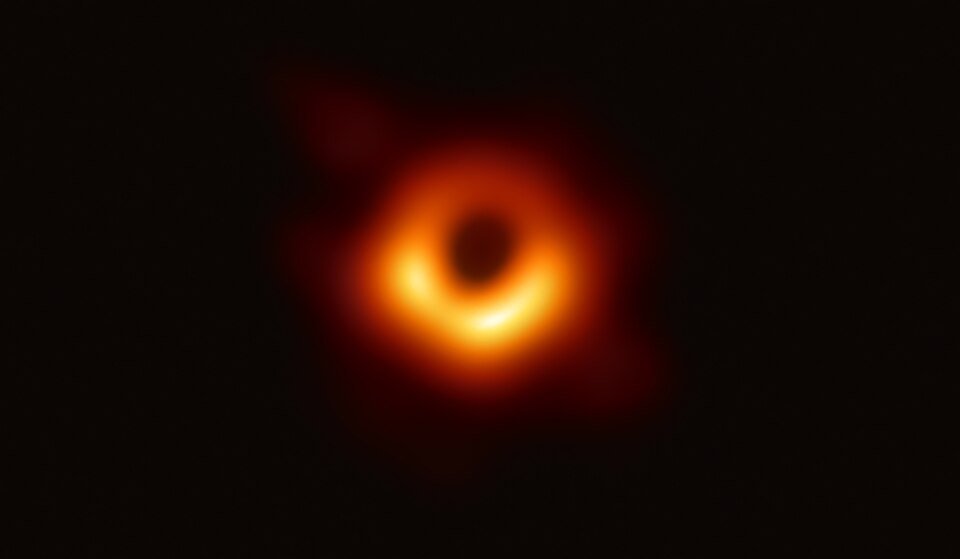
Astronomers have found the first hints that supermassive black holes may be surrounded by dense clouds of dark matter, using a novel technique that repurposes a standard method of weighing black holes: listening for light echoes.
The research, led by Mayank Sharma, a physics graduate student at Virginia Polytechnic Institute and State University (Virginia Tech), uses reverberation mapping, a technique that measures the time delay between a black hole’s flare and its reflected glow from surrounding gas, to probe the distribution of mass around 14 distant galaxies.
In five of those galaxies, the team found that the enclosed mass increases with distance from the black hole faster than visible matter alone can explain. The excess, described in a paper published in Physical Review D, is consistent with a dense halo of dark matter surrounding each supermassive black hole.
“We are reaching a point where the observational evidence for dark matter is simply undeniable,” Sharma said in a statement.
Seeing the invisible
Dark matter makes up roughly 85% of all matter in the universe, yet it remains invisible to every telescope ever built because it does not interact with electromagnetic radiation. Its presence is inferred solely through gravity: the rotational speeds of galaxies, the bending of light around galaxy clusters, and the large-scale structure of the cosmos all point to an unseen mass that holds everything together.
Around a supermassive black hole, the situation is particularly murky. The black hole’s immense gravity strips surrounding matter into a glowing accretion disk, but dark matter cannot join that disk. Because it does not interact with ordinary matter or with itself through friction, it has no way to lose angular momentum and spiral inward. Theory predicts it should simply hover on the outskirts, forming a dense but invisible spike.
“That was the problem,” Sharma told Space.com. “We could actually test this prediction using a technique in astronomy which allows you to measure the distance to the surrounding gas by looking for echoes of light.”
How echo mapping works
Reverberation mapping, also called echo mapping, relies on a simple principle: when matter falls toward a supermassive black hole, it releases a burst of energy that causes the accretion disk to pulse. That pulse of light travels outward, striking gas clouds at various distances from the black hole. Those clouds absorb the light and re-emit it as a secondary pulse: an echo.
Because the speed of light is constant, the time delay between the initial pulse and the echo reveals the distance to the gas cloud. Using the virial theorem, the team can then calculate the total enclosed mass at that distance. By observing multiple emission lines (helium, hydrogen-alpha, hydrogen-beta) that probe different radii, they built a radial mass profile for each galaxy.
The key question: does the enclosed mass grow with radius at a rate consistent with just the central black hole, or is there extra mass that cannot be accounted for by visible matter?
Five galaxies show a signal
Of the 14 galaxies studied, five showed a clear preference for a model that includes dark matter. The strongest signal came from a galaxy called 3C 390.3, located roughly 4 billion light-years away. In that object, the Bayesian Information Criterion strongly favored the dark matter model, with approximately 60% of the enclosed mass at the outermost mapped radius attributed to unseen matter.
The best-fit dark matter density profile had a slope of approximately gamma equals 1.6, consistent with a theoretical “dark matter spike” that has been mildly relaxed by stellar heating over billions of years.
The team is careful not to overstate the result. “These galaxies are definitely showing a hint that there is extra material that cannot be explained by just the supermassive black hole,” Sharma said. “The prospects are exciting.”
The statistical significance ranges from one to two sigma, suggestive but not definitive. Nine of the 14 galaxies showed no clear preference for a dark matter signal.
A new window on the dark universe
If confirmed with larger samples and higher-cadence observations, the method would open an entirely new window on dark matter physics. By probing the sub-parsec environment around supermassive black holes in distant galaxies, reverberation mapping could test predictions of the cold dark matter paradigm at scales that are otherwise inaccessible.
Future missions such as the ULTRASAT ultraviolet transient survey and the Vera C. Rubin Observatory’s Legacy Survey of Space and Time could provide the high-cadence data needed to turn this proof of concept into a robust detection.
For now, Sharma and his colleagues have demonstrated that the tool works. The question is what it will find when applied to hundreds of galaxies instead of 14.
“There is a huge discrepancy,” said co-author Nahum Arav, a Virginia Tech physicist. “What we see is much less than what we need.”
Whether that discrepancy points to dark matter around black holes or requires a revision of the models, the echo mapping technique has given astronomers a way to find out.