

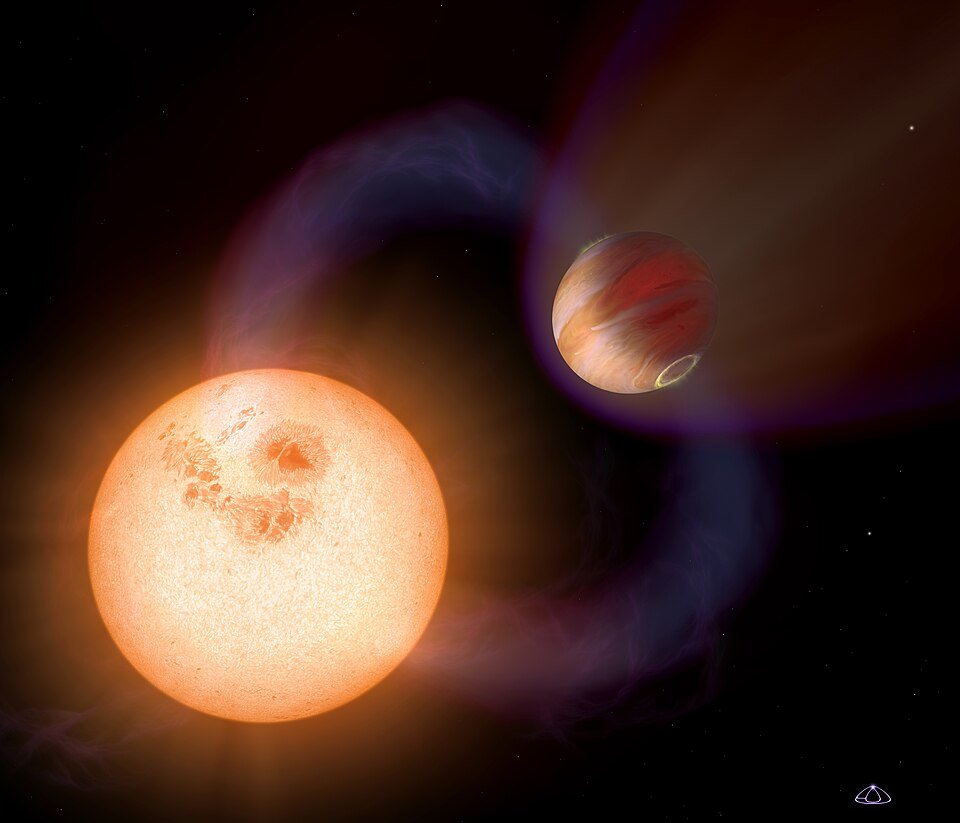
Featured image: [Artist’s concept of the Sun as a red giant, with Earth in the foreground; credit: ESA/Hubble (M. Kornmesser)]
For decades, the standard answer to the question of Earth’s ultimate fate has been grim: in roughly 5 billion years, the Sun will swell into a red giant, engulf the inner planets, and incinerate whatever remains of our world. New research published in Astronomy & Astrophysics suggests that answer may be wrong.
A team led by astronomer Mats Esseldeurs at KU Leuven in Belgium has used state-of-the-art tidal physics to model Earth’s orbital evolution through the Sun’s red giant branch (RGB) and asymptotic giant branch (AGB) phases. Their conclusion: Earth is likely to survive.
“Earth’s fate depends on a delicate balance between two effects,” Esseldeurs told AFP. “If tidal interactions predominate, Earth is engulfed by the Sun. If the Sun’s mass loss predominates, Earth escapes into an orbit larger than the radius of its star.”
A tug-of-war between tides and mass loss
When the Sun exhausts its core hydrogen supply roughly 5 billion years from now, it will begin a dramatic transformation. First, it swells into a red giant, expanding to roughly 256 times its current radius while losing mass through powerful stellar winds. After a brief helium-burning phase lasting about 130 million years, it enters the asymptotic giant branch, expanding even further before finally settling into a slowly cooling white dwarf.
Earth’s fate during this process is determined by a tug-of-war between two competing forces. Tidal interactions between Earth and the swollen Sun create a drag that pulls Earth’s orbit inward, toward eventual engulfment. At the same time, the Sun’s relentless mass loss weakens its gravitational hold on Earth, causing the planet’s orbit to expand outward.
Which force wins depends critically on two poorly understood factors: the efficiency of tidal dissipation inside the aging Sun, and the rate at which the Sun loses mass during its AGB phase.
New physics, new outcome
Previous studies, most notably a widely cited 2008 paper by Schroder and Smith, concluded that tidal effects would dominate and Earth would be engulfed during the AGB phase. But those models relied on older, simplified prescriptions for tidal dissipation.
Esseldeurs and colleagues used new ab initio (first-principles) calculations of tidal dissipation in evolved stars, which replace the earlier parameterized models with physics derived from simulations of stellar interiors. The difference is decisive: the new models predict significantly weaker tidal dissipation, meaning Earth’s orbit decays less than previously expected.
“Better understanding of tidal physics and the most advanced constraints we have on mass loss allow us to say that, in the current state of knowledge, Earth could move away from the Sun, contrary to what was predicted before,” said co-author Stephane Mathis of CEA Paris-Saclay.
The L2 Puppis clue
The second critical uncertainty is how much mass the Sun will lose during its AGB phase, and at what rate. Different theoretical prescriptions produce mass-loss rates differing by more than an order of magnitude, a spread that flips the outcome from engulfment to survival.
To break the ambiguity, the team turned to an observational proxy: L2 Puppis, an AGB star located roughly 200 light-years away with an initial mass of about 0.98 solar masses, nearly identical to the Sun. L2 Pup has two independent estimates of its mass-loss rate: a dust-based measurement suggesting a high rate, and a carbon-monoxide-based measurement suggesting a low rate.
Combining the higher (dust-based) mass-loss estimate with the new tidal model predicts that Earth will survive both the RGB and AGB phases. Mercury and Venus are still doomed (they lie too close to the Sun to escape), but Earth and Mars would drift outward into wider orbits as the Sun sheds its outer layers.
Not a clean bill of health
The authors caution that Earth’s survival is not guaranteed. The dust-based and CO-based mass-loss measurements for L2 Pup differ by a factor of roughly 100, underscoring how poorly constrained AGB mass loss remains. If the true rate is closer to the low end, Earth could still be swallowed.
Nor does survival mean the planet remains habitable. The Sun’s luminosity has been increasing by roughly 1 percent every 100 million years throughout its main-sequence life. Long before the red giant phase begins, the oceans will boil and the atmosphere will strip away. Earth will be a charred, airless rock for millions of years before the engulfment question even becomes relevant.
“The survival of the Earth and the inner Solar System is not robustly determined,” the paper concludes. “Given the current observational uncertainties in AGB mass-loss rates, the ultimate fate of the Earth remains uncertain.”
Still, the study marks a significant shift. For the first time, the best available physics suggests that Earth may not share the fate of Mercury and Venus. Whether our planet drifts into the darkness of a wider orbit or is consumed by the dying Sun, the answer depends on details of stellar physics that astronomers are only now beginning to untangle.
The PLATO mission, scheduled for launch later this year, will dramatically increase the number of known planets orbiting red giant stars, giving astronomers a population-level perspective on how planetary systems like ours typically end.