

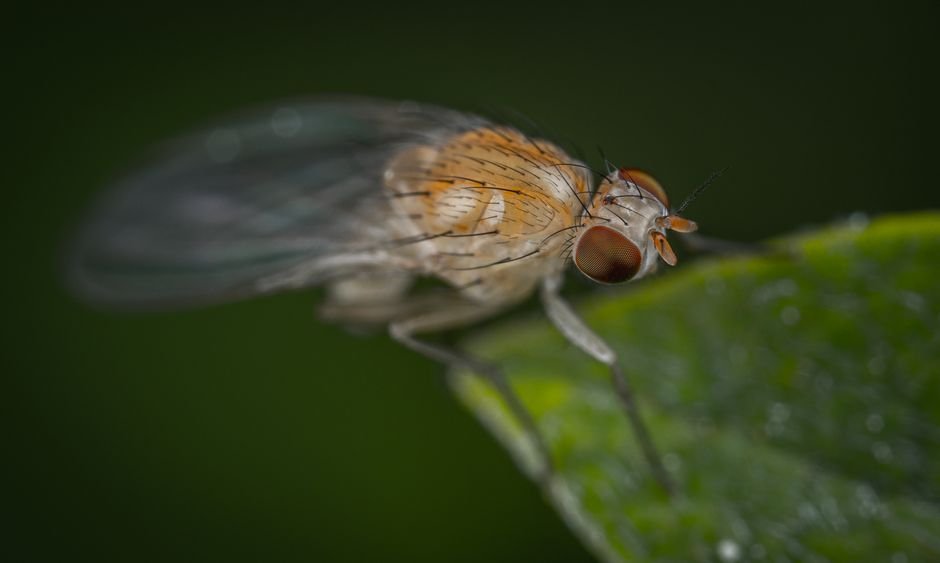
The fruit fly brain is the size of a poppy seed. It contains roughly 100,000 neurons, fewer than the number of people in a small stadium. With that meager allotment of biological hardware, a fly must find food, evade predators, navigate turbulent air, and remember where it is going after losing a scent. The prevailing assumption in neuroscience has been that complex cognitive operations such as working memory and evidence accumulation require the elaborate, layered circuitry of the mammalian cortex. A study published July 25 in Nature Communications challenges that assumption at its foundation.
Researchers at NYU School of Medicine have discovered that a tiny population of neurons in the navigation center of the Drosophila brain simultaneously performs both working memory and evidence integration during odor-guided flight. The finding suggests that these fundamental cognitive operations do not depend on cortical architecture at all. They may be general solutions to navigation problems that evolution discovered early and refined across species, solutions that engineers building neuromorphic artificial intelligence systems would do well to study.
Working Memory in a Single Neural Bump
The team, led by Nicholas D. Kathman, Aaron J. Lanz, Jacob D. Freed, and Katherine I. Nagel, focused on a set of local neurons in the fan-shaped body, a structure within the fly central complex that functions as a navigation center. Using a genetic line called VT062617-Gal4, they labeled a small population of these neurons and then performed two-photon calcium imaging while flies navigated a virtual odor environment.
In the setup, a fly walked on an air-supported ball while a camera system (FicTrac) tracked its rotations and translated them into movement through a virtual world. Wind direction was controlled by the fly itself in a closed loop, while odor pulses were delivered on a fixed schedule. This allowed the researchers to observe neural activity as the fly experienced the equivalent of flying through a natural odor plume.
What they saw was remarkable. A localized bump of neural activity, spanning just one or two columns of the fan-shaped body, activated when the fly encountered the odor. After the odor stopped, the bump did not disappear immediately. It persisted, in some cases for many seconds, in others for only a brief moment. The persistence times followed an exponential distribution with a characteristic time constant of 5.59 seconds.
This is working memory in its purest form: the storage of a goal direction after the sensory cue that established it has vanished. The bump encoded the direction the fly should travel relative to the wind, an allocentric frame of reference, meaning it represented a fixed goal in the external world, not the fly’s own heading. When the fly turned, the bump position stayed stable. The animal carried an internal compass pointing toward where it needed to go.
Behavioral Consequence of Forgetting
The existence of such persistent activity is notable in itself, but the team went further by connecting it to behavior. When the neural bump persisted, flies maintained straighter trajectories and deviated less from their goal heading. The heading standard deviation dropped significantly (p = 5.0 x 10^-6). When the bump collapsed, the deviation from the goal direction increased sharply (p = 0.0002). The fly, in effect, forgot where it was going and began to wander.
This behavioral correlation establishes a direct link between the persistent neural activity and the animal’s ability to maintain a course. The bump is not an epiphenomenon; it is the neural substrate of a remembered heading.
Evidence Accumulation in the Same Circuit
The second major finding is that the same neuron population also performs evidence integration over time. In nature, odor plumes in turbulent air are not continuous streams. They are patchy, intermittent filaments of scent broken by gaps of clean air. An animal navigating by smell must integrate encounters over time to determine whether it is still on the right track.
The researchers simulated this natural condition by delivering a turbulent plume structure to the flies while imaging the same fan-shaped body neurons. The neural activity did not simply switch on and off with each puff. It ramped up progressively with successive odor encounters. A decorrelation analysis revealed that the system acts as an odor filter that integrates information over roughly 10 seconds into the past.
This is textbook evidence accumulation, the same process that, in vertebrates, is associated with parietal and prefrontal cortical circuits and is modeled as a drift-diffusion process. In the fly, it happens in a few hundred neurons inside a brain region no larger than a grain of salt.
Causal Proof and Optimal Timing
To determine whether this persistent activity is causally involved in maintaining upwind heading, the team used optogenetic silencing. They expressed GtACR1, a light-activated chloride channel that silences neurons, in the same VT062617 population. When the researchers silenced these cells immediately after odor offset, the flies turned sooner and more sharply away from the upwind direction. They could not hold their course without the sustained neural activity.
A control experiment reinforced the specificity of the finding. A different population of fan-shaped body neurons, labeled by the line 52G12, showed only transient activity that correlated with turning movements. These neurons did not exhibit persistent activity. The working memory function is not a general property of the navigation center. It belongs specifically to the VT062617 population.
The team also addressed the question of why the persistence time constant is 5.59 seconds. Working with John Crimaldi’s lab, which specializes in plume physics, they ran computational simulations using real data from turbulent boundary-layer plumes. The simulations varied the memory time constant and measured navigational performance. The real value of approximately 5.5 seconds was near the optimal point for navigating naturalistically structured plumes. A shorter memory would cause the fly to give up too quickly during gaps in the odor signal; a longer memory would cause it to persist on incorrect headings after the plume has shifted. Evolution appears to have tuned the circuit to the statistics of the environment.
Implications for Intelligence, Natural and Artificial
The broader significance of this work extends well beyond the fly. It suggests that working memory and evidence accumulation are not emergent properties of large, complex neural networks. They are solutions that can be implemented in very small circuits, perhaps even in the simplest possible circuits that can perform navigation at all.
This realization has implications for evolutionary neuroscience. If insects and vertebrates independently evolved working memory circuits, convergent evolution would be one explanation. But an alternative is more provocative: perhaps the common ancestor of bilaterian animals, which lived more than 500 million years ago, already possessed a navigation circuit capable of these computations. In that case, the fly brain is not a stripped-down approximation of a mammalian brain. It is a conserved archetype, a design that has worked for half a billion years.
For artificial intelligence and neuromorphic computing, the implications are equally significant. Current AI systems that perform working memory and evidence accumulation typically require large recurrent neural networks or transformer architectures with millions or billions of parameters. The fly demonstrates that the same computations can be achieved with extreme efficiency. A population of local neurons spanning a few columns of a neuromorphic chip could, in principle, replicate the function.
The fact that both working memory and evidence integration co-localize to the same neural population is particularly striking. In the vertebrate brain, these processes are distributed across different regions and cell types. The fly compresses them into a single, compact module. Understanding how that module works at the circuit level might inspire new architectures for embodied AI systems that must navigate real-world environments with noisy, intermittent sensory data.
The Nature Communications paper, supported by the NINDS Brain Initiative, the NIDCD, and the National Science Foundation, is a reminder that the gap between insect and mammalian cognition may be narrower than it appears. A fly does not think in any sense we would recognize. But it remembers where it is going. It accumulates evidence. It makes navigational decisions. And it does all of this with a brain that could fit inside the period at the end of this sentence. Perhaps the question is not how much brain is needed for cognition, but how little.
References
Kathman, N.D., Lanz, A.J., Freed, J.D., & Nagel, K.I. (2026). Neural dynamics for working memory and evidence integration in the Drosophila navigation center. Nature Communications. DOI: 10.1038/s41467-026-75945-2