

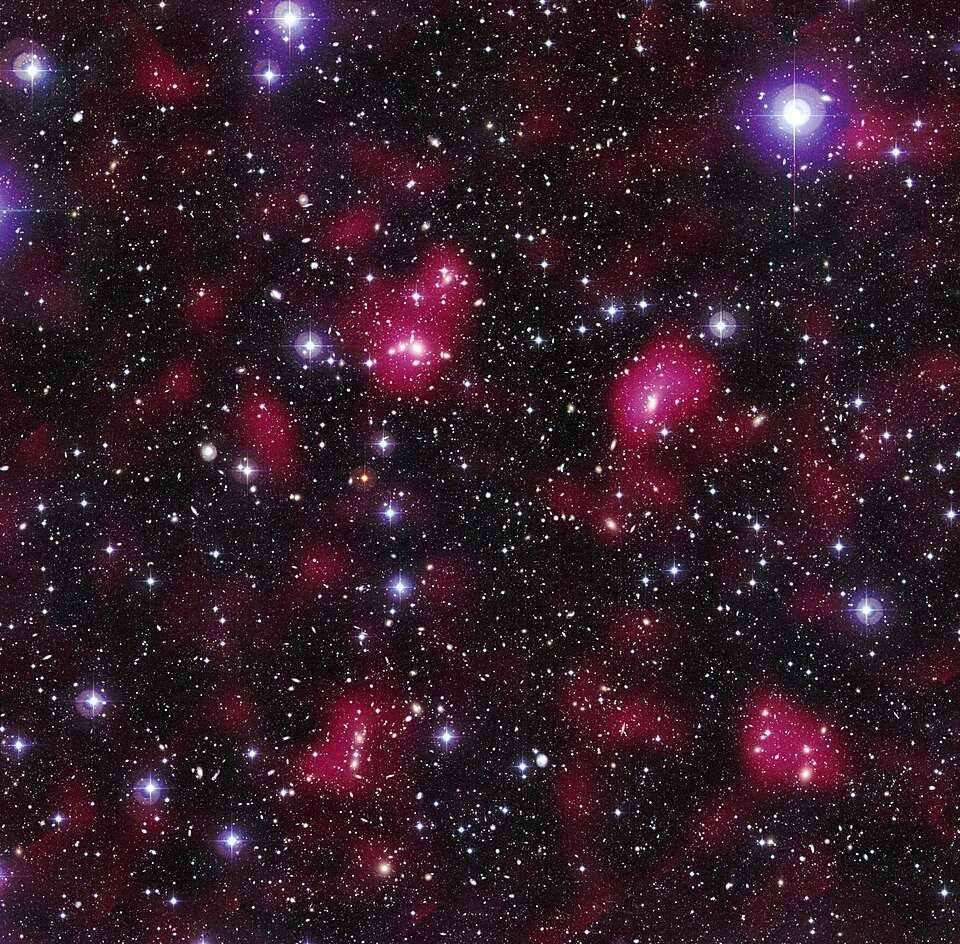
Featured image: [Artist’s concept of dark matter particles decaying in a galaxy halo; credit: ESA/Hubble, NASA, J. Mould]
One of the deepest assumptions in modern cosmology is that dark matter is stable. It has been there since the early universe, and it will be there, unchanged, for the foreseeable future. But what if that assumption is wrong?
A new paper by Jeremy Mould, a cosmologist at Swinburne University of Technology in Australia, takes a hard look at whether the data can support the idea that dark matter decays into other particles over cosmic time. The answer, submitted to the Journal of Cosmology and Astroparticle Physics, is not yet, but the tools to find out are nearly here.
“If dark matter decays, it would leave a measurable discrepancy in the matter density of the universe between the early cosmos and today,” Mould writes. “But current data is not precise enough to tell us whether that discrepancy exists.”
The matter density test
The logic of the experiment is simple in principle. The Cosmic Microwave Background, the afterglow of the Big Bang, provides an exquisitely precise measurement of the universe’s matter density at roughly 380,000 years after the Big Bang, a redshift of about 1,100. The Planck satellite pinned this number at omega_m equals 0.3153 plus or minus 0.0073.
If dark matter is perfectly stable, that same density should hold today, 13.8 billion years later. But if dark matter particles decay into lighter particles, perhaps into neutrinos, or photons, or other invisible products, the local universe would contain less matter than the early universe. The difference, delta omega_m, would be a direct signature of decay.
The problem is that measuring the local matter density is far harder than measuring the CMB. The local universe is messy: galaxies have uncertain masses, the spaces between galaxies contain diffuse gas that is difficult to detect, and mapping the full distribution of dark matter requires assumptions about how it clusters.
A messy accounting problem
Mould compiled local matter density estimates from several independent techniques and found a troubling spread. A catalog of galaxies within 20 megaparsecs, combined with gas measurements from fast radio bursts and estimated dark matter in intergalactic space, gives a local omega_m of roughly 0.228. The GAMA survey, using galaxy masses and halo relations, gives 0.176. The DES supernova survey, which probes the last 5 billion years, gives values as high as 0.33.
Compared to Planck’s 0.315, the local estimates range from a possible 10 percent deficit to essentially no deficit at all. The systematic uncertainties are simply too large to draw a conclusion.
“Current local inventories of baryonic and dark matter are subject to systematic uncertainties,” Mould writes. “A definitive verdict on late-time dark matter decay is currently hard to pin down.”
Four ways dark matter could decay
The paper examines four specific decay scenarios to see whether existing constraints already rule them out.
The first is a neutrino channel, where a heavy dark matter particle decays into a Standard Model neutrino and an invisible fermion. This model, proposed by Acharya and Johnson in 2026, reduces clustering dark matter at late times while evading most collider and direct detection bounds.
The second is primordial black holes, which lose mass through Hawking radiation. For black holes in the asteroid mass window (roughly 10 to the minus 17 to 10 to the minus 11 solar masses), the evaporation rate depends strongly on mass. Those below 10 to the minus 13 solar masses would have produced too much ionization in the early universe, contradicting Lyman-alpha forest observations. Larger ones survive essentially unchanged.
The third is a two-body decay, in which a cold dark matter particle decays into two identical products. The energy released goes into kinetic energy of the products, avoiding the ionization constraints that plague other models. This scenario is motivated by recent DESI measurements suggesting roughly 5 percent less matter in the late universe than Planck predicts.
The fourth and simplest is a finite lifetime for dark matter. For any electromagnetic decay channel, the particle must have a lifetime of at least 1.4 times 10 to the 40 years to maintain a neutral intergalactic medium across cosmic time. That is roughly 30 orders of magnitude longer than the current age of the universe.
What comes next
Mould does not claim to have found evidence for dark matter decay. His paper argues the opposite: the data is simply not good enough to tell. But he is optimistic that the situation will change within the next decade.
High-resolution spectroscopic surveys will improve galaxy mass measurements. Next-decade X-ray missions will detect the warm-hot intergalactic medium that currently accounts for a large fraction of the missing baryons. Advanced weak lensing campaigns will map dark matter halos at unprecedented resolution. And the Vera C. Rubin Observatory will detect millions of supernovae, some of which could show microlensing signatures of primordial black holes in the asteroid mass range.
“Upcoming high-resolution spectroscopic surveys, next-decade X-ray missions, and advanced weak lensing campaigns will drastically reduce baryon and mass-mapping uncertainties,” Mould writes. “These will transform the late-time matter audit into a cleaner, more definitive test.”
For now, the question of whether dark matter decays remains open. It is a question that touches on the deepest foundations of cosmology: if dark matter is not stable, then the standard lambda-CDM model that has served as the backbone of cosmology for two decades will need revision. If it is stable, the apparent discrepancies between early and late universe measurements must have other explanations.
Either way, the answer will come not from a single experiment but from a painstaking accounting of every particle, visible and invisible, in the local universe.