

Dark Comets Finally Caught Sprouting Tails, Solving the ‘Oumuamua Mystery
Date: 2026-07-11
Featured image: Artist’s impression of the interstellar object ‘Oumuamua outgassing as a dark comet; credit: ESO/M. Kornmesser
Nearly a decade after the interstellar object ‘Oumuamua buzzed through the solar system and reignited speculation about alien technology, astronomers have finally caught the smoking gun that explains its strange behavior. Two independent teams have directly observed cometary tails sprouting from “dark comets,” objects that outgas like comets but rarely produce visible dust, resolving one of the most persistent mysteries in modern astronomy.
The work closes a debate that began in 2017, when ‘Oumuamua swept through the inner solar system and accelerated unexpectedly as it departed. No visible tail was observed, which led some scientists to speculate about exotic explanations ranging from hydrogen icebergs to alien sailcraft. The most natural explanation was always that ‘Oumuamua was a dark comet, an object rich in ice that releases gas without kicking up enough dust to be seen.
A Tail Found by Motion, Not Sight
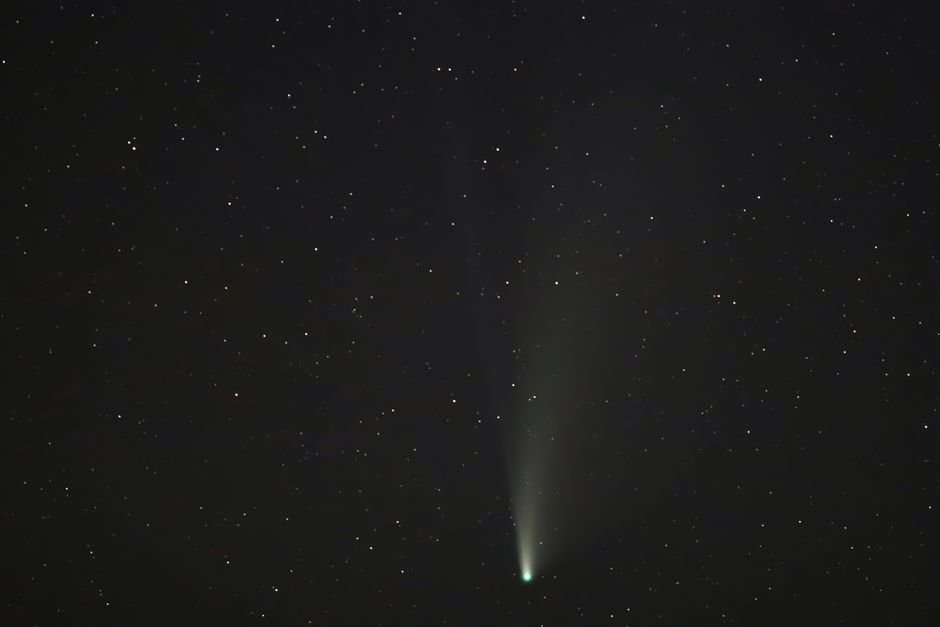
A team led by NASA Jet Propulsion Laboratory scientist Davide Farnocchia, reporting in Nature Astronomy, used the Very Large Telescope in Chile to image a cometary tail on a dark comet after first detecting its nongravitational acceleration. This marks the first time a comet has been discovered by its motion alone rather than a glimpse of its distinctive tail.
!Diagram showing the orbital path of a dark comet with annotated tail detection

Conceptual illustration of how nongravitational acceleration reveals dark comets; credit: NASA/JPL-Caltech
“It doesn’t just contextualize ‘Oumuamua’s acceleration,” Farnocchia told reporters. “It also offers a potential breakthrough in our understanding of the solar system’s inventory of comets and asteroids.”
In a complementary study published in the Planetary Science Journal, a separate team led by Zhang identified a second dark comet’s tail using archival data from the ESA/NASA SOHO mission.
Nearly 20 Dark Comets and Counting
Shortly after ‘Oumuamua’s passage, astronomers began noticing that several near-Earth asteroids were also accelerating in a comet-like manner. By 2023, two papers led by Michigan State University’s Darryl Seligman had identified the first seven dark comets. Today, nearly 20 are known, and the new tail observations confirm that these are not a separate class of object but rather ice-rich comets that only sporadically produce visible tails.
The discovery implies that the solar system contains far more comets than previously thought, with many masquerading as asteroids in survey catalogs. “Finding an abundance of dark comets scattered around the solar system could represent a major advance in our understanding of the origins of oceans, habitability and life on our planet,” Seligman wrote in an accompanying Scientific American piece.
Implications for Earth’s Origins
Comets are rich in water ice and organic compounds, the raw ingredients for life. Dark comets lurking in near-Earth space could help explain how Earth acquired its oceans and the prebiotic chemistry that led to life, a delivery mechanism that has been theorized for decades but never directly linked to an abundant celestial population.
Upcoming facilities are poised to accelerate the discovery rate. NASA’s Near-Earth Object Surveyor, the Vera C. Rubin Observatory, and the James Webb Space Telescope will together map, characterize, and measure the composition of dark comets. Webb, in particular, can determine whether these objects carry water ice or more exotic ices such as carbon monoxide or carbon dioxide.
For ‘Oumuamua, the answer is now clear: it was not an alien spaceship. It was a natural comet, just one that hides its tail so well that it took astronomers eight years and a new method of discovery to prove it.