

How to Tell a Comet From an Asteroid and a Meteor From a Meteorite
Date: 2026-06-29
Featured image: [Composite illustration showing a comet, asteroid, and meteor against a star field; credit: NASA/JPL-Caltech]
Next time you see a streak of light across the night sky, you are watching the end of a journey that began 4.6 billion years ago. Whether that flash came from a comet, an asteroid, or something else depends on where it formed, what it is made of, and how it meets its end in Earth’s atmosphere.
A recent article in Scientific American, republished from The Conversation and written by astronomer Adam Lark of Hamilton College, offers a clear guide to telling these celestial visitors apart. The distinctions are rooted in the earliest history of the solar system.
Asteroids and comets are both leftovers from the formation of the planets, but they come from very different neighborhoods. Asteroids formed in the warm inner solar system, made mostly of rock and metal that could withstand high temperatures. The largest of these planetesimals grew into the terrestrial planets: Mercury, Venus, Earth, and Mars. The leftovers are the asteroids we see today, concentrated primarily in the main belt between Mars and Jupiter.
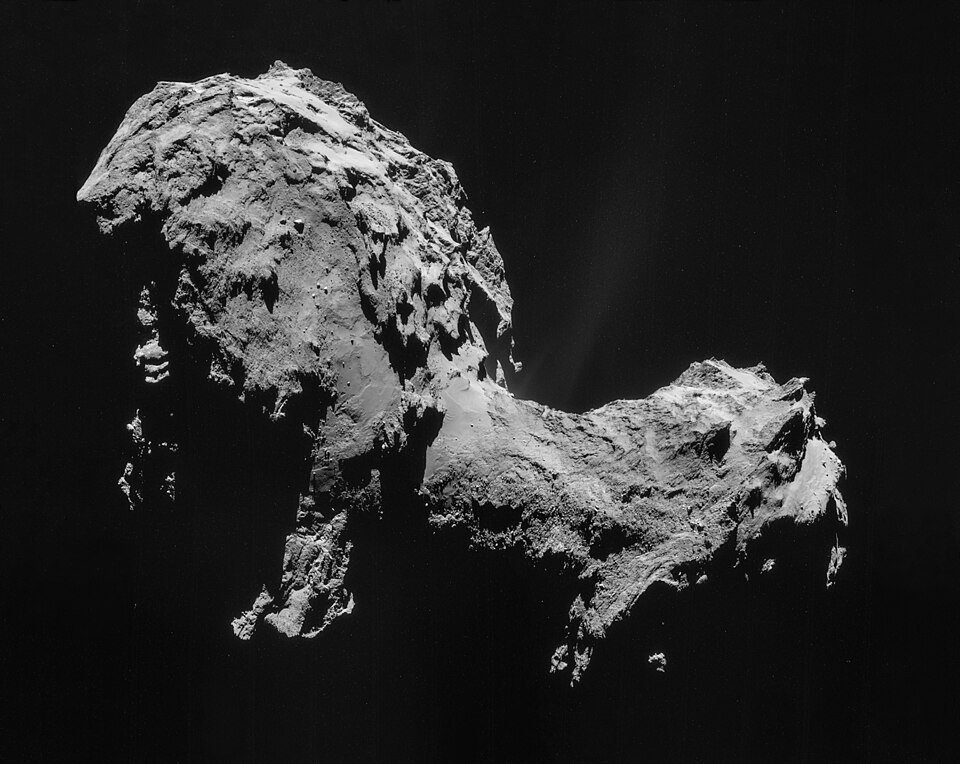
Comets, by contrast, formed in the cold outer solar system, where water and other volatile ices could survive. They are mixtures of rock, metal, and frozen gases, earning them the nickname “dirty snowballs.” Some of these outer planetesimals grew large enough to hold onto hydrogen and helium atmospheres, becoming the gas giants Jupiter, Saturn, Uranus, and Neptune. The leftovers became comets.
The meteor moment
A meteor is not a type of object at all. It is the bright streak of light, commonly called a shooting star, produced when a space rock enters Earth’s atmosphere at high speed and vaporizes. Millions of meteors occur every day, most from particles the size of a grain of sand.
Where that particle came from determines what kind of show it puts on. Asteroids that collide with Earth travel at dozens of kilometers per second, creating a single bright fireball with a sonic boom and shock wave. The intense heat and pressure vaporize the asteroid, producing a trail of ionized gas.
Comets produce a different spectacle. They travel on long, highly elliptical orbits that bring them close to the Sun. Each time a comet approaches the Sun, its ices warm and sublimate, releasing gas and dust that form the characteristic tail. Over many orbits, the comet leaves a trail of debris along its path. When Earth crosses one of these debris fields, we see an annual meteor shower with dozens or even hundreds of streaks per hour.
The Perseids (peaking in mid-August from debris left by Comet Swift-Tuttle), the Geminids (December from asteroid 3200 Phaethon), and the Quadrantids (January) are among the most reliable and prolific showers.
When a meteor becomes a meteorite
If a meteoroid is large enough to survive the fiery passage through the atmosphere and reach the ground, the surviving fragment is called a meteorite. Most meteorites that reach the surface are between the size of a pebble and a fist, and they come from asteroids larger than a football field.
Identifying a meteorite on the ground is not easy. They resemble Earth rocks but tend to be dense, magnetic (high in iron and nickel), and often have a smooth black fusion crust from atmospheric melting. They are best found in geologically unchanged regions such as deserts and ice fields. Anyone who thinks they have found a meteorite is advised to verify its features against identification guides and contact local geologists.
Some of the most famous meteorites in history have reshaped our planet. The Chicxulub impactor, a 10-to-15-kilometer-wide (6 to 9 miles) asteroid that struck 66 million years ago, ended the age of dinosaurs and killed 70 percent of all species. The Tunguska event in Siberia in 1908, caused by an asteroid or comet roughly 30 meters across, flattened 80 million trees over an area of 2,150 square kilometers. The Chelyabinsk airburst in 2013, from a 20-meter asteroid, injured 1,500 people primarily from shattered glass.
A question of scale and structure
Not all asteroids are solid rocks. Many of the smaller ones, especially those under 10 kilometers (6 miles) in diameter, are actually rubble piles: loose collections of shattered debris held together by their own weak gravity. These have low density with large cavities between chunks, and most rotate slower than 2.2 hours; anything faster would cause them to fly apart. Notable examples include Itokawa (sampled by Japan’s Hayabusa mission), Bennu (by NASA’s OSIRIS-REx), and Ryugu (by Hayabusa2).
Comets are equally varied in size. Comet Hale-Bopp, which dazzled observers in 1997, had a nucleus 40 to 60 kilometers (25 to 37 miles) across, far larger than typical comets. NASA has confirmed 3,535 comets but estimates there are billions in the outer solar system’s Kuiper Belt and Oort Cloud.
Why it matters
Understanding the difference between comets, asteroids, meteors, and meteorites is more than a matter of vocabulary. These objects are direct samples of the building blocks from which the solar system formed. Every meteor that burns up in the atmosphere and every meteorite that reaches the ground carries chemical information about conditions 4.6 billion years ago.
As Lark wrote in The Conversation, observing a meteor means witnessing the end of a 4.6-billion-year journey. Knowing what you are seeing, and where it came from, turns a fleeting streak of light into a window on the deep history of the solar system.