

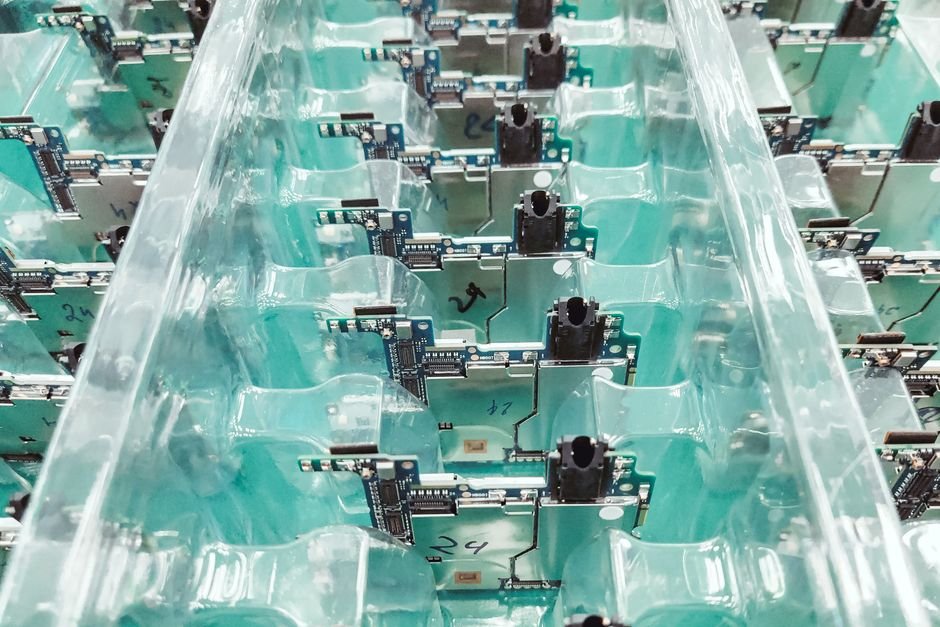
A Shanghai-based startup claims to have established the world’s first 8-inch pilot production line dedicated to two-dimensional semiconductors , a technology that could offer China a pathway to advanced chips without the extreme ultraviolet (EUV) lithography machines that US export controls block.
Yuanjiwei (also romanized as Yuanjiwei Semiconductor) says its pilot line covers the entire manufacturing chain from material preparation and device fabrication through chip integration and tape-out, moving 2D semiconductors from lab-scale demonstrations toward an industrial-scale pipeline. The company has set a target of reaching 5-nanometer-equivalent chip technology by 2029 without using EUV lithography.
“Compared with conventional silicon-based chips, 2D semiconductors offer several potential advantages,” Bao Wenzhong, chairman of Yuanjiwei, told the South China Morning Post. “Due to the atomic-scale thickness of 2D materials, transistors in 2D semiconductors could be made smaller without relying on increasingly complex transistor structures.”
Conventional silicon transistors at atomic scales suffer from electrical leakage, which wastes energy and generates heat. Two-dimensional semiconductors are made from materials only one or a few atoms thick, allowing electrons to move through an ultra-thin layer with excellent electrical performance even at extremely small dimensions. The ultra-thin layers also enable efficient three-dimensional stacking, potentially increasing compute and memory density without increasing the chip footprint.
Strategic context
The pilot line is part of a broader Chinese national push to reduce dependence on foreign semiconductor manufacturing equipment. US-led export restrictions have blocked Chinese companies from purchasing EUV lithography machines, which are essential for producing the most advanced silicon chips. Alternative approaches , including 2D semiconductors, chiplet architectures, and advanced packaging , have become central to China’s semiconductor strategy.
“The aim is for China to eventually be able to make advanced chips on machines that are entirely China-made,” an anonymous source with direct knowledge of the secret EUV project told Reuters.
Remaining challenges
Despite the milestone, significant hurdles remain before 2D semiconductors can reach commercial scale. Producing millions of identical atom-thin devices with high manufacturing yield is unproven at production volumes. No single company can commercialize 2D semiconductors alone , every part of the supply chain, from equipment manufacturers to materials suppliers, must advance together.
Many promising semiconductor technologies have failed to transition from research papers to mass production. Yuanjiwei’s pilot line represents a critical step from lab to fab, but commercial success is far from guaranteed.
Sources: Chinese startup claims world’s first 8-inch 2D semiconductor pilot production line (Interesting Engineering, July 12, 2026)