

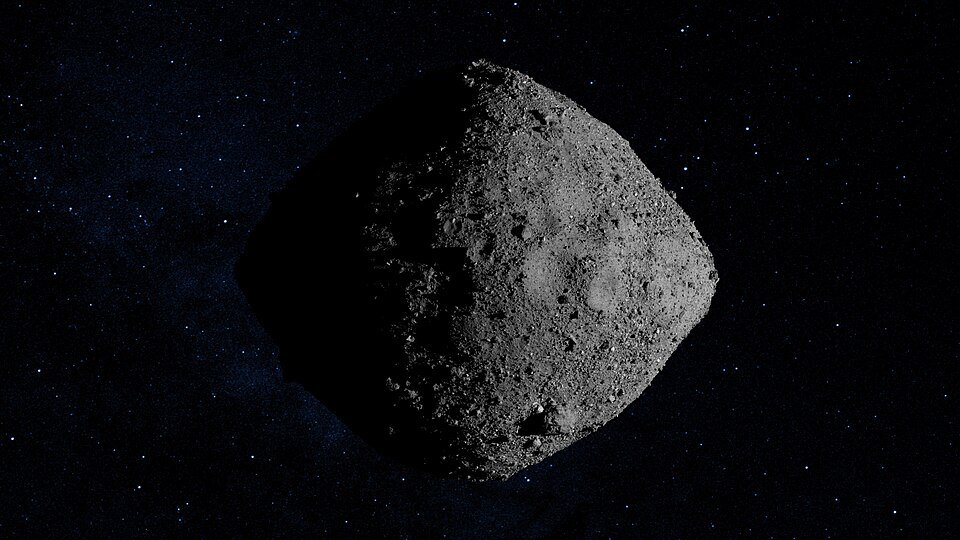
A Chinese spacecraft that slipped into orbit around Earth with almost no public fanfare has now reached its true destination: a bizarre object called Kamo’oalewa that dances alongside our planet but is not quite a moon. Tianwen-2, China’s first asteroid sample-return mission, arrived at the 40-to-100-meter-wide space rock on June 7 after a year-long cruise, and is now preparing for a landing attempt that would be unlike anything ever attempted in the history of planetary exploration.
The mission has been remarkably secretive. CNSA did not broadcast the launch live in May 2025. The first image of the spacecraft was released nearly two weeks after liftoff. CNSA has published no official mission timeline — all specific dates come from independent tracking and the reporting of Andrew Jones, a journalist who specializes in Chinese space programs. The arrival at Kamo’oalewa was never officially announced; it was confirmed only through independent orbital tracking.
Kamo’oalewa (full designation 469219 Kamo’oalewa, also known as 2016 HO3) is not a moon in the traditional sense. It is a quasi-satellite: an asteroid that orbits the Sun in a 1:1 resonance with Earth, taking the same 365.77 days to complete one orbit, and appearing from our perspective to loop around the planet. But it is not gravitationally bound to Earth.
“The way Kamo’oalewa moves with Earth is kind of like a dog that might tag along with you for a while on a long walk through the woods, but it’s not your dog,” said Richard Binzel, a planetary scientist at MIT.
The asteroid is small — about the size of a Ferris wheel — and spins rapidly, completing one rotation every 28 minutes. It has been accompanying Earth for roughly 100 years and is expected to remain in this configuration for another 300 before drifting away.
What makes Kamo’oalewa scientifically extraordinary is its likely origin. Spectroscopy in 2021 and dynamical modeling in 2024 suggested that the asteroid is not a typical near-Earth object from the main asteroid belt. Instead, it appears to be a fragment of the Moon itself — possibly ejected from the 22-kilometer-wide Giordano Bruno crater on the lunar far side by a large impact. If confirmed, Kamo’oalewa would be the first identified piece of the Moon orbiting Earth as an independent body.
The Landing That Has Never Been Done
Tianwen-2 carries three sampling techniques to handle either of two possible surface types. If the asteroid turns out to be a loose rubble pile of gravel and dust — like Bennu or Ryugu, which were visited by NASA’s OSIRIS-REx and Japan’s Hayabusa2 — the spacecraft will perform a touch-and-go maneuver, hovering above the surface while a robotic arm scoops up at least 100 grams of material. This technique has been demonstrated before.
If Kamo’oalewa is a solid, monolithic rock, the spacecraft will attempt something that has never been done: it will land directly on the asteroid, anchor itself in place with a drill, and extract a sample from the solid surface. The probe carries small explosives to expose potential subsurface volatiles, and the anchoring system is designed to hold the spacecraft against the asteroid’s negligible gravity during drilling.
“We don’t yet know the object’s composition or origin,” said Li Chunlai, chief commander of Tianwen-2’s ground system. “We’ll only obtain definitive answers after completing our exploration.”
The timeline, pieced together from independent tracking and pre-launch documents, places the landing attempt around July 4. If successful, the spacecraft will spend the following months conducting close-up science with its 11 instruments — including a visible-infrared imaging spectrometer, a subsurface detection radar, a magnetometer, and the DIANA dust analyzer contributed by Italy — before departing in April 2027 and returning the sample capsule to Earth in November 2027.
Beyond the Sample Return
After dropping its sample capsule to Earth, Tianwen-2 will not be done. The spacecraft will use a gravity assist from Earth to redirect itself toward a second target: the main-belt comet 311P/PanSTARRS, which it is scheduled to rendezvous with in 2035, well beyond the orbit of Mars. The 10-year dual-mission design makes Tianwen-2 one of the most ambitious deep-space missions ever attempted by any nation.
The mission’s broader significance extends beyond the sample. Understanding the composition of quasi-moons has implications for planetary defense — knowing what these objects are made of helps develop mitigation strategies if one were ever on a collision course with Earth. It also matters for human exploration: quasi-moons have been proposed as potential staging points or resource depots for future missions to Mars, since they are energetically cheap to reach from Earth.
But for now, the focus is on the next few weeks. Tianwen-2 is mapping Kamo’oalewa from progressively lower altitudes — 20 kilometers, 3 kilometers, 600 meters, 300 meters — selecting a landing site for an attempt that, if the asteroid is solid, will be a first in the history of space exploration.
Sources: (1) Baker H. A secretive Chinese probe has just arrived at one of Earth’s ‘quasi-moons’ and will soon attempt a first-of-its-kind landing. Live Science. 17 June 2026. (2) Jones A. China’s Tianwen-2 probe operating normally on approach to asteroid. SpaceNews. 26 February 2026. (3) CNSA/Xinhua launch and mission announcements. (4) Sharkey BNL, et al. Lunar-like silicate material from the Earth quasi-satellite (469219) 2016 HO3 Kamo’oalewa. Nat. Commun. 2021. (5) Jiao Y, et al. Giordano Bruno crater as the source of Kamo’oalewa. 2024.