

China Hits Back: Beijing Sanctions 10 US Defense Companies, Excludes 46 Others From Government Procurement in Retaliation for Pentagon Blacklist
China imposed sweeping sanctions on Monday against American defense and industrial firms, retaliating for the Pentagon’s recent decision to add major Chinese technology companies to its blacklist of military-linked entities. The coordinated countermeasures, announced simultaneously by Beijing’s Commerce and Finance Ministries, mark the latest escalation in the ongoing technology and defense rivalry between the world’s two largest economies.
The Commerce Ministry placed 10 American industrial suppliers on its export control list, blocking them from receiving Chinese “dual-use” items, goods that have both civilian and military applications. The ministry ordered that “any relevant export activities currently underway must cease immediately.” In a provision with potentially far-reaching global implications, the ban also applies to organizations or individuals in third countries who might attempt to transfer Chinese-origin dual-use items to the sanctioned firms.
Separately, China’s Finance Ministry announced a ban on government procurement from 46 US companies, including major defense primes such as Lockheed Martin, Raytheon, General Dynamics, Anduril Industries, and the Boeing defense division. Companies with US investments operating in China were excluded from the procurement ban, a carve-out that may shield some American-affiliated joint ventures.
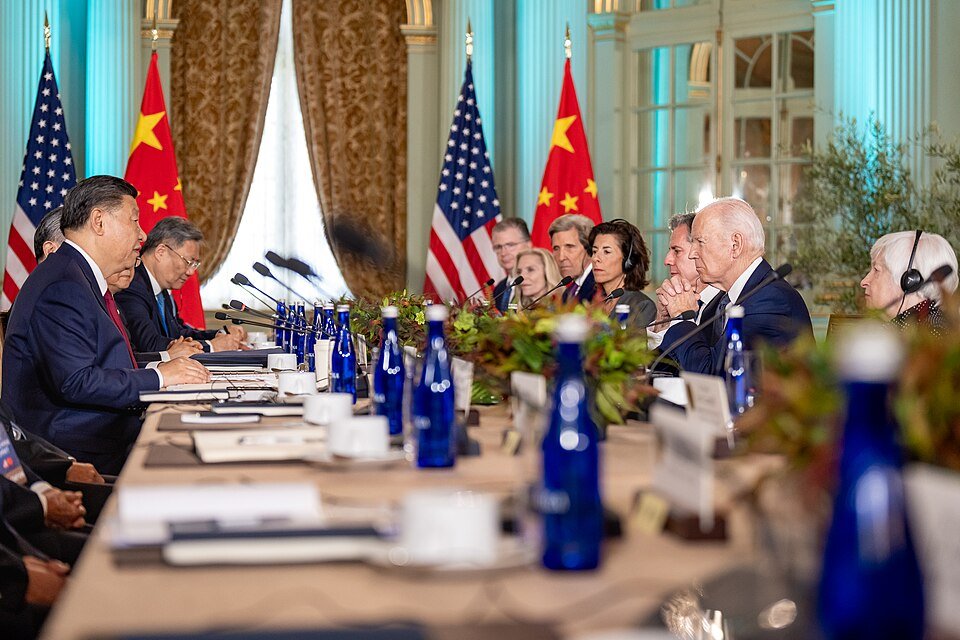
The sanctions came just weeks after US President Donald Trump’s visit to Beijing in May, where he and Chinese President Xi Jinping publicly agreed to work toward reducing tariffs and stabilizing bilateral trade relations. That diplomatic moment now appears increasingly fragile as both capitals continue to deploy economic statecraft against each other’s defense and technology sectors.
The 10 sanctioned companies span aerospace, robotics, drone manufacturing, military vehicle production, and rare earth mining. They include Aveox (Simi Valley, California), a supplier holding aerospace defense contracts with the US military; Red Cat Holdings and its subsidiary Teal Drones (South Salt Lake, Utah), which produce military drone systems; IMSAR (Springville, Utah), a radar and sensor specialist; Jaia Robotics (Bristol, Rhode Island), an autonomous underwater vehicle developer; Ball Aerospace & Technologies (Broomfield, Colorado); Oshkosh Defense (Oshkosh, Wisconsin), which manufactures military vehicle fleets for the US armed forces; L3Harris Maritime Services (Norfolk, Virginia); MP Materials (Las Vegas, Nevada); and USA Rare Earth (Stillwater, Oklahoma).
Notably, the inclusion of MP Materials and USA Rare Earth signals Beijing’s willingness to weaponize its dominance over critical mineral supply chains. MP Materials operates the Mountain Pass rare earth mine in California, one of the few rare earth processing facilities outside China, yet remains dependent on Chinese supply chains for downstream processing. USA Rare Earth is developing domestic rare earth processing capabilities. The sanctions could complicate their access to Chinese-sourced materials and processing technology critical to their operations.
China’s Commerce Ministry framed the sanctions as a defensive necessity. The measures were taken, the ministry said, to “safeguard national security” and in response to what Beijing described as the US government’s “wrongful expansion of its so-called List of Chinese Military Companies.” Earlier this month, the Pentagon added several of China’s most prominent technology firms to that list, including Alibaba, search engine giant Baidu, and electric vehicle manufacturer BYD. Baidu called the suggestion that it is a military company “totally baseless.” The designation bars those companies from US defense contracts and is intended to expose them to greater scrutiny.
China’s Commerce Ministry said at the time that the American sanctions contradicted the consensus Xi and Trump reached during the May summit in Beijing. Monday’s retaliatory measures suggest that diplomatic reassurances from Beijing have done little to deter the Communist Party from using its economic leverage against US defense interests.
Several of the sanctioned firms were already under Chinese sanctions imposed in 2024 and 2025 over US arms sales to Taiwan, the self-governing island that Beijing claims as its own territory. Taiwan relies heavily on Washington’s security backing to counter growing military and political pressure from Beijing, which has not ruled out using force to bring the island under its control. The Pentagon has described China’s military modernization, particularly its naval buildup, as a growing threat to regional stability.
Complicating the picture further, US Secretary of State Marco Rubio said this month that a proposed $14 billion arms package to Taiwan, which would be one of the largest ever, is “under review.” The package, if approved and delivered, would almost certainly trigger another round of Chinese sanctions and further degrade what remains of bilateral trust between Washington and Beijing.
The latest round of tit-for-tat sanctions underscores a deepening structural reality: despite periodic summits and tariff reduction pledges, the US-China relationship is increasingly defined by competition over technology supply chains, defense industrial bases, and strategic minerals. Each side appears prepared to accept economic pain in pursuit of what it frames as national security imperatives. The Pentagon blacklist and Beijing’s retaliation are not aberrations but features of a new normal in great-power competition.
For American defense firms, particularly those that rely on Chinese rare earths or dual-use components, the sanctions create real operational vulnerabilities. For Chinese tech giants locked out of US defense contracts, the Pentagon blacklist imposes reputational and commercial costs. And for the global supply chains that connect the two economies, the cumulative weight of overlapping sanctions regimes is becoming an increasingly difficult navigation problem.
The Commerce Ministry said Chinese companies could still apply for export approval for dual-use goods deemed “genuinely necessary,” a standard exception that Beijing has included in previous sanctions regimes. How strictly that exception is administered will determine the practical severity of the sanctions.
As both Washington and Beijing expand their respective blacklists and export control lists, the space for normal commercial activity between the two countries continues to shrink. The May summit’s rhetoric of tariff reduction and cooperation now stands in sharp tension with the reality of deepening sanctions warfare, a contradiction that neither capital has so far been able to resolve.