

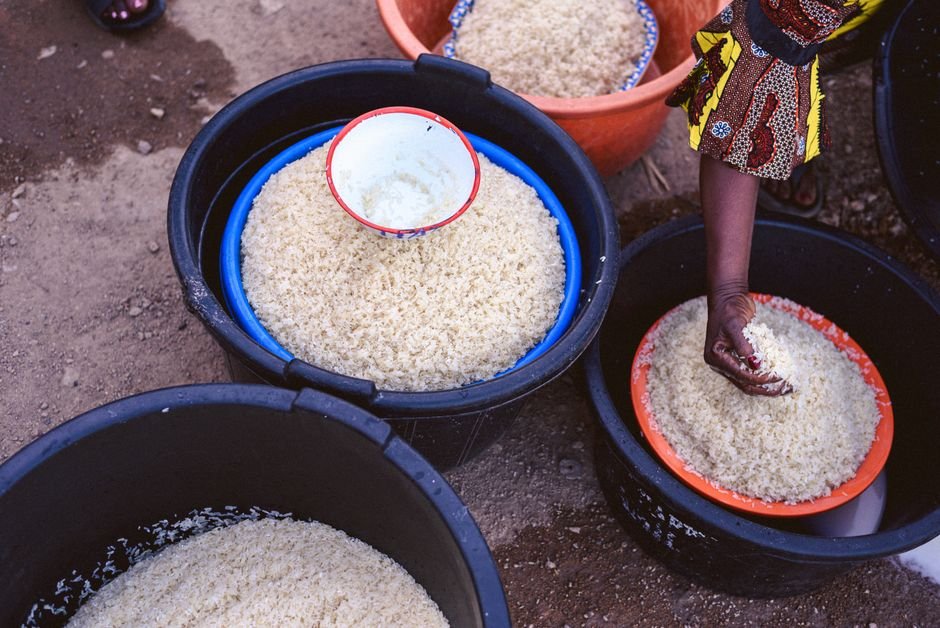
Just outside Abuja, farmers do not say the company’s name. They say it is where the Chinese sell magic rice seeds. For Ahmed Yusuf, 42, the magic was arithmetic. He had farmed for more than a decade, and for years the losses stacked up: yields of about two tonnes per hectare (roughly 0.9 tons per acre), a family to feed, and no way forward. He was ready to quit. Then he planted a strain sold by Green Agriculture West Africa Limited, known as Gawal, and his yield rose more than threefold on the same land and the same effort. He stayed in farming.
The magic has a name and a history. The strain is R1, a variety Gawal registered in Nigeria in 2017 with yields running about 30 percent above the most popular local rice. The company behind it was founded in 2006 by CGCOC Group, a Chinese state-linked conglomerate, and it has spent two decades building a seed business: a license from Nigeria’s seed council, a mechanized demonstration farm of more than 2,000 hectares (about 4,900 acres) in Kebbi State, seven seed cooperatives that sign up more than 5,000 smallholder farmers as out-growers, and more than 20,000 tonnes (about 22,000 tons) of seed supplied to farmers across more than 30 states. Outside Abuja sits the China-aid agricultural technology center, completed in 2022 and handed to Gawal to run, with training halls, machinery displays and irrigation demonstrations. The operation looks like aid. It is not aid. It is a company selling a product, and that distinction is the whole story.
Beijing’s approach is hands-off by design. Instead of government-to-government programs that give seeds away, Chinese companies sell improved seed, train farmers, and build the machinery and processing links around the sale. The South China Morning Post, which reported the story, describes this commercial model as a challenge to traditional Western aid, and notes that Washington is now moving to counter it with agribusiness interventions of its own. The competition is not over who gives more. It is over whose agricultural system African farmers buy into.
There is fine print under the magic, and it matters. A seed company stays in business by selling seed, and farmers who plant improved varieties buy fresh seed every season; the miracle is renewable only at a price. The farmer’s field stays tied to the company’s catalog, year after year. That is not a scandal, it is the model, and it is the same model that keeps hybrid rice programs alive across Africa. But it means the magic is a relationship, not a gift, and the relationship is the thing China is really exporting.
Nigeria is the right place to watch this happen. Rice is politics there: import restrictions, self-sufficiency campaigns, and a government that needs visible successes in food production. A company that can show a farmer’s yields tripling is worth more to Abuja than a warehouse of donated grain, and Beijing knows it. Agricultural diplomacy has become one of the quieter instruments of China’s engagement with the continent, and seed is its sharpest edge, because seed is where the farmer meets the system every single season.
The magic rice works because it is a commercial product, and that is exactly why it scales where aid has not: the farmer pays, the company profits, and the government gets its success story. The question underneath is dependency, of seeds, machinery and standards, and it will be answered by the same market forces that made the magic spread in the first place. In a country where food security is national politics, the place outside Abuja that sells magic seeds has become a small piece of the argument about who feeds Africa.