

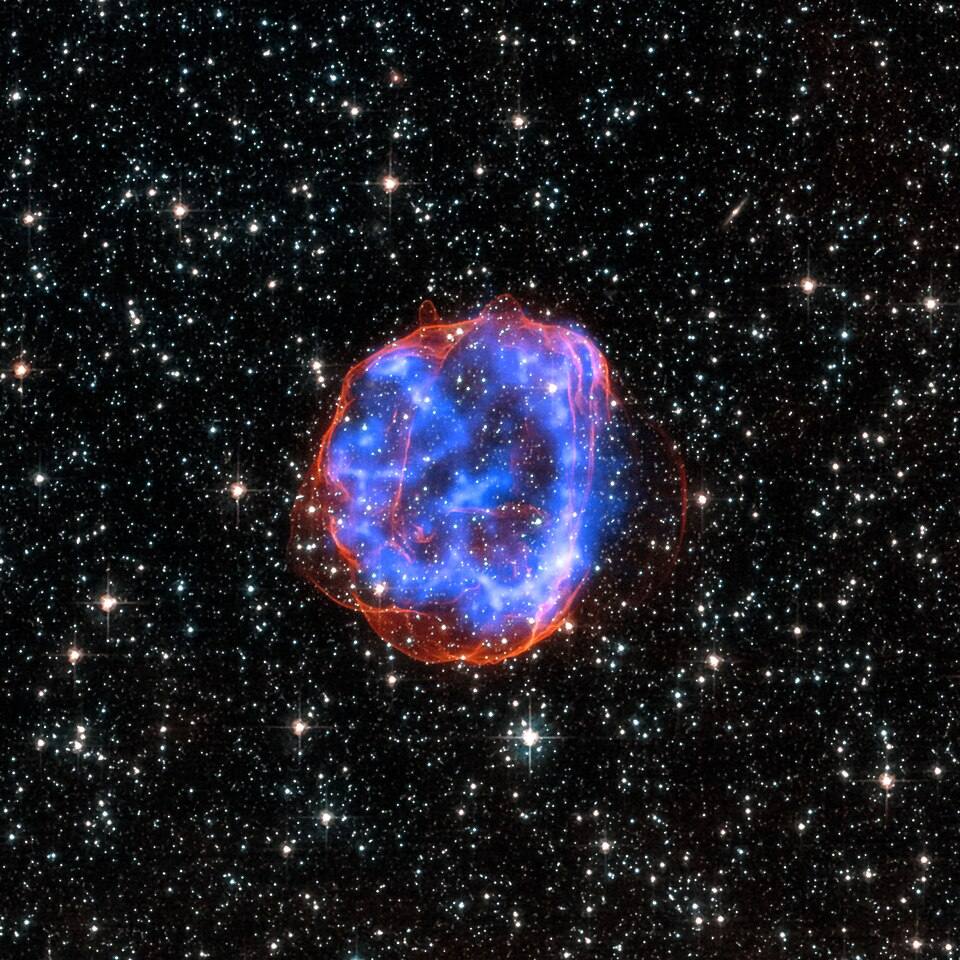
Supernova remnants — the expanding debris clouds left behind after a star explodes — are supposed to fade smoothly and quietly over centuries. But staring at the same remnants in the galaxy M83 for 14 years, NASA’s Chandra X-ray Observatory found something unexpected: roughly half of them are flickering, flaring, and changing brightness in ways that challenge a century-old assumption.
The finding, published in The Astrophysical Journal and presented this week at the 248th meeting of the American Astronomical Society in Pasadena, California, comes from a systematic survey of 22 X-ray sources associated with previously identified supernova remnants in the Southern Pinwheel Galaxy, M83, located about 15 million light-years away.
Over Chandra observations spanning 2000 to 2014, roughly half of those sources showed dramatic changes in X-ray brightness — both brightening and dimming — on timescales of years. SN 1957D, the remnant of a supernova observed nearly 70 years ago, was among the most striking, showing X-ray flares as its expanding shockwave rammed into surrounding material.
“The assumption has been that once a supernova remnant passes the first century, it becomes quiet and predictable,” said team member K.D. Kuntz of Johns Hopkins University. “What we found is that many of these objects are anything but quiet.”
The leading explanation for the variability is not the supernova remnant shell itself, but rather something embedded within it: a high-mass X-ray binary (HMXB) — a neutron star or stellar-mass black hole pulling gas from a massive companion star. As the infalling gas is superheated to millions of degrees, it produces X-ray emission that can flare or flicker as the accretion rate changes.
These compact objects are the leftover cores of the original supernovae. The companion stars are survivors — massive stars that were in orbit with the progenitor before it exploded and somehow emerged intact.
The variable remnants were concentrated in regions of M83 with higher densities of massive stars, consistent with the HMXB explanation. Previously, only a handful of HMXBs associated with supernova remnants were known across all galaxies; this study identifies roughly 20 candidates in a single galaxy.
The limitation: unresolved sources
At M83’s distance, the supernova remnants appear as unresolved point sources even in Chandra’s sharp X-ray vision. The emission from the SNR shell and any embedded HMXB cannot be spatially separated — the association is inferred rather than directly imaged.
This means alternative explanations remain possible: young, rapidly evolving SNRs interacting with dense clumps of surrounding material, reverse shocks hitting irregular ejecta, or fallback accretion onto a compact object could all produce similar variability.
What it means
If the HMXB interpretation holds, it suggests that a large fraction of supernova remnants — at least in star-forming galaxies like M83 — may host compact objects that remain actively accreting for thousands of years after the initial explosion. This would have implications for estimates of neutron star and black hole populations, the rate of binary disruption during supernovae, and the overall energy budget of supernova remnants.
Previous surveys had found only occasional X-ray variability in supernova remnants. This study suggests the phenomenon may be widespread but missed because most observations are too brief to catch it.
M83 is a barred spiral galaxy in the constellation Hydra, spanning about 60,000 light-years across. It has hosted six observed supernovae since 1923, the most recent in 1983, and is one of the closest and brightest barred spirals in the sky.
The team plans to extend the search to other nearby galaxies, including M51 (the Whirlpool Galaxy), where Chandra has already found hints of similar variable behavior.
Source: “Variable X-Ray Sources Associated with Extragalactic Supernova Remnants.” The Astrophysical Journal (2026). DOI: 10.3847/1538-4357/ae5d49. Presented at the 248th AAS Meeting, June 2026.