

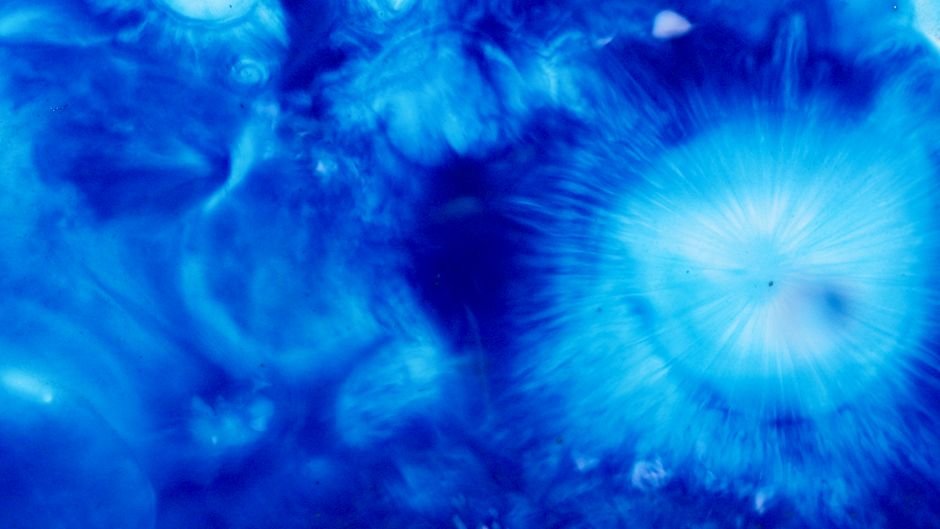
When galaxies cluster together, the space between them, emptier than any vacuum engineers have created, fills with gas: not cold hydrogen, but plasma heated to tens of millions of degrees. Astronomers call this the intracluster medium, or ICM, and have studied it for decades in mature clusters close enough to examine in detail. How this vast, invisible atmosphere first formed has remained largely unanswered. A new study in Astronomy & Astrophysics changes that.
Using 180 hours of observations from the Chandra X-ray Observatory, a team led by Andrea Travascio of the National Institute for Astrophysics (INAF) in Italy has directly detected the birth of the intracluster medium in a protocluster called MQN01, seen as it was just 2.1 billion years after the Big Bang. The finding is the earliest direct observation of a forming cluster atmosphere in the young universe.
A Quasar in a Crowded Nursery
MQN01 is a protocluster, a dense gathering of galaxies in the process of assembling into one of the modern universe’s great city-like structures. At its heart sits a hyperluminous quasar, a supermassive black hole vigorously consuming surrounding matter and blasting energy across the electromagnetic spectrum. The quasar is radio-quiet, lacking the powerful relativistic jets that shoot from the poles of many active black holes. That detail matters: jets can heat and reshape surrounding gas in ways that confuse the signal astronomers are trying to isolate.
Travascio and his collaborator Sebastiano Cantalupo of the University of Milan-Bicocca adapted techniques originally developed for studying the hot gas around Seyfert galaxies, active galaxies with bright nuclei, to peer through the quasar’s glare and detect the faint, diffuse X-ray emission of the surrounding gas. The signal was genuine but subtle: 66 net X-ray photon counts at a statistical significance of 8 sigma, meaning the chance of a random fluctuation is vanishingly small. The emission extends roughly 30 kiloparsecs (about 98,000 light-years) from the quasar, tracing a reservoir of hot plasma never before seen at such an early epoch.
The First Breath of a Cluster
The gas is hot. Its temperature, measured from the spectrum of X-rays it emits, corresponds to kT = 1.8 ± 0.4 kiloelectronvolts, equivalent to approximately 20 million Kelvin. The core of the Sun is about 15 million Kelvin, so this diffuse atmosphere is hotter than the engine that powers our nearest star.
More striking is the gas’s mass and density. The team calculated that the hot gas reservoir in MQN01 contains roughly 2.6 trillion solar masses, comparable to the total hot gas mass of some fully formed galaxy clusters in the local universe, and it is not spread thin: densities are 1 to 2 orders of magnitude higher than in present-day clusters. MQN01 is 3 to 10 times brighter in X-rays and 4.3 times denser than the Spiderweb protocluster, another well-studied system at a similar redshift. The young atmosphere is concentrated, still settling and spreading.
This is the first direct observation of the formation of the intracluster medium. In mature clusters such as the Coma Cluster and the Virgo Cluster, the ICM is a settled, well-mixed plasma in place for billions of years, filling the cluster’s gravitational potential well, emitting X-rays through thermal bremsstrahlung radiation, and shaping the evolution of the galaxies embedded within it. In MQN01, astronomers are watching that process at its beginning, as the hot atmosphere first assembles around the protocluster’s central engine.
The Precipitation Balance
The discovery also says something about the physical state of this young gas. The team examined the ratio of cooling time to free-fall time, written t_cool/t_ff, which describes whether hot gas can cool and condense before falling into the system’s gravitational center. When the ratio falls between 1 and 10, a regime known as the precipitation limit, the gas becomes thermally unstable. Some of it cools, condenses, and rains back toward the center, potentially feeding star formation and further fueling the central black hole.
The hot gas in MQN01 sits squarely in this precipitation regime, suggesting a dynamic, self-regulating cycle. The quasar pumps energy into the surrounding gas, keeping much of it hot and buoyant, while pockets of the same gas cool fast enough to precipitate inward, providing raw material for new stars in the protocluster’s galaxies and perhaps for the quasar itself. The birth of the intracluster medium is not a passive filling of empty space but an active, turbulent process in which heating and cooling compete on million-year timescales.
A New Window on the Young Universe
The detection was possible only because of Chandra’s unique capabilities. At X-ray wavelengths, the hot gas glows in thermal emission invisible to optical and infrared telescopes, and Chandra’s sharp spatial resolution let the team separate the quasar’s blinding point-source emission from the faint, extended glow of the surrounding gas. The technique, borrowed from Seyfert galaxy studies and refined for the much greater distances of this target, shows that even in the young universe, where signals are faint and backgrounds are high, the diffuse X-ray sky can be mapped in detail.
Travascio and his team have opened a direct observational window onto an epoch when the first galaxy clusters were just beginning to assemble their hot atmospheres. Future observations with Chandra and with next-generation X-ray observatories such as Athena can build on this result, targeting more protoclusters to map how the intracluster medium grows from a dense, nascent fog around a bright quasar into the vast, dilute atmospheres that fill the largest structures in the universe.
For now, MQN01 offers a snapshot of that transition caught in the act. At 2.1 billion years after the Big Bang, in a dense protocluster 30 kiloparsecs across, the atmosphere of a future galaxy cluster was being born, glowing faintly in X-rays and holding the seeds of thousands of galaxies yet to form. Chandra, watching from its orbit around Earth, saw it.
Reference
Travascio, A., Cantalupo, S., et al. 2026, Astronomy & Astrophysics, 711, A242. DOI: <a href=”https://doi.org/10.1051/0004-6361/202557020″ target=”_blank”>10.1051/0004-6361/202557020</a> (Open Access)