

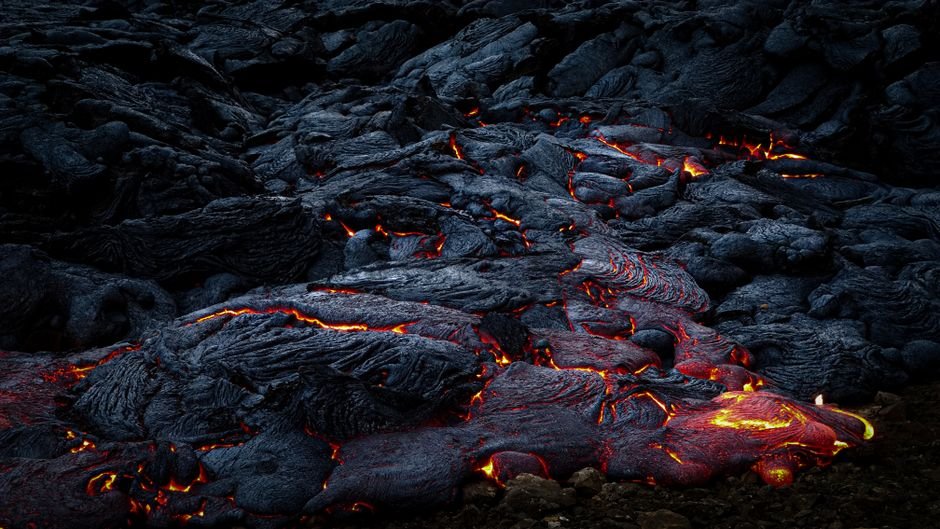
A team of researchers has discovered a vast, glassy lava field on the floor of the northwestern Atlantic Ocean that does not fit any existing model of volcanic eruptions. Named the Balerion Lava Field, after the black dragon from Game of Thrones, it may represent a previously unrecognized form of volcanism.
The findings were presented at the Goldschmidt Conference in Montreal, the world’s premier geochemistry meeting, by Froukje van der Zwan, a geochemist at King Abdullah University of Science and Technology (KAUST). “This may be a common but invisible form of volcanism,” she told the conference.
An anomaly on the seafloor
The Balerion Lava Field covers approximately 360 square kilometers in a remarkably flat sheet of glassy basalt. It lies far from any subduction zone, mid-ocean ridge, or known volcanic hot spot, sitting on top of 20-million-year-old oceanic crust that should, by all expectations, be thickly buried in sediment.
Acoustic data from a previous research cruise first flagged the anomaly: hard rock buried just beneath sediment where soft sediment should dominate. A dedicated six-week cruise later confirmed the lava field and collected samples. Dating of shells preserved above and below the lava flow placed the eruption less than 50,000 years ago, geologically recent.
The lava itself is glassy, indicating it was hot and runny when it erupted, spreading across the seafloor in a thin sheet rather than building the cone-shaped seamounts typical of intraplate volcanism. It also shows no surface deformation, no uplift, no graben, no collapse, suggesting the magma rose and erupted without any of the structural signatures volcanologists expect.
“The compositions are wacky,” said Isra Ezad, an experimental petrologist at the University of Western Australia who analyzed the samples. “They are so far away from what we expect. There seems to be no surface deformation associated with it. It’s like someone secretly just put in some lava without there ever being any reason why.”
A possible explanation
The leading hypothesis, van der Zwan explained, involves a block of pyroxenite, a dense, pyroxene-rich rock from the lowermost mantle, that sank deep into Earth and was then carried back up by the mantle’s slow convective circulation. Because pyroxenite melts more easily than the surrounding peridotite mantle, it would create a buoyant pocket of magma that eventually forced its way to the seafloor.
Exactly how such a block cycled through the deep mantle in a location far from any subduction zone, where surface rocks normally get carried downward, remains unclear. The chemistry of the Balerion lavas is inconsistent with any known classification of submarine basalts, including mid-ocean ridge basalts, ocean island basalts, and back-arc basin basalts.
If the hypothesis is correct, Balerion would join a growing list of volcanic anomalies that challenge existing frameworks. These include “petit-spot” volcanoes (tiny, young volcanoes on old oceanic crust near subduction zones) and proposed new types of intraplate volcanism at Mount Etna.
Could this be common but overlooked?
The team has already identified a second site approximately 400 kilometers away with a similar acoustic signature: hard rock buried shallowly beneath sediment in a location with no obvious volcanic source. This raises the possibility that Balerion-type lava fields are not rare, they have simply been overlooked.
Standard seafloor mapping focuses on topographic highs: seamounts, ridges, and volcanic cones that rise above the abyssal plain. A flat lava field that sits flush with the surrounding seafloor would be invisible to the kind of mapping that prioritizes bathymetric features.
The ecological implications are significant. Deep-sea creatures, from sponges to corals, often depend on hard substrates for attachment. “A lot of life needs a rock,” van der Zwan noted. Flat lava fields that carpet large areas of abyssal plain could fundamentally alter the habitat structure of the deep ocean.
On a planetary scale, the discovery could change estimates of how much volcanism occurs away from plate boundaries, and how much carbon and sulfur are exchanged between Earth’s interior and surface through such hidden eruptions.
Conference disclosure
Balderion was presented at the Goldschmidt Conference 2026 (Montreal, July 12–17) as research in progress. A peer-reviewed paper has not yet been published. The Science AAAS news article reporting the discovery was published on July 15, 2026. “We still have a lot of discoveries to make,” said Sébastien Pilet of the University of Lausanne, who was not involved in the work, as quoted in Science. “These are things that open a lot of new questions about lava in Earth.”
Sources:
1. Dinneen, J. “Undersea lava flows named after Game of Thrones dragon may reveal a new type of volcanism.” Science AAAS (15 July 2026). DOI: 10.1126/science.znrp92j
2. Presentation by Froukje van der Zwan (KAUST) at the Goldschmidt Conference 2026, Montreal, Canada (12–17 July 2026).